
Bioenergetics 1
Life has evolved from a primordial mixture of elements, which have reacted together in specific
patterns.
Life is just a co-ordinated set of chemical reactions – metabolism.
Chemical reactions involve transformations of energy.
Energy can take many forms.
Atoms of molecules are held together by energy in the form of bonds.
Therefore if we are to study the chemistry of life we need to understand energy.
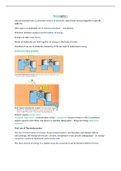
Closed and Open Systems:
System reaches steady state.
Metabolic equivalent – concentration of the 2 compounds (levels of water in the 2 containers)
appear equal to each other, but there is a reaction taking place – things are being added and
removed.
First Law of Thermodynamics:
The law of conservation of energy: “In an isolated system, one that does not interact with its
surroundings, the energy will remain constant, irrespective of any process taking place.” i.e. energy
cannot be created or destroyed, just transformed.
The total amount of energy in a system stays the same but it can be found in different forms.
, Enthalpy:
Energy can be added to a closed system by heat (Q) and work (W).
Adding heat or work increases the total energy or ENTHALPY (H) of the system.
The total change in enthalpy (H) to go from the initial to the final state is independent of the path
taken.
Chemical Reactions:
Thermochemistry is the practical application of the First Law to chemical reactions.
Definition: Enthalpy of a reaction is the heat absorbed during a reaction at constant pressure.
Exo/Endothermic Reactions:
If a reaction gives out heat the enthalpy will be negative.
Such a reaction is termed EXOTHERMIC.
When a reaction takes up heat, it is described as ENDOTHERMIC.
In biological systems several forms of work are carried out:
Mechanical work performed by muscles
Electrical work required to transmit nerve impulses
Chemical work to synthesise molecules (anabolism)
First Law of Thermodynamics cont.
The First Law simply deals with energy balance in a given reaction or process, and suggests that
processes (reactions) can occur in either direction.
Equilibrium and steady state:
Closed System: A + B C+D
Open System: A B C D Protein
In practice many processes only occur in one direction: e.g. Heat flows Hot Cold
We also need some understanding of the likelihood of a process occurring in a certain direction. This
is the subject of the Second Law of Thermodynamics.
Second Law of Thermodynamics:

