Chapter 8
Memory
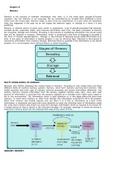
Memory is the process of maintain information over time. It is the most basic concept of human
cognition. We use memory in our everyday life as remembering an incident from childhood or some
event from the recent past. Memory helps us learn from our experiences. It is only when we remember
what has happened in the past we do not repeat the behavior again, or indulge in it more if it was
gratifying.
Memory is internal record of some prior event or experience; a set of mental processes that receives,
encodes stores, organizes, alters, and retrieves information over time. The basic processes of memory
are encoding, storage and retrieval. Encoding is the process of translating information into neural codes
that will be retained in memory. Information which is presented in the form of language is encoded in
the form of mental representations. Storage is the process of retaining neural coded information over
time. If any piece of information is stored properly it can be retrieved later. Retrieval is the process of
recovering information from memory storage. Retrieval failure is possible if the information is not stored
properly or is not accessed. Such retrieval failure is called forgetting.
MULTI STORE MODEL OF MEMORY:
Atkinson and Shiffrin proposed the modal model of memory. According to this model there are three
different kinds of memory namely, sensory memory, short term memory and long term memory. This
model assumes that each type of memory receives processes and stores information differently. The
sensory memory receives information from the sensory registers namely eyes, ears, nose, skin. Vast
amount of information is received from the sensory registers as it includes every object seen, heard or
felt in the environment. The information which is paid attention to in this stage enters the short term
memory. In short term memory or short term storage the information is stored for 20 to 30 seconds.
Short term memory has limited capacity and can store 5 to 9 bits of information at a time. If the
information is rehearsed and paid even more attention to enter the unlimited store of information called
the Long term memory also known as Long term storage. Information which is required to be known for
a longer period of time is stored in the long term storage. For example, spellings of words are stored in
Long term memory which can be retrieved with ease at any point of time.
SENSORY MEMORY:
, Sensory memory is the memory for events from the sensory inputs which we encounter every now and
then in our surrounding. It is the raw material which forms the basis of any sort of memory stored by
the human mind. The two main types of sensory memory studied widely are, Iconic memory i.e.
memory for events or aspects which are visually encountered and Echoic Memory i.e. memory for
auditory information.
Iconic memory:
Sperling suggested that when stimuli consisting of a number of
items are shown briefly to an observer, only a limited number of the
items can be correctly reported. The fact that observers assert they
can see more than they can report suggests the memory sets a limit
on a processes that is otherwise rich in information. He conducted
the first experiment to understand the properties of iconic memory.
He presented the participants with display of letters or numbers
(figure 1). Letters were presented for a brief period of time, for 50
milliseconds. Sperling found that participants could recall 4 or 5
letters of the 12 letters presented. Figure 1: Display used
by Sperling
He further extended the display time to 500 milliseconds but it did not improve the performance. He
then invented the partial report technique. After presenting the display the participants were presented
with a low, medium, or a high pitched tone. Low pitched tone indicated recalling the letter in the bottom
row, medium tone - middle row and high tone - upper row. Participants could recall 3 out of 4 items
from any row when presented with the tone. Sperling explained that in the initial display of recalling all
letters together, which he called the whole report technique, participants forgot the letter which came
letter in the attempt to name the initial letters. Even when they were recalling the display, the
information was fading from wherever it was being stored. This explains that information lasts only
briefly in this memory system.
Neisser gave the term ‘icon’ for the visual sensory memory. It holds the visual information for up to 1
second. Sperling presented participants with consonants and vowels and different tones for the recall for
either vowels or consonants. However the participant’s performance was no different than the whole
report technique. Sperling thus inferred that icon holds information that has not yet been categorized.
Echoic memory:
Neisser called the auditory sensory memory ‘echo’. Moray, Bates, and Barnett (1965) studied the echoic
memory in a clever demonstration. Participants were made to listen to multiple messages
simultaneously. In the whole report technique participants were made to recall all the letters they heard.
In partial report technique participant was visually cued to report letters spoken on the specific speakers
by presenting lights corresponding the speakers. Results of this study showed that a greater number of
letters could be recalled through the partial report procedure than whole report technique. Thus, they
concluded that one second after the auditory display, there is more information available than can be
reported by the whole report procedure. Information was lost after about 4 seconds.
Crowder (1982) studied the duration of the echo. He presented the participants with two vowels, one
after the other. Sometimes the vowels were identical and other times they were different but similar.
He used a Varied inter stimulus interval from 1/2 sec to 5 sec. The participants had to report whether
the letters were the same or different than what was earlier presented. The results of the study showed
that performance was most accurate where less than a second occurred between presentations reaching
asymptote at about 3 sec. He thus concluded that the duration of the echo is 3 seconds. Cowan (1984)
posited a short auditory store that decays in less than 1 sec and is pre categorical in nature.
Echoic memory is similar to Iconic memory in that there is more information accessible than can be
recalled. Echoic memory is different in that the trace lasts longer than a second
SHORT TERM MEMORY:
Short term memory Atkinson and Shiffrin proposed that information that had been attended to in the
sensory stores went into a short-term store (also called short-term memory). There are three key
aspects of short term memory:
It has limited capacity .i.e., only about 5 to 9 items can be stored at a time
It has limited duration i.e., storage is very fragile and information can be lost with distraction
or passage of time
Encoding in short term memory is primarily acoustic. It also translates visual information into
sounds.
Chunking is a phenomenon where participants group the information they are trying to remember.
Participants demonstrate "chunking" in serialand free recall tasks. Test items may be formed of words,
lists of letters ornumbers. Chunking is a process wherein responses based on the
Memory
Memory is the process of maintain information over time. It is the most basic concept of human
cognition. We use memory in our everyday life as remembering an incident from childhood or some
event from the recent past. Memory helps us learn from our experiences. It is only when we remember
what has happened in the past we do not repeat the behavior again, or indulge in it more if it was
gratifying.
Memory is internal record of some prior event or experience; a set of mental processes that receives,
encodes stores, organizes, alters, and retrieves information over time. The basic processes of memory
are encoding, storage and retrieval. Encoding is the process of translating information into neural codes
that will be retained in memory. Information which is presented in the form of language is encoded in
the form of mental representations. Storage is the process of retaining neural coded information over
time. If any piece of information is stored properly it can be retrieved later. Retrieval is the process of
recovering information from memory storage. Retrieval failure is possible if the information is not stored
properly or is not accessed. Such retrieval failure is called forgetting.
MULTI STORE MODEL OF MEMORY:
Atkinson and Shiffrin proposed the modal model of memory. According to this model there are three
different kinds of memory namely, sensory memory, short term memory and long term memory. This
model assumes that each type of memory receives processes and stores information differently. The
sensory memory receives information from the sensory registers namely eyes, ears, nose, skin. Vast
amount of information is received from the sensory registers as it includes every object seen, heard or
felt in the environment. The information which is paid attention to in this stage enters the short term
memory. In short term memory or short term storage the information is stored for 20 to 30 seconds.
Short term memory has limited capacity and can store 5 to 9 bits of information at a time. If the
information is rehearsed and paid even more attention to enter the unlimited store of information called
the Long term memory also known as Long term storage. Information which is required to be known for
a longer period of time is stored in the long term storage. For example, spellings of words are stored in
Long term memory which can be retrieved with ease at any point of time.
SENSORY MEMORY:
, Sensory memory is the memory for events from the sensory inputs which we encounter every now and
then in our surrounding. It is the raw material which forms the basis of any sort of memory stored by
the human mind. The two main types of sensory memory studied widely are, Iconic memory i.e.
memory for events or aspects which are visually encountered and Echoic Memory i.e. memory for
auditory information.
Iconic memory:
Sperling suggested that when stimuli consisting of a number of
items are shown briefly to an observer, only a limited number of the
items can be correctly reported. The fact that observers assert they
can see more than they can report suggests the memory sets a limit
on a processes that is otherwise rich in information. He conducted
the first experiment to understand the properties of iconic memory.
He presented the participants with display of letters or numbers
(figure 1). Letters were presented for a brief period of time, for 50
milliseconds. Sperling found that participants could recall 4 or 5
letters of the 12 letters presented. Figure 1: Display used
by Sperling
He further extended the display time to 500 milliseconds but it did not improve the performance. He
then invented the partial report technique. After presenting the display the participants were presented
with a low, medium, or a high pitched tone. Low pitched tone indicated recalling the letter in the bottom
row, medium tone - middle row and high tone - upper row. Participants could recall 3 out of 4 items
from any row when presented with the tone. Sperling explained that in the initial display of recalling all
letters together, which he called the whole report technique, participants forgot the letter which came
letter in the attempt to name the initial letters. Even when they were recalling the display, the
information was fading from wherever it was being stored. This explains that information lasts only
briefly in this memory system.
Neisser gave the term ‘icon’ for the visual sensory memory. It holds the visual information for up to 1
second. Sperling presented participants with consonants and vowels and different tones for the recall for
either vowels or consonants. However the participant’s performance was no different than the whole
report technique. Sperling thus inferred that icon holds information that has not yet been categorized.
Echoic memory:
Neisser called the auditory sensory memory ‘echo’. Moray, Bates, and Barnett (1965) studied the echoic
memory in a clever demonstration. Participants were made to listen to multiple messages
simultaneously. In the whole report technique participants were made to recall all the letters they heard.
In partial report technique participant was visually cued to report letters spoken on the specific speakers
by presenting lights corresponding the speakers. Results of this study showed that a greater number of
letters could be recalled through the partial report procedure than whole report technique. Thus, they
concluded that one second after the auditory display, there is more information available than can be
reported by the whole report procedure. Information was lost after about 4 seconds.
Crowder (1982) studied the duration of the echo. He presented the participants with two vowels, one
after the other. Sometimes the vowels were identical and other times they were different but similar.
He used a Varied inter stimulus interval from 1/2 sec to 5 sec. The participants had to report whether
the letters were the same or different than what was earlier presented. The results of the study showed
that performance was most accurate where less than a second occurred between presentations reaching
asymptote at about 3 sec. He thus concluded that the duration of the echo is 3 seconds. Cowan (1984)
posited a short auditory store that decays in less than 1 sec and is pre categorical in nature.
Echoic memory is similar to Iconic memory in that there is more information accessible than can be
recalled. Echoic memory is different in that the trace lasts longer than a second
SHORT TERM MEMORY:
Short term memory Atkinson and Shiffrin proposed that information that had been attended to in the
sensory stores went into a short-term store (also called short-term memory). There are three key
aspects of short term memory:
It has limited capacity .i.e., only about 5 to 9 items can be stored at a time
It has limited duration i.e., storage is very fragile and information can be lost with distraction
or passage of time
Encoding in short term memory is primarily acoustic. It also translates visual information into
sounds.
Chunking is a phenomenon where participants group the information they are trying to remember.
Participants demonstrate "chunking" in serialand free recall tasks. Test items may be formed of words,
lists of letters ornumbers. Chunking is a process wherein responses based on the