16.10.19
L3 -Pathway reg survival, growth and proliferation (week 4/5)
Keywords:
Senescence, phosphorylation (transfer of phosphate group from ATP to another molecule species),
enzymatic activity, quorum sensing (when bacteria release chemicals and the concentration allows
other bacteria to know the pop density in that area), Transautophosphorylation (Ligands cross-
phosphorylate each other on multiple tyrosine’s), g protein (series of molecular switches inside the
cell for regulation)
Lecture:
Multiple interactions/signals = alter process (eg survive/division)
Coincidence detection
o If one of the inputs is blocked = no output (↑ specify)
Reg to stop cancers forming (↑ # of inputs =↑ specificity)
o Protein tyrosine kinase (PTK/receptor RTk) controls cell proliferation coupled to:
Sends signal to Ras MAP kinase (if not there = apoptosis)
PI 3-kinase/PKB/Akt, SH2 recruitment means lipids phosphorylated
Activated together = strong cell division signal and cell survival in PKB/Akt
occurs
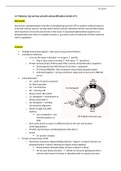
Cell proliferation
o G1 = synth of proteins required
for DNA/organelles
o G2 = can stop here G1 checkpoint
o G0 = starving cells
o Always check after phase
o G1 checkpoint = commitment to
division (favorable?)
o G2 checkpoint = checking
chromosome alignment
o Divide at night (circadian
rhythm)
Less metabolism = less
harmful products to
DNA
o Each cyclin family is made at a different point in the cell cycle (protein
synth/degradation)
o Proteins reg by kinases and phosphatases that alter it
o Kinase
Src protein complex
Protein tyrosine kinase (PTK)
o Membrane monomers (ligand binding domain) + ligand = receptors interact via
phosphorylation→ dimers (sticking two ligand chains together)
Kinase domain phosphorylates tyrosine residues on dimer
W/ tyrosine kinase domains = ↑ affinity for intracell signaling proteins =
activate when bound to kinase or phosphorylate to tyrosine structure
L3 -Pathway reg survival, growth and proliferation (week 4/5)
Keywords:
Senescence, phosphorylation (transfer of phosphate group from ATP to another molecule species),
enzymatic activity, quorum sensing (when bacteria release chemicals and the concentration allows
other bacteria to know the pop density in that area), Transautophosphorylation (Ligands cross-
phosphorylate each other on multiple tyrosine’s), g protein (series of molecular switches inside the
cell for regulation)
Lecture:
Multiple interactions/signals = alter process (eg survive/division)
Coincidence detection
o If one of the inputs is blocked = no output (↑ specify)
Reg to stop cancers forming (↑ # of inputs =↑ specificity)
o Protein tyrosine kinase (PTK/receptor RTk) controls cell proliferation coupled to:
Sends signal to Ras MAP kinase (if not there = apoptosis)
PI 3-kinase/PKB/Akt, SH2 recruitment means lipids phosphorylated
Activated together = strong cell division signal and cell survival in PKB/Akt
occurs
Cell proliferation
o G1 = synth of proteins required
for DNA/organelles
o G2 = can stop here G1 checkpoint
o G0 = starving cells
o Always check after phase
o G1 checkpoint = commitment to
division (favorable?)
o G2 checkpoint = checking
chromosome alignment
o Divide at night (circadian
rhythm)
Less metabolism = less
harmful products to
DNA
o Each cyclin family is made at a different point in the cell cycle (protein
synth/degradation)
o Proteins reg by kinases and phosphatases that alter it
o Kinase
Src protein complex
Protein tyrosine kinase (PTK)
o Membrane monomers (ligand binding domain) + ligand = receptors interact via
phosphorylation→ dimers (sticking two ligand chains together)
Kinase domain phosphorylates tyrosine residues on dimer
W/ tyrosine kinase domains = ↑ affinity for intracell signaling proteins =
activate when bound to kinase or phosphorylate to tyrosine structure