GCSE Chemistry Paper 2 Edexcel Notes.
Key Concepts:
1.1 Describe how the Dalton model of an atom has changed over time because of the
discovery of subatomic particles
Dalton believed all atoms of an element are identical, different elements have different atoms.
Thomson Plum pudding model- big sphere of sponge, with loads of fruit. The sponge was made
of positive charges with embedded negative charges (electrons).
Rutherford gold foil experiment- Fired alpha particles (positive helium nuclei) at gold foil, most
of them passed straight through. If it was like the plum pudding model it should not have
passed through, leading to the understanding of the atom being very largely spaced.
Some alpha particles were deflected. This means the alpha particles must have hit something
else positive to be deflected. 2 same charged particles deflect/repel, 2 different, attract. Very
few particles were deflected, this tells us the nucleus is small.
1.2 Describe the structure of an atom as a nucleus containing protons and neutrons,
surrounded by electrons in shells
1.3 Recall the relative charge and relative mass of:
a a proton
b a neutron
c an electron
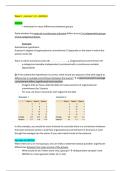
Key Concepts:
1.1 Describe how the Dalton model of an atom has changed over time because of the
discovery of subatomic particles
Dalton believed all atoms of an element are identical, different elements have different atoms.
Thomson Plum pudding model- big sphere of sponge, with loads of fruit. The sponge was made
of positive charges with embedded negative charges (electrons).
Rutherford gold foil experiment- Fired alpha particles (positive helium nuclei) at gold foil, most
of them passed straight through. If it was like the plum pudding model it should not have
passed through, leading to the understanding of the atom being very largely spaced.
Some alpha particles were deflected. This means the alpha particles must have hit something
else positive to be deflected. 2 same charged particles deflect/repel, 2 different, attract. Very
few particles were deflected, this tells us the nucleus is small.
1.2 Describe the structure of an atom as a nucleus containing protons and neutrons,
surrounded by electrons in shells
1.3 Recall the relative charge and relative mass of:
a a proton
b a neutron
c an electron