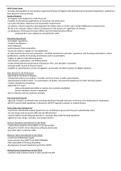
SCOUT
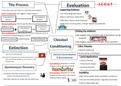
• Takes place when two stimuli are repeatedly paired together Supporting Evidence:
Before Conditioning: UCS triggers a reflex response • Ivan Pavlov (dog experiment)
Unconditioned Unconditioned • Watson and Rayner (Little Albert)
Stimulus Response • Mirte Brom (Human sexual responses)
During Conditioning: The UCS and the NS are experienced close • Bagby (Fear of running water—foot got trapped near waterfall)
together in time Unconditioned
Unconditioned Response
Neutral stimulus
Stimulus
Criticing the evidence:
After Conditioning: The NS produces the same response as UCS so
it is not the CS and the response is the CR • Only explains how a limited range of behaviours can be
acquired
Conditioned Stimulus Conditioned Response
• Only explains acquisition of simple reflex responses
Other Theories
• Operant Conditioning
• When the CS is experienced without the UCS over a period of
• Social Learning and Biological
time, the CR is extinguished.
• This process of responses has survival value because it means Useful Applications
that our learning is flexible e.g. we can learn to stop
• Aversion Therapy
fearing things
Generalisation: Response to certain • Treatment for Phobia
stimulus is same too similar stimuli
• Changing behaviour
• Sometimes the extinct responses reappear, even
Discrimination: Response to certain Testability:
without new pairings with the UCS stimulus remains only to that certain
• High internal validity (Pavlov and Watson and Rayner)
thing and doesn't generalise
• Generally responses are weaker than the original ones • Poor external validity (Pavlov’s dogs kept unnaturally)
• Empirical (observable) data
, GRAVE
Generalisability:
• Exploring the role of conditioned reflexes in the eating
behaviour of dogs • Experiment conducted on dogs and there is a problem generalising the results of animal studies to
humans
• Exploring how salivation becomes associated with new
• However in Watson and Rayner’s study they found that classical conditioning does take place in
stimuli apparently unrelated to food and the
humans
properties of this association
Reliability:
• This is a reliable study because it has standardised procedures and it was carefully documented
• Pavlov did this experiment again and again over 25 years with different breeds of dog but with different
neutral stimuli– good test-retest reliability
• Done in a laboratory so the production of saliva could be • He got different researchers to observe the dog and measure of the saliva—
easily observed and measured either by volume or no. of good inter-rater reliability
drops in a cannula •
Applications:
• Salivation was the dependent variable
• Further research into classical conditioning in humans e.g Watson and Rayner
• Took place in a sound proof chamber in order to minimise
the effects of extraneous variables such as noise
Validity:
• Pavlov established a baseline by measuring salivation in
• Reduced the impact of extraneous variables enhancing the internal
response to the NS e.g. a buzzer or a metronome
validity as the experiment took place in a sound proof chamber
• Then he would pair the NS with the UCS of food usually 20x • Pavlov found that the salivation reflex
• Neutral stimuli were carefully chosen and tested to ensure they didn’t
only occurred if the dog was alert already elicit a salivation response
• Pavlov varied the presentation so that the NS was presented
and undistracted
before (forward conditioning) or after the UCS • Poor external validity as dogs were kept in unusual conditions to
• No salivation was recorded in response everyday life making it non applicable to other situations
(backward conditioning)
to the NS for backward pairing
• Further variations were done to investigate extinction and Ethics:
• Extinction could be seen as the CS was
spontaneous recovery of salivation
repeatedly presented without the • Inhumane treatment of animals
UCS but spontaneous recovery did
• Kept tied to harness, sealed up in small rooms and subjected to surgery
occur
• Takes place when two stimuli are repeatedly paired together Supporting Evidence:
Before Conditioning: UCS triggers a reflex response • Ivan Pavlov (dog experiment)
Unconditioned Unconditioned • Watson and Rayner (Little Albert)
Stimulus Response • Mirte Brom (Human sexual responses)
During Conditioning: The UCS and the NS are experienced close • Bagby (Fear of running water—foot got trapped near waterfall)
together in time Unconditioned
Unconditioned Response
Neutral stimulus
Stimulus
Criticing the evidence:
After Conditioning: The NS produces the same response as UCS so
it is not the CS and the response is the CR • Only explains how a limited range of behaviours can be
acquired
Conditioned Stimulus Conditioned Response
• Only explains acquisition of simple reflex responses
Other Theories
• Operant Conditioning
• When the CS is experienced without the UCS over a period of
• Social Learning and Biological
time, the CR is extinguished.
• This process of responses has survival value because it means Useful Applications
that our learning is flexible e.g. we can learn to stop
• Aversion Therapy
fearing things
Generalisation: Response to certain • Treatment for Phobia
stimulus is same too similar stimuli
• Changing behaviour
• Sometimes the extinct responses reappear, even
Discrimination: Response to certain Testability:
without new pairings with the UCS stimulus remains only to that certain
• High internal validity (Pavlov and Watson and Rayner)
thing and doesn't generalise
• Generally responses are weaker than the original ones • Poor external validity (Pavlov’s dogs kept unnaturally)
• Empirical (observable) data
, GRAVE
Generalisability:
• Exploring the role of conditioned reflexes in the eating
behaviour of dogs • Experiment conducted on dogs and there is a problem generalising the results of animal studies to
humans
• Exploring how salivation becomes associated with new
• However in Watson and Rayner’s study they found that classical conditioning does take place in
stimuli apparently unrelated to food and the
humans
properties of this association
Reliability:
• This is a reliable study because it has standardised procedures and it was carefully documented
• Pavlov did this experiment again and again over 25 years with different breeds of dog but with different
neutral stimuli– good test-retest reliability
• Done in a laboratory so the production of saliva could be • He got different researchers to observe the dog and measure of the saliva—
easily observed and measured either by volume or no. of good inter-rater reliability
drops in a cannula •
Applications:
• Salivation was the dependent variable
• Further research into classical conditioning in humans e.g Watson and Rayner
• Took place in a sound proof chamber in order to minimise
the effects of extraneous variables such as noise
Validity:
• Pavlov established a baseline by measuring salivation in
• Reduced the impact of extraneous variables enhancing the internal
response to the NS e.g. a buzzer or a metronome
validity as the experiment took place in a sound proof chamber
• Then he would pair the NS with the UCS of food usually 20x • Pavlov found that the salivation reflex
• Neutral stimuli were carefully chosen and tested to ensure they didn’t
only occurred if the dog was alert already elicit a salivation response
• Pavlov varied the presentation so that the NS was presented
and undistracted
before (forward conditioning) or after the UCS • Poor external validity as dogs were kept in unusual conditions to
• No salivation was recorded in response everyday life making it non applicable to other situations
(backward conditioning)
to the NS for backward pairing
• Further variations were done to investigate extinction and Ethics:
• Extinction could be seen as the CS was
spontaneous recovery of salivation
repeatedly presented without the • Inhumane treatment of animals
UCS but spontaneous recovery did
• Kept tied to harness, sealed up in small rooms and subjected to surgery
occur