Progressive Waves
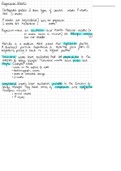
Earthquakes produce 2 main P
types of seismic waves waves
-
-
and S -
waves
P -
waves are longitudinal} both are
progressive
S waves are
-
transverse waves -
Progressive wave : an oscillation that travels
through matter ( or
in some cases a vacuum
) .
all
transfer energy
but not matter .
Particles in a medium more about their equilibrium position .
A displaced particle experiences
it back
a
restoring force from its
neighbours pulling ,
to its
original position .
Transverse waves have oscillations that are perpendicular to the
direction Transverse waves have peaks
of transfer
energy include
.
and
troughs Examples
.
the
:
surface of water
•
waves on
electromagnetic waves
•
stretched
waves on
strings
•
•
8- waves .
Longitudinal waves have oscillations parallel to the direction of
have
energy transfer
.
they areas of compression and
rarefaction .
Examples include :
• sound waves
•
P -
waves .
, Wave Properties
Term Symbol Unit Definition
displacement s m distance from the equilibrium
position
in a particular direction vector quantity
. .
amplitude A m maximum displacement from equilibrium
position .
i
wavelength m minimum distance between two points
in phase on adjacent waves .
period of T s time taken for one whole wavelength
oscillation to move past a given point .
frequency f th number of full wavelengths to pass a
given point per unit time .
speed travelled
distance
by
'
wave v Ms a wave per
unit time .
V=fX wave speed metres per second '
v. in Ms
-
, ,
frequency f. in ,
hertz Hz ,
wavelength 4 , , in metres ,m
f- -
f frequency f , ,
in hertz Hz ,
period of oscillation ,
T.in seconds S ,
Phase difference
Describes the difference between the displacements of particles on a
wave or between different waves .
Earthquakes produce 2 main P
types of seismic waves waves
-
-
and S -
waves
P -
waves are longitudinal} both are
progressive
S waves are
-
transverse waves -
Progressive wave : an oscillation that travels
through matter ( or
in some cases a vacuum
) .
all
transfer energy
but not matter .
Particles in a medium more about their equilibrium position .
A displaced particle experiences
it back
a
restoring force from its
neighbours pulling ,
to its
original position .
Transverse waves have oscillations that are perpendicular to the
direction Transverse waves have peaks
of transfer
energy include
.
and
troughs Examples
.
the
:
surface of water
•
waves on
electromagnetic waves
•
stretched
waves on
strings
•
•
8- waves .
Longitudinal waves have oscillations parallel to the direction of
have
energy transfer
.
they areas of compression and
rarefaction .
Examples include :
• sound waves
•
P -
waves .
, Wave Properties
Term Symbol Unit Definition
displacement s m distance from the equilibrium
position
in a particular direction vector quantity
. .
amplitude A m maximum displacement from equilibrium
position .
i
wavelength m minimum distance between two points
in phase on adjacent waves .
period of T s time taken for one whole wavelength
oscillation to move past a given point .
frequency f th number of full wavelengths to pass a
given point per unit time .
speed travelled
distance
by
'
wave v Ms a wave per
unit time .
V=fX wave speed metres per second '
v. in Ms
-
, ,
frequency f. in ,
hertz Hz ,
wavelength 4 , , in metres ,m
f- -
f frequency f , ,
in hertz Hz ,
period of oscillation ,
T.in seconds S ,
Phase difference
Describes the difference between the displacements of particles on a
wave or between different waves .