
What is Coulomb’s Law? Laws of Electrostatics with Example
Coulomb's Laws of Electrostatics
Charles-Augustin de Coulomb found the Laws of Electrostatics in 1785 known as Coulomb's
Law. Until 1784, nobody had some awareness of the unit of the electric charge, then, at that
point, the Coulomb presented these regulations after different analyses on force between two
masses in view of the Inverse Square Law.
Coulomb's laws of electrostatic can be expressed as observe:
First Law
Coulomb's most memorable law expresses that like charges of power repulse one another,
while dissimilar to charges draw in one another.
Second Law
The second law of electrostatic states that the power applied between two little charged bodies
(point charges) is straightforwardly corresponding to the result of their charges and contrarily
relative to the square of the distance between them.
At the end of the day, the electric power of fascination or shock between two charged focuses
fluctuates straightforwardly as the result of the charged places and conversely as the square of
the distance between those charges focuses.
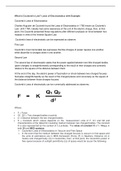
Coulomb's Laws of electrostatic can be numerically addressed as observes.
Where:
F = Force
Q1, Q2 = Two charged bodies or points
d = Distance between the two charged bodies
K = Constant which values depends on the measurement units of F, Q1 and Q2 and
characteristics of the dielectric insulating medium between two charged bodies. The constant
K is also represented by the symbol of λ (Lambda). The value of constant K = πεoεr in
both SI and MKS systems.
Coulomb's Laws of Electrostatics in Vacuum and Free Space
In the event that the medium between two charged focuses is vacuum or free space and
the units of estimations are in MKS framework (Force (F) in Newtons, Distance (d) in
meters and charged body (Q) in Coulombs), then, at that point, the Coulomb's power in
free space because of outright permittivity (εo) of space would be as per the following:

