
Within this report I am going to demonstrate my understanding of cell division and heredity
and genetic variation. I will demonstrate my understanding by explaining mitosis, meiosis,
impacts of geneticists, monohybrid and dihybrid crosses, sex links and variation sources.
What is Mitosis?
Mitosis in simple terms is a type of cell division resulting in two daughter cells obtaining the
same kind and number of chromosomes as the parenting nucleus. This is regular in ordinary
tissue growth. In more detail, mitosis the cell division for replication, growth and differentiation
process. Contrasting to meiosis, it creates two diploid daughter cells as spoken about before,
rather than 4 haploid cells that differ genetically. Mitosis can be split into six steps, interphase,
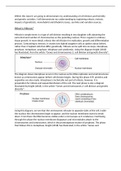
prophase, metaphase, anaphase, telophase and cytokinesis. Using the diagram Knight (2018)
has illustrated, from the article “Genes and chromosomes 2: cell division and genetic diversity”:
The diagram shows interphase occurs in the nucleus as the DNA replicates and small structures
known as centrosomes appear before cell division begins. During this phase ATP, proteins and
organelles are also made. Interphase is technically not part of mitosis; however, it is
preparation for mitosis and sequential division of the cell. The next phase is also a diagram
illustrated by Knight (2018), in the article “Genes and chromosomes 2: cell division and genetic
diversity”:
Using this diagram, we see that the centrosomes relocate to opposite sides of the cell. Inside
the nucleus the chromosomes begin to appear, and the nuclear membrane starts to break
down. From there the DNA becomes visible under a microscope as it condenses. Continuing
through the phase the nuclear membrane disappears and microtubules attach to the
chromosomes and centrosomes, which is the prometaphase section of prophase. The phase
that follows this is metaphase, Knight (2018) has illustrated, in the article “Genes and
, chromosomes 2: cell division and genetic diversity”:
Reviewing the diagram, we see microtubules attach to the chromosomes and pull them to the
centre of the cell during this phase. The chromosomes then align along the equator of the cell,
this is in preparation for the cell division. The next phase in sequence is anaphase and Knight
(2018) has illustrated, from the article “Genes and chromosomes 2: cell division and genetic
diversity”:
Using this diagram, we can see that during this phase the chromosomes are split into two, then
they migrate to opposite cell poles. They are then pulled by the attached microtubules towards
centrosomes. The telophase phase that Knight (2018) has illustrated, in the article “Genes and
chromosomes 2: cell division and genetic diversity”:
By using this diagram, we can see that within this phase, nuclear envelopes begin to reform
around each chromatids group. The chromatids become indistinct and unwind in the nuclei.
The breakdown of the spindles then occurs, and the cell surface membrane starts to pinch in
the middle ready to split. Each half now contains one chromosome and the same DNA from the
original cell in each half. In the article “Cytokinesis – Definition and Process” illustrated by
Mokobi (2020):

