Exam preparation
Social Media
An Introduction
Social media platforms amplifies people’s voices. The internet started out as an idea that it is an
‘ideal world’.
Some basic concepts
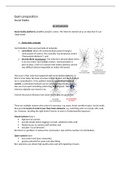
Centralization: there are two kinds of networks:
1. centralized, where all communication passes through a
central point of control. The controller has dictatorial control
(“benevolent dictators”), and
2. decentralized (distributed). The internet is decentralized: there
is no one center, but multiple centers. Communication is
peer-to-peer: a lack of a central node makes absolute control
very difficult (almost impossible to switch off/censor).
The issue is that, what has happened with social media platforms, is
that it is has taken the basic structure of the internet and decentralized
(or re-centralized) it. It has pulled it back in a centralized mode of
control: a centralized network can be controlled (Facebook can, e.g.,
ban you if you post something which they do not want). This is the
internet originally not meant to do.
Control structures influence how social media sites are governed.
There are multiple reasons why control is necessary, e.g. spam, fraud, sensitive topics. Social media
thus provide levels of control over their basic elements, e.g. restricting who can create, edit, read,
etc. However, deciding the right kinds if barrier to entry is fundamentally important.
Closed systems have a
high level of control;
provide details before logging in (email, validated credit card);
limited access to content until verified; and
excludes “social deviants”.
But there is a problem: it reduces the community’s size and the number of contributions.
Open systems have
less control and more anonymity;
greater potential for spam and advertising.
But, openness can attract high quality posts and self-regulating of spam.
,Platform vs. Publisher: a platform has very limit responsibility for what is being published (e.g., if you
sent a mean letter, the post office is not responsible for that). Publishers (e.g., newspapers, books,
movies) make very strong editorial decisions about what is in the, e.g., newspaper. Here is a very
strong sense of responsibility.
The difficulty here is: are, e.g., twitter or Facebook a platform or publisher? The question is: how
much control turns a platform into a publisher (e.g., if x is banned, if y is not allowed, does it make
one a publisher?). Important here is: it is no longer a who, but what: the algorithms are doing the
things here.
Algorithms
Social Media companies started to use news feed algorithms to optimize and maximize your
engagement with the platform, and because of the amount of content. This has had the consequence
that you can now see less than 20% of the things your friends post (before posts of your friends were
displayed by time). Roughly, there are 100.000 factors or more that go in to what you see. Content is
being hidden, reordered, and promoted by algorithms.
“We learn based on what you’ve done in the past, and we quickly learn about the things that you’re
interested in." – Facebook manager.
o An example: Twitter vs. Facebook.
At the same time, your twitter feed showed the riots and your Facebook feed showed the ice bucket
challenge, because of different algorithms. – Facebook pretended here to be the AI.
The question of algorithms and of what you see is a constant delicate balance between the AI
algorithms and people controlling what you see. Social media companies are walking a fine line
between being a neutral platform to host news, and a subjective media company that
creates/curates it. The algorithms are becoming increasingly “social”, but still requiring (some)
human oversight and control.
Boundary between social algorithm (AI) vs. human is becoming increasingly blurred.
2
,AI-mediated communication: people talking through AI to another.
Why can’t we use another platform? The main thing why we can’t do this is the Metcalfe’s law (he
invented the network cable).
“The value of a (decentralized) communications network is proportional to the square of the number
of tis users.” – Value of network =(about) (number of users)^2.
Imagine you have a network of 5 pc’s, all connected to each other, you have 10 connections, and
they are all connected to each other. As the number of devices of users increases, the value of how
many connections you have goes up exponentially, whereafter the costs goes up exponentially.
The concept of the network’s effect.
In addition, quantity has its own quality.
People use a (social media) technology because everyone else is using it.
Explains emergence of single technology (e.g. Facebook, Twitter).
Winner-takes-all. Very difficult to compete and to create alternative platform.
“Lock-in”: users don’t move to other platforms because nobody else is using it (e.g. Google+).
Algorithms are furthermore designed to attract the attention (what is placed on the screen, where it
is placed, how long it is placed there: all to get you engaged maximally and as long as possible). The
media platforms haven’t centralized control, they have centralized attention this way.
Not only the adverts, but also the messages themselves on Facebook or twitter are targeting you
(based on personal aspects). It is psychology, data science, and marketing together: the point of
intersection between these three fields is used here. This point of intersection is the content of this
course: sometimes one aspect is highlighted more to understand another aspect.
In the last five years, social platforms themselves have put data analysis (information science) and
communication (communication science) together.
Data is meaningless unless you understand its meaning, and to understand its meaning is to know
where it comes from and why, and vice versa.
3
, Social Network Analysis
Social Network Analysis is a science that has got more and more popular as a way of understanding
and modelling society: it focuses on connections between individuals. It can be used as a technique
to understand social media, to understand what people do.
A concept within social network analysis is the bacon number; also known as six degrees of Kevin
Bacon. Google calculates this number for you. It is measuring how many steps a person is at distance
from another person.
o E.g.: take for example the actor Kevin Bacon. If someone was in a film with him (i.e. person
A), the bacon number is 1, since Person 1 is directly (with one step) connected to Kevin
Bacon. Then, if person B is in a film with person A (i.e. bacon number 1), the bacon number
of person B is 2, since there are two steps between person B and Kevin Bacon. Then, if
person C is in a film with person B, person C’s bacon number is 3, since (s)he is three steps
removes from Kevin Bacon (Kevin Bacon – Person A – Person B – Person C, where the stripes
are the steps).
The erdös number is a similar type of number: co-author distance of Paul Erdös. So, somebody who
wrote a paper with Erdös, has the erdös number 1. The difference is that here it is very easy to get a
high erdös number and very difficult to have a low erdös number, while with Bacon it is very easy to
get a low Bacon number (since many actors have played in a movie with him).
But what do these numbers tell us? The distribution of numbers tells us how people are
connected to other people. It tells us about
individual relationships: how well-connected (powerful) is an individual? Who knows whom?
the structure of society: the density of connections between people – the speed at which
information can be spread.
o E.g.: think of the coronavirus where it can represent pathways of infection.
The structure of social networks
If everyone only speaks with their neighbors, it is a local network, which can be visualizes as below.
But, people travel, use communication technologies (e.g. social media) that allow communication at
a distance.
Human society is therefore a small-world network: some are connected close (local), and some are
connected at a distance. This is the fundamental structure of nature, in terms of how everything
organizes itselves.
4
Social Media
An Introduction
Social media platforms amplifies people’s voices. The internet started out as an idea that it is an
‘ideal world’.
Some basic concepts
Centralization: there are two kinds of networks:
1. centralized, where all communication passes through a
central point of control. The controller has dictatorial control
(“benevolent dictators”), and
2. decentralized (distributed). The internet is decentralized: there
is no one center, but multiple centers. Communication is
peer-to-peer: a lack of a central node makes absolute control
very difficult (almost impossible to switch off/censor).
The issue is that, what has happened with social media platforms, is
that it is has taken the basic structure of the internet and decentralized
(or re-centralized) it. It has pulled it back in a centralized mode of
control: a centralized network can be controlled (Facebook can, e.g.,
ban you if you post something which they do not want). This is the
internet originally not meant to do.
Control structures influence how social media sites are governed.
There are multiple reasons why control is necessary, e.g. spam, fraud, sensitive topics. Social media
thus provide levels of control over their basic elements, e.g. restricting who can create, edit, read,
etc. However, deciding the right kinds if barrier to entry is fundamentally important.
Closed systems have a
high level of control;
provide details before logging in (email, validated credit card);
limited access to content until verified; and
excludes “social deviants”.
But there is a problem: it reduces the community’s size and the number of contributions.
Open systems have
less control and more anonymity;
greater potential for spam and advertising.
But, openness can attract high quality posts and self-regulating of spam.
,Platform vs. Publisher: a platform has very limit responsibility for what is being published (e.g., if you
sent a mean letter, the post office is not responsible for that). Publishers (e.g., newspapers, books,
movies) make very strong editorial decisions about what is in the, e.g., newspaper. Here is a very
strong sense of responsibility.
The difficulty here is: are, e.g., twitter or Facebook a platform or publisher? The question is: how
much control turns a platform into a publisher (e.g., if x is banned, if y is not allowed, does it make
one a publisher?). Important here is: it is no longer a who, but what: the algorithms are doing the
things here.
Algorithms
Social Media companies started to use news feed algorithms to optimize and maximize your
engagement with the platform, and because of the amount of content. This has had the consequence
that you can now see less than 20% of the things your friends post (before posts of your friends were
displayed by time). Roughly, there are 100.000 factors or more that go in to what you see. Content is
being hidden, reordered, and promoted by algorithms.
“We learn based on what you’ve done in the past, and we quickly learn about the things that you’re
interested in." – Facebook manager.
o An example: Twitter vs. Facebook.
At the same time, your twitter feed showed the riots and your Facebook feed showed the ice bucket
challenge, because of different algorithms. – Facebook pretended here to be the AI.
The question of algorithms and of what you see is a constant delicate balance between the AI
algorithms and people controlling what you see. Social media companies are walking a fine line
between being a neutral platform to host news, and a subjective media company that
creates/curates it. The algorithms are becoming increasingly “social”, but still requiring (some)
human oversight and control.
Boundary between social algorithm (AI) vs. human is becoming increasingly blurred.
2
,AI-mediated communication: people talking through AI to another.
Why can’t we use another platform? The main thing why we can’t do this is the Metcalfe’s law (he
invented the network cable).
“The value of a (decentralized) communications network is proportional to the square of the number
of tis users.” – Value of network =(about) (number of users)^2.
Imagine you have a network of 5 pc’s, all connected to each other, you have 10 connections, and
they are all connected to each other. As the number of devices of users increases, the value of how
many connections you have goes up exponentially, whereafter the costs goes up exponentially.
The concept of the network’s effect.
In addition, quantity has its own quality.
People use a (social media) technology because everyone else is using it.
Explains emergence of single technology (e.g. Facebook, Twitter).
Winner-takes-all. Very difficult to compete and to create alternative platform.
“Lock-in”: users don’t move to other platforms because nobody else is using it (e.g. Google+).
Algorithms are furthermore designed to attract the attention (what is placed on the screen, where it
is placed, how long it is placed there: all to get you engaged maximally and as long as possible). The
media platforms haven’t centralized control, they have centralized attention this way.
Not only the adverts, but also the messages themselves on Facebook or twitter are targeting you
(based on personal aspects). It is psychology, data science, and marketing together: the point of
intersection between these three fields is used here. This point of intersection is the content of this
course: sometimes one aspect is highlighted more to understand another aspect.
In the last five years, social platforms themselves have put data analysis (information science) and
communication (communication science) together.
Data is meaningless unless you understand its meaning, and to understand its meaning is to know
where it comes from and why, and vice versa.
3
, Social Network Analysis
Social Network Analysis is a science that has got more and more popular as a way of understanding
and modelling society: it focuses on connections between individuals. It can be used as a technique
to understand social media, to understand what people do.
A concept within social network analysis is the bacon number; also known as six degrees of Kevin
Bacon. Google calculates this number for you. It is measuring how many steps a person is at distance
from another person.
o E.g.: take for example the actor Kevin Bacon. If someone was in a film with him (i.e. person
A), the bacon number is 1, since Person 1 is directly (with one step) connected to Kevin
Bacon. Then, if person B is in a film with person A (i.e. bacon number 1), the bacon number
of person B is 2, since there are two steps between person B and Kevin Bacon. Then, if
person C is in a film with person B, person C’s bacon number is 3, since (s)he is three steps
removes from Kevin Bacon (Kevin Bacon – Person A – Person B – Person C, where the stripes
are the steps).
The erdös number is a similar type of number: co-author distance of Paul Erdös. So, somebody who
wrote a paper with Erdös, has the erdös number 1. The difference is that here it is very easy to get a
high erdös number and very difficult to have a low erdös number, while with Bacon it is very easy to
get a low Bacon number (since many actors have played in a movie with him).
But what do these numbers tell us? The distribution of numbers tells us how people are
connected to other people. It tells us about
individual relationships: how well-connected (powerful) is an individual? Who knows whom?
the structure of society: the density of connections between people – the speed at which
information can be spread.
o E.g.: think of the coronavirus where it can represent pathways of infection.
The structure of social networks
If everyone only speaks with their neighbors, it is a local network, which can be visualizes as below.
But, people travel, use communication technologies (e.g. social media) that allow communication at
a distance.
Human society is therefore a small-world network: some are connected close (local), and some are
connected at a distance. This is the fundamental structure of nature, in terms of how everything
organizes itselves.
4