Summary Accounting
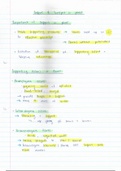
Chapter 1 (13-04-22)
Accounting and the Business Environment
Accounting is the information system that measures business activities, processes
the information into reports, and communicates the results to decision makers.
There are two types of accounting:
- Financial accounting
- Managerial accounting
[Financial accounting ]
The organizations that govern accounting
FASB
Financial Accounting Standards Board
Privately funded
Creates the rules and standards that govern financial accounting
In Europe: International Accounting Standards Board (IASB) and National GAAP
SEC
Securities and Exchange Commission
Oversees the US financial markets
In Europe: European Securities and Market Authority (ESMA) and National
Authorities
GAAP: Generally Accepted Accounting Principles
- Guidelines that govern accounting
- Based on a conceptual framework
Relevant the info allows users to make a decision
Faithfully representative the info is complete, neutral, and free from material errors
Accounting assumptions:
Economic entity assumption
Cost principle
Monetary unit assumption
Going concern assumption
The accounting equation
Assets = liabilities + equity
Rule: the accounting equation must always be in balance!
Assets economic resources that are expected to benefit the business in the future
(land, furniture, cash, inventory)
Liabilities debts that are owed to creditors (accounts payable, notes payable,
salaries payable)
Equity the owner’s residual claim against the assets of the company (owner’s
capital, owner’s withdrawal).
The owner’s claim on the resources increases and decrease as the company
engages in earning activities
Owner’s capital - Owner’s withdrawals + revenues – expenses = Equity
Revenues are economic resources that have been earned by delivering products
or services to customers.
,Expenses are the costs associated with selling goods or services
Transactions and accounting:
It involves the exchange of economic resources
We must be able to measure the economic impact in monetary units
Four based financial statements
Used by all companies as the primary means of communicating to stakeholders
Income statement reports the success or the failure of the company’s
operations at a certain period of time
Statement of Owner’s equity shows amounts and causes of changes in
owner’s capital during a period
Balance sheet reports assets and claim to those assets at a specific point
in time
Stamen of cash flows answers the question of whether the business
generates enough cash to pay its bills.
Chapter 2 (13-04-22)
Recording Business Transactions
What is an account?
Each element of the accounting equation contains smaller elements called accounts.
Account: the detailed record of all increase and decreases that have occurred in an
individual asset, liability, equity, revenue, or expense during a specific period.
What is double-entry accounting?
Transactions always have two impacts on the accounting equation. These double
entries keep the accounting equation in balance.
What is a T-account?
A T-account is a shortened visual form of the more formal general ledge account
format. Increase is shown on one side of the T-account and decreases on the other
side. The T-account is balanced at the end of each period
What are debits and credits?
Debits and credits are used to record the increases and decreases in T-accounts.
Debit means left, credit means right.
Any time we put a debit in one account, we have to put an equal credit in another
account. Some accounts will be increased with debits, and some accounts will be
increased with credits.
We can explain the balancing impact of transactions using T-accounts and debits
and credits.
Increases in owner’s contributions or owner’s withdrawals will be reflected in the
changing owner’s capital balance. When revenues exceed expenses, net income
increases Owner’s capital (profit).
How do you record transactions?
1. A transaction occurs
,2. Source documents are prepared
3. Transactions are analysed
4. Transactions are journalized and posted
The next step in the process is to formally record the transaction in the general
journal.
Trial balance:
The primary purpose of the trial balance is to prove the mathematical equality of
debits and credits after posting.
The amounts come from the individual account balances in the general ledger.
First, the income statement is prepared. The information for the statement of Owner’s
equity comes from the trial balance and from the income statement.
The debt ratio
The debt ratio shows the proportion of assets financed with debt. It can be used to
evaluate a business’s ability to pay its debts and to determine if the company has too
much debt to be considered financially healthy.
Debt ratio = total liabilities / total assets
Chapter 3 (14-04-22)
The Adjusting Process
There is cash-basis accounting and accrual-basis accounting
Cash-basis:
Revenue is recorded when cash is received
Expenses are recorded when cash is paid
Not allowed under GAAP
Accrual-basis:
Revenue is recorded when it is earned
Expenses are recorded when incurred
Generally used by larger businesses
The time period concept: assumes that a business’s activities can be sliced into small
segments and that financial statements can be prepared for specific time periods,
such as a month, quarter, or year. A twelve-month period fiscal year
Revenue recognition principle
Revenue should be recorded when earned a good has been delivered or a service
has been performed the earning process is complete
- The amount of revenues must represent the actual selling price (if a 200 item is
discounted to 100, then the revenue is 100)
The matching principle
Expenses are matched at the end of the period against revenues for that period.
Expenses are recorded when they are incurred during the period.
For example, rent expense for January should be matched against January
revenues, even if it was actually paid in December.
Adjusting entry rules:
Never involve cash
, Either increase revenue or increase an expense
Accrued means amount must be recorded
The initial trial balance that comes from the general ledger is referred to as
unadjusted trial balance. Because of the time period concept, revenue recognition
principle, and matching principle, some adjustments are needed.
Adjustments to the trial balance are made by recording actual adjusting journal
entries.
Adjusting journal entries:
This can be divided into two basic categories:
Prepaids:
1. Prepaid expenses
2. Unearned revenues
Accruals:
1. Accrued revenues
2. Accrued expenses
Depreciation:
- Long-lived, tangible assets used to generate revenue are referred to as plant
assets
- Plant assets act like prepaid expenses
Paid for when acquired
Used up over time
Used to produce revenues
Depreciation: the process of systematically recording the periodic usage of plant
assets to generate revenues.
The accounts used are:
- Depreciation expense
- Accumulated depreciation
Land is never depreciated. Accumulated depreciation is a contra-asset.
- It has a credit balance
- Appears in the asset section of the balance sheet
Accrued revenues: arise when the company recognizes that it has performed a
service, or delivered a product, but has not yet recorded that they have earned the
revenue.
The adjusted trial balance:
After journalizing and posting all the adjusting journal entries at the end of the fiscal
period, a new adjusted trial balance is prepared.
List all accounts
List debit balances in the debit column
List credit balance in the credit column
If it balances, financial statements can be prepared.
The adjusted trial balance includes accounts that did not appear on the original
unadjusted trial balance. The financial statements are prepared directly from the
adjusted trial balance.
Preparing adjusted entries and the adjusted trial balance:
Chapter 1 (13-04-22)
Accounting and the Business Environment
Accounting is the information system that measures business activities, processes
the information into reports, and communicates the results to decision makers.
There are two types of accounting:
- Financial accounting
- Managerial accounting
[Financial accounting ]
The organizations that govern accounting
FASB
Financial Accounting Standards Board
Privately funded
Creates the rules and standards that govern financial accounting
In Europe: International Accounting Standards Board (IASB) and National GAAP
SEC
Securities and Exchange Commission
Oversees the US financial markets
In Europe: European Securities and Market Authority (ESMA) and National
Authorities
GAAP: Generally Accepted Accounting Principles
- Guidelines that govern accounting
- Based on a conceptual framework
Relevant the info allows users to make a decision
Faithfully representative the info is complete, neutral, and free from material errors
Accounting assumptions:
Economic entity assumption
Cost principle
Monetary unit assumption
Going concern assumption
The accounting equation
Assets = liabilities + equity
Rule: the accounting equation must always be in balance!
Assets economic resources that are expected to benefit the business in the future
(land, furniture, cash, inventory)
Liabilities debts that are owed to creditors (accounts payable, notes payable,
salaries payable)
Equity the owner’s residual claim against the assets of the company (owner’s
capital, owner’s withdrawal).
The owner’s claim on the resources increases and decrease as the company
engages in earning activities
Owner’s capital - Owner’s withdrawals + revenues – expenses = Equity
Revenues are economic resources that have been earned by delivering products
or services to customers.
,Expenses are the costs associated with selling goods or services
Transactions and accounting:
It involves the exchange of economic resources
We must be able to measure the economic impact in monetary units
Four based financial statements
Used by all companies as the primary means of communicating to stakeholders
Income statement reports the success or the failure of the company’s
operations at a certain period of time
Statement of Owner’s equity shows amounts and causes of changes in
owner’s capital during a period
Balance sheet reports assets and claim to those assets at a specific point
in time
Stamen of cash flows answers the question of whether the business
generates enough cash to pay its bills.
Chapter 2 (13-04-22)
Recording Business Transactions
What is an account?
Each element of the accounting equation contains smaller elements called accounts.
Account: the detailed record of all increase and decreases that have occurred in an
individual asset, liability, equity, revenue, or expense during a specific period.
What is double-entry accounting?
Transactions always have two impacts on the accounting equation. These double
entries keep the accounting equation in balance.
What is a T-account?
A T-account is a shortened visual form of the more formal general ledge account
format. Increase is shown on one side of the T-account and decreases on the other
side. The T-account is balanced at the end of each period
What are debits and credits?
Debits and credits are used to record the increases and decreases in T-accounts.
Debit means left, credit means right.
Any time we put a debit in one account, we have to put an equal credit in another
account. Some accounts will be increased with debits, and some accounts will be
increased with credits.
We can explain the balancing impact of transactions using T-accounts and debits
and credits.
Increases in owner’s contributions or owner’s withdrawals will be reflected in the
changing owner’s capital balance. When revenues exceed expenses, net income
increases Owner’s capital (profit).
How do you record transactions?
1. A transaction occurs
,2. Source documents are prepared
3. Transactions are analysed
4. Transactions are journalized and posted
The next step in the process is to formally record the transaction in the general
journal.
Trial balance:
The primary purpose of the trial balance is to prove the mathematical equality of
debits and credits after posting.
The amounts come from the individual account balances in the general ledger.
First, the income statement is prepared. The information for the statement of Owner’s
equity comes from the trial balance and from the income statement.
The debt ratio
The debt ratio shows the proportion of assets financed with debt. It can be used to
evaluate a business’s ability to pay its debts and to determine if the company has too
much debt to be considered financially healthy.
Debt ratio = total liabilities / total assets
Chapter 3 (14-04-22)
The Adjusting Process
There is cash-basis accounting and accrual-basis accounting
Cash-basis:
Revenue is recorded when cash is received
Expenses are recorded when cash is paid
Not allowed under GAAP
Accrual-basis:
Revenue is recorded when it is earned
Expenses are recorded when incurred
Generally used by larger businesses
The time period concept: assumes that a business’s activities can be sliced into small
segments and that financial statements can be prepared for specific time periods,
such as a month, quarter, or year. A twelve-month period fiscal year
Revenue recognition principle
Revenue should be recorded when earned a good has been delivered or a service
has been performed the earning process is complete
- The amount of revenues must represent the actual selling price (if a 200 item is
discounted to 100, then the revenue is 100)
The matching principle
Expenses are matched at the end of the period against revenues for that period.
Expenses are recorded when they are incurred during the period.
For example, rent expense for January should be matched against January
revenues, even if it was actually paid in December.
Adjusting entry rules:
Never involve cash
, Either increase revenue or increase an expense
Accrued means amount must be recorded
The initial trial balance that comes from the general ledger is referred to as
unadjusted trial balance. Because of the time period concept, revenue recognition
principle, and matching principle, some adjustments are needed.
Adjustments to the trial balance are made by recording actual adjusting journal
entries.
Adjusting journal entries:
This can be divided into two basic categories:
Prepaids:
1. Prepaid expenses
2. Unearned revenues
Accruals:
1. Accrued revenues
2. Accrued expenses
Depreciation:
- Long-lived, tangible assets used to generate revenue are referred to as plant
assets
- Plant assets act like prepaid expenses
Paid for when acquired
Used up over time
Used to produce revenues
Depreciation: the process of systematically recording the periodic usage of plant
assets to generate revenues.
The accounts used are:
- Depreciation expense
- Accumulated depreciation
Land is never depreciated. Accumulated depreciation is a contra-asset.
- It has a credit balance
- Appears in the asset section of the balance sheet
Accrued revenues: arise when the company recognizes that it has performed a
service, or delivered a product, but has not yet recorded that they have earned the
revenue.
The adjusted trial balance:
After journalizing and posting all the adjusting journal entries at the end of the fiscal
period, a new adjusted trial balance is prepared.
List all accounts
List debit balances in the debit column
List credit balance in the credit column
If it balances, financial statements can be prepared.
The adjusted trial balance includes accounts that did not appear on the original
unadjusted trial balance. The financial statements are prepared directly from the
adjusted trial balance.
Preparing adjusted entries and the adjusted trial balance: