
South UniversityPATHOPHYSI 5003week 7and 8 test.
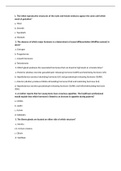
1. The initial reproductive structures of the male and female embryos appear the same until which week of gestation? a. Third b. Seventh c. Twentieth d. Thirtieth 2. The absence of which major hormone is a determinant of sexual differentiation (Wolffian system) in utero? a. Estrogen b. Progesterone c. Growth hormone d. Testosterone 3. Which gland produces the associated hormones that are found in high levels in a female fetus? a. Posterior pituitary excretes gonadotropin-releasing hormone (GnRH) and luteinizing hormone (LH). b. Hypothalamus excretes luteinizing hormone (LH) and gonadotropin-releasing hormone (GnRH). c. Anterior pituitary produces follicle-stimulating hormone (FSH) and luteinizing hormone (LH). d. Hypothalamus excretes gonadotropin-releasing hormone (GnRH) and folliclestimulating hormone (FSH). 4. A mother reports that her young teens have voracious appetites. The healthcare professional would explain that which hormone is linked to an increase in appetite during puberty? a. Inhibin b. Leptin c. Activin d. Follistatin 5. The Skene glands are located on either side of which structure? a. Introitu s b. Urinary meatus c. Clitoris d. Vestibule 6. What is the function of the mucus secreted by the Bartholin glands? a. Enhancement of the motility of sperm b. Lubrication of the urinary meatus and vestibule c. Maintenance of an acid-base balance to discourage infection d. Enhancement of the size of the penis during intercourse 7. Which change is a result of puberty and defends the vagina from infection? a. The pH stabilizes between 7 and 8. b. A thin squamous epithelial lining develops. c. Vaginal pH becomes more acidic. d. Estrogen levels are low. 8. What happens to the vagina’s lining at puberty? a. It becomes thinner. b. It becomes thicker. c. It assumes a neutral pH. d. It undergoes atrophy. 9. Which structure is lined with columnar epithelial cells? a. Perimetrium b. Endocervical canal c. Myometrium d. Vagina 10. Where is the usual site of fertilization of an ovum? a. Trumpet end of the fallopian tubes b. Fimbriae of the fallopian tubes c. Ampulla of the fallopian tubes d. Os of the fallopian tub
Información del documento
- Subido en
- 11 de mayo de 2022
- Número de páginas
- 49
- Escrito en
- 2021/2022
- Tipo
- Examen
- Contiene
- Preguntas y respuestas

