Top-down approach Assessment
Tasks:
1. Produce an offender profile for the crime in the case study using the
top down approach. (P5) (M3) (D3)
2. Explain the top down technique and how it’s been used in your profile.
Refer to the theory underpinning this approach. (P6)
3. Assess two strengths and two weaknesses of using the top down
technique in your case. (P6) (M4) (D3)
Case Study:
Police were called to a house where they found a body in the kitchen. The victim
was a 20 year old woman with a pale freckled complexion and long fair hair parted
in the middle. She was stabbed to death with a single blow to the heart, and there
were other stab injuries to her abdomen that formed the pattern of a star. There
were no other visible signs of injury. She was carefully placed on the floor with her
hands resting on her stomach and bound with a ribbon.
1. Produce an offender profile (using the template below) for the crime in the case
study using the top down approach. (P5) (M3) (D3)
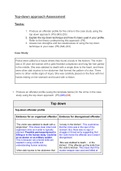
Top down
Top-down offender profile
Evidence for an organised offender Evidence for disorganised offender
“The victim was stabbed to death with a “a body in the kitchen”. This could show
single blow”. This shows clear intent and that the crime was in the spur of the
organised crime as murder is typically moment. But, there was no sign of
planned. Possible past-experienced in struggle or forced entry suggesting that
killing or in the human body. Could be the victim knew the offender and it wasn't
an ex-doctor or ex-military soldier. disorganised.
This is because very precise skills are
needed in using a knife and “She was stabbed to death … in the
understanding human anatomy. kitchen”. If the offender got the knife from
the victim’s kitchen. This mean that if the
“other stab injuries to her abdomen that murder weapon was used and lefted at
, formed the pattern of a star”. This shows he crime scene it may demonstrate
possible ritualistic killing as a pattern of a disorganisation. But, if the offender used
star can be found in a multitude of their own knife it was organised and
religions. For example; the star of David planned.
in Judaism, the pentagram in satanism,
wicca and paganism. Overall, with an educated guess it is
safe to assume that this wasn’t a
“She was carefully placed on the floor disorganised offender. This is
with her hands resting on her stomach because if forensic evidence was left
and bound with a ribbon”. This shows behind it would suggest that the
that the offender intentionally moved the offender was disorganised. However,
victim’s body and stayed the body. The it’s not clear if any forensic evidence
ribbon shows further ritualistic was found. Therefore, it's most likely
connotations and it being brought to the that the offender is organised.
crime scene shows that it was planned.
“There were no other visible signs of
injury”. This shows that the offender
planned the crime and knew that no more
stabbing was necessary. Also, it means
there were no signs of struggle
suggesting that the offender is known to
the victim. Or the offender has a possible
link to a criminal history
“a body in the kitchen”. The crime scene
was at the victim’s home. This means
that it was personal and planned as the
offender waited until the victim was alone
at home. Could also suggest that the
victim knew the offender enough to allow
them in the house as there are no signs
of forced entry.
Overall, the evidence supports the
claim that the offender is organised as
there is very little evidence and
ritualistic killing hints at a skilled
intelligent offender.
2. Explain the top down technique and how it’s been used in your profile. Refer
to the theory underpinning this approach. (P6)
2a Explain the theory by Hazelwood, Douglas and Ressler underpinning the
top-down approach:
Hazelwood and Douglas (1980) conducted a study into the breakthrough idea of classifying serial
homicide crime scenes according to an organised v disorganised dichotomy. Their theory was
Tasks:
1. Produce an offender profile for the crime in the case study using the
top down approach. (P5) (M3) (D3)
2. Explain the top down technique and how it’s been used in your profile.
Refer to the theory underpinning this approach. (P6)
3. Assess two strengths and two weaknesses of using the top down
technique in your case. (P6) (M4) (D3)
Case Study:
Police were called to a house where they found a body in the kitchen. The victim
was a 20 year old woman with a pale freckled complexion and long fair hair parted
in the middle. She was stabbed to death with a single blow to the heart, and there
were other stab injuries to her abdomen that formed the pattern of a star. There
were no other visible signs of injury. She was carefully placed on the floor with her
hands resting on her stomach and bound with a ribbon.
1. Produce an offender profile (using the template below) for the crime in the case
study using the top down approach. (P5) (M3) (D3)
Top down
Top-down offender profile
Evidence for an organised offender Evidence for disorganised offender
“The victim was stabbed to death with a “a body in the kitchen”. This could show
single blow”. This shows clear intent and that the crime was in the spur of the
organised crime as murder is typically moment. But, there was no sign of
planned. Possible past-experienced in struggle or forced entry suggesting that
killing or in the human body. Could be the victim knew the offender and it wasn't
an ex-doctor or ex-military soldier. disorganised.
This is because very precise skills are
needed in using a knife and “She was stabbed to death … in the
understanding human anatomy. kitchen”. If the offender got the knife from
the victim’s kitchen. This mean that if the
“other stab injuries to her abdomen that murder weapon was used and lefted at
, formed the pattern of a star”. This shows he crime scene it may demonstrate
possible ritualistic killing as a pattern of a disorganisation. But, if the offender used
star can be found in a multitude of their own knife it was organised and
religions. For example; the star of David planned.
in Judaism, the pentagram in satanism,
wicca and paganism. Overall, with an educated guess it is
safe to assume that this wasn’t a
“She was carefully placed on the floor disorganised offender. This is
with her hands resting on her stomach because if forensic evidence was left
and bound with a ribbon”. This shows behind it would suggest that the
that the offender intentionally moved the offender was disorganised. However,
victim’s body and stayed the body. The it’s not clear if any forensic evidence
ribbon shows further ritualistic was found. Therefore, it's most likely
connotations and it being brought to the that the offender is organised.
crime scene shows that it was planned.
“There were no other visible signs of
injury”. This shows that the offender
planned the crime and knew that no more
stabbing was necessary. Also, it means
there were no signs of struggle
suggesting that the offender is known to
the victim. Or the offender has a possible
link to a criminal history
“a body in the kitchen”. The crime scene
was at the victim’s home. This means
that it was personal and planned as the
offender waited until the victim was alone
at home. Could also suggest that the
victim knew the offender enough to allow
them in the house as there are no signs
of forced entry.
Overall, the evidence supports the
claim that the offender is organised as
there is very little evidence and
ritualistic killing hints at a skilled
intelligent offender.
2. Explain the top down technique and how it’s been used in your profile. Refer
to the theory underpinning this approach. (P6)
2a Explain the theory by Hazelwood, Douglas and Ressler underpinning the
top-down approach:
Hazelwood and Douglas (1980) conducted a study into the breakthrough idea of classifying serial
homicide crime scenes according to an organised v disorganised dichotomy. Their theory was