NUR2063: Essentials of Pathophysiology Exam 1 Blueprint Winter 2021.
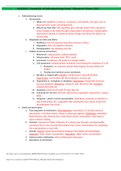
NUR2063: Essentials of Pathophysiology Exam 1 Blueprint Winter 2021. 1. Pathophysiology basics a. Homeostasis i. What is it? equilibrium, balance, consistency, and stability. vital signs such as blood pressure, pulse, and temperature. ii. Why do we have this? self-regulating, give-and-take system that responds to minor changes in the body through compensation mechanisms. Compensation mechanisms attempt to counteract those changes and return the body to its normal state b. Adaptation to stress and illness i. Resilience: How one bounces back from sickness or illness ii. Adaptation: How one adapts to sickness iii. Maladaptation: Not adapting correctly c. Cellular structures & functions i. Ribosomes: make proteins, protein synthesis ii. Mitochondria: cell power plant, ATP is made iii. Lysosomes: breakdown cell products & foreign bodies iv. Cell membrane: semipermeable membrane surrounding the cytoplasm of a cell 1. Receptors: Ion channels, protein-linked signals, Enzyme-linked cell funtion 2. Passing ions/nutrients across membrane v. Atrophy vs. hypertrophy: Atrophy: cell decrease in size and function. Hypertrophy: overworked cells (heart disease), increase size vi. Hyperplasia vs. metaplasia vs dysplasia: Hyperplasia: overgrowth of tissues, increase workload. Metaplasia: change in cells, abnormal cells. Dysplasia: mutated abnormal size vii. Apoptosis: planned cell death-90 days then die viii. Cell death d/t necrosis: Necrotic: dead tissue (coagulative, liquefactive, caseous, fatty) ix. Gangrene—what it is & the presentation: dead tissue caused by an infection or lack of blood flow. Dry: coagulative Wet: liquefactive Gas: release of gas from decomposition into tissue 2. Fluids and electrolytes a. Fluid regulation & distribution: Fluid regulation: intracellular 2/3 of fluid volume & extracellular 1/3of fluid volume. Water & sodium go together. Distribution: interstitial fluid=between cells, intravascular=inside blood vessels, transcellular= third space-a space it doesn’t belong b. Osmosis: movement of fluid. Molecules of a solvent pass through a semipermeable membrane from a less concentrated solution into a more concentrated one, equalizing the concentrations on each side c. Tonicity: Isotonic: equal concentrations between intracellular and extracellular Hypotonic: lower solute concentration. Hypertonic: higher solute concentration d. Sodium/water relationship: where sodium goes water goes e. Alterations in electrolytes 1 NUR2063: Essentials of Pathophysiology Exam 1 Blueprint Winter 2021 This study source was downloaded by from CourseH on :37:11 GMT -05:00 f. Fluid movement through body –basic principles: fluid intake, absorption, Distribution between vascular and interstitial, excretion g. Antidiuretic hormone (ADH): tells kidneys to hold onto water, promotes reabsorption of water in the kidneys h. Aldosterone: Hold on to water and sodium i. Sensible vs. insensible fluid losses: Sensible fluid loss: measurable (pee, diarrhea, blood). Insensible fluid losses: cannot be measured (sweat, fluid loss while talking/breathing) j. Abnormal fluid loss: Emesis(vomitus), Hemorrhage, wounds k. Fluid balance control: Antidiuretic Hormone (ADH): “tap water”, kidneys reabsorb plain water. Aldosterone: “salt water” hormone, cause kidney to reabsorb sodium and water. l. Fluid excess causes/presentation: Excessive sodium or water intake, High sodium diet, hypertonic fluid administered. Difficulty breathing(dyspnea), bouncing pulse, fast heart rate (tachycardia), polyuria, rapid weight gain. i. Third spacing – what is this? Fluid leaks into interstitial tissues m. Fluid deficit causes/presentation: inadequate sodium or water elimination, hyperaldosteronism, Cushing’s syndrome, renal failure, liver failure, heart failure. Dehydration 3. Normal electrolyte levels (table below) a. Sodium and associated disorders Normal range 135-145 i. Implications of sodium imbalances: Hypernatremia: excess sodium ingested, hypertonic saline administered, deficient water, excessive sweating, prolonged hyperventilation. Hyponatremia: deficient sodium, excessive water intake b. Potassium and associated disorders 3.5-5 i. Implications of potassium imbalances: hyperkalemia: deficient excretion; renal failure, excessive intake, increase release from cells. Hypokalemia: excessive loss, deficient intake, increased shift into cell c. Calcium 9-11 i. Chvostek’s signs: the healthcare practitioner taps the patient’s facial nerve in front of the ear. A spasm or brief contraction of the corner of the mouth, nose, eye, and muscles in the cheek is considered a positive sign and indicates increased neuromuscular irritability ii. Trousseau’s signs: The inflated cuff is left in place for approximately 3 minutes. The test is considered positive for increased neuromuscular irritability if it elicits a carpal spasm d. Phosphorus 2.5-4.5 i. Lab relationship with calcium: phosphorus has an inverse relationship with calcium. Absorption of phosphorus is decreased when it is ingested with foods containing calcium, magnesium, and aluminum—all of which bind with phosphorus. e. Magnesium 1.8-2.5 4. Acid-base balance a. Normal pH & what it means: 7.35-7.45. pH indicates hydrogen ions. Hydrogens=acid. More hydrogen ions=lower pH b. Buffers (video): Carbonic acid (H2CO3), Phosphate (PO4), Hemoglobin, Protein 2 NUR2063: Essentials of Pathophysiology Exam 1 Blueprint Winter 2021 This study source was downloaded by from CourseH on :37:11 GMT -05:00 i. H2CO3 1. Bicarbonate/carbonic acid system: most significant in extracellular fluid ii. Phosphate iii. Hemoglobin iv. Protein c. Potassium + hydrogen ions: Potassium & Hydrogen move interchangeably into and out of the cell to balance pH. Potassium imbalance leads to pH imbalances. d. Respiratory system regulation (very basic): Manages pH by altering CO2 excretion. Faster respirations excrete more CO2, decreasing acidity. Slower respirations excrete less CO2, increasing acidity e. Renal regulation (very basic): kidneys alter the excretion or retention of hydrogen or bicarbonate. ^ potassium ^ acid= dialysis. If pH imbalance is in the lungs, the kidneys will initiate efforts to correct.
Escuela, estudio y materia
Información del documento
- Subido en
- 8 de mayo de 2022
- Número de páginas
- 7
- Escrito en
- 2021/2022
- Tipo
- Examen
- Contiene
- Preguntas y respuestas
Temas
- nur 2063
-
nur2063 essentials of pathophysiology exam 1 blueprint winter 2021
-
nur2063 essentials of pathophysiology exam 1
-
nur2063 essentials of pathophysiology exam 1 2021
-
nur2063 essentials of pat

Documento también disponible en un lote