100% de satisfacción garantizada Inmediatamente disponible después del pago Tanto en línea como en PDF No estas atado a nada 4,6 TrustPilot
logo-home
Examen

NURS 6630 Week 11 Final Exam (Spring 2022)

Puntuación
-
Vendido
-
Páginas
11
Subido en
21-04-2022
Escrito en
2021/2022

1. Question: A 59-year-old male has been admitted to the E. D. due to a methamphetamine overdose. The patient’s friend reported he ingested up to 2 grams because “he thought cops were coming to get him.” The patient’s vitals are all within normal limits, except his blood pressure is 180/110. What is the best recommendation to make at this time? 2. Question: Disorientation, tremor, hyperactivity, fever, hallucinations, marked wakefulness, and increased autonomic tone are all features that are consistent with which part of alcohol withdrawal? 3. Question: Which medication(s) requires a test dose to determine accurate use of the drug (i.e., how addicted the patient truly is on a certain drug) before beginning a titration schedule to withdrawal the patient? 4. Question: Drug addiction includes many prescription medications and illegal substances. Of the drugs listed, which ones can be withdrawn abruptly WITHOUT medical intervention to prevent withdraw seizures? 5. Question: What should our treatment goal be with our patients when it comes to managing chronic pain? 6. Question: Which of the following psychiatric conditions is present in both domains (i.e., core psychopathology & pain-related psychological symptoms) of chronic pain that will likely lead to an outcome of disability, pain, and poor quality of life? 7. Question: Which of the following drugs is structurally similar to tramadol; thus, its opioid-mediated analgesia can be reversed by naloxone in mice? 8. Question: Daytrana is the MPH transdermal system of methylphenidate approved for the treatment of ADHD in children aged 6 years and older. What is the difference in terms of the metabolism compared to the other formulations in this class? 9. Question: T. C. is an 88-year-old male who is diagnosed at your clinic with Dementia with Lewy Bodies. He currently has some debilitating gait issues, which makes his quality of life very poor. His memory is still intact with minor deficits. Which medication would likely benefit T. C. as his initial therapy? 10. Question: Which of the following drugs is often used in the management of opioid addiction due to its ceiling effect? 11. Question: The experience of pain is ALWAYS subjective 12. Question: Which neurotransmitters are likely involved in the pathophysiology of withdrawal seizures? 13. Question: What is the difference between Ritalin and Focalin? 14. Question: When can buprenorphine be initiated in a patient who is suffering from an opioid overdose? 15. Question: Which enzyme does disulfiram inhibit leading to a build-up of the ethanol metabolite acetaldehyde? 16. Question: In the pathophysiology of Alzheimer’s Disease, there are certain proteins that lead to the plaques and tangles that result in this progressive, irreversible brain disorder. Choose the appropriate protein with its corresponding pathology. 17. Question: Of the following medications, which one is contraindicated with stimulants such as Ritalin or Adderall? 18. Question: Select all the criteria for what is considered “At-Risk Drinking.” 19. Which of the following drugs in the treatment of Alzheimer’s Disease requires administration with food? 20. Question: Which medication below should be routine for all suspected cases of alcohol intoxication and dependence? 21. Question: Choose the correct statement regarding an anti-ADHD medication and its respectful mechanism of action 22. Question: Y. R. is a 35-year-old woman who presents to your clinic today complaining of ankle pain. She said she was running the trail when she saw a snake. During a quick turn to run away from the snake, she twisted her ankle. Which of the following medications may be a good choice in helping Y. R. with her pain? 23. Question: A new patient presents to your clinic today. The patient is a 13-year-old boy who complains that he has no interest in anything. The patient states, “I just want to sleep more than I normally do, and I don’t care much for playing my video games anymore.” His mother states he cannot focus on anything for more than a few minutes at a time, and that he often gets in trouble at school because he cannot sit still. What would you recommend at this time? 24. Question: There are many different types of dementia. Which dementia is NOT a direct result of disrupted neurotransmitters, but a result of degeneration of different regions in the brain? Onset of the disease is typically before the age of 60, and very rare after the age of 75. 25. Question: L. J. is a 55-year-old male who attended a funeral and found himself laughing during the service, but later that evening he was irritated with himself for what he had done. His wife said this was abnormal behavior and took him to his doctor to be evaluated. After L. J.’s MRI was reviewed, he was diagnosed with frontotemporal dementia. Which medication is recommended to help L. J. with his emotional outbursts? 26. Question: Benzodiazepines can be withdrawn abruptly despite duration of therapy/abuse. 27. Question: Patient is a 10-year-old female with diagnosed ADHD who was started on Ritalin 5 mg twice a day over 2 months ago. She is still experiencing the triad of symptoms associated with ADHD (impaired attention, impulsivity, and excessive motor activity). Her mother reports that she is now having difficulty in falling asleep since starting the medication. She has been on no other anti-ADHD medications and the mother reports full compliance with medication regimen. What is the appropriate recommendation to make based on this scenario? 28. Question: This medication cannot be used for more than 5 days, it is a non-steroidal, anti- inflammatory drug, and it is often substituted for morphine due to its rapid onset and high potency. What is this medication? 29. Question: Disulfiram has been proven effective in the treatment of alcoholism, but recently it has been trialed in the management of cocaine addiction. What is the mechanism of action that likely helps produce these aversive effects? 30. Question: What baseline levels should you perform before initiating an anti-ADHD medication? 31. Question: Of the following neurotransmitters, which one(s) are known to be severely disrupted in the disease Dementia with Lewy Bodies? 32. Question: If a patient suffers from a multitude of small strokes and later begins experiencing mood disturbances in an acute fashion that sometimes resolve, from what type of dementia would you think that patient may suffer? 33. Question: Select the correct treatment regarding drugs involved in addiction management and their corresponding mechanism of action. 34. Question: Select the correct treatment regarding drugs involved in addiction management and their corresponding mechanism of action. 35. Question: Of the following neurotransmitters, which ones play a critical role in modulating attention in ADHD? 36. Question: FILL IN THE BLANK: is the main neurotransmitter behind reward systems in the brain, which usually leads to addiction when altered in any way. 37. Question: Select the correct description of a somatoform disorder. 38. Question: T. B. is a 55-year-old male who has diagnosed with type 2 diabetes 10+ years ago. He has since had complications from the disease and is suffering from severe neuropathy. On top of that, T. B. is struggling with his mental health and was recently told he could be depressed but he had refused treatment at that time. Besides getting his blood sugar under control, what medication(s) can we use that may be useful in helping T. B.? 39. Question: Which features are consistent with delirium? 40. Question: Choose the correct statement regarding medications used for alcoholism 41. Question: E. B., a 55-year-old female, is a patient at your clinic today who has a past medical history significant for breast cancer, hypertension, hepatic cirrhosis, type 2 diabetes, and a recent diagnosis of alcohol use disorder. She has no known drug allergies. She states she is ready to quit drinking but fears the cravings that it may bring. Which medication would you recommend for E. B. to begin? 42. Question: T. K. is a 72-year-old female who has suffered many strokes in the past, likely due to uncontrolled hypertension and hyperlipidemia. She has now been diagnosed with vascular dementia due to memory loss and motor system slowing. What is the recommended treatment for T. K.? 43. Question: Which of the following drugs in the treatment of Alzheimer’s Disease helps normalize glutamate by antagonizing the NMDA receptor? 44. Question: The patient is a 16-year-old girl with a past history of substance use disorder. She has been known to abuse prescription opioids and smokes one pack of cigarettes every day. She has been in and out of recovery for the past year. During her last admission into a recovery center, she was diagnosed with ADHD, which may have contributed to her addictive personality. She presents to your clinic today to initiate pharmacotherapy for her new diagnosis. What would you recommend in this patient? 45. Question: Which club drug is structurally similar to GABA? 46. Question: If a patient is being managed for chronic pain and is not getting better after months of therapy with multiple agents (i.e., NSAIDs with opioids, muscle relaxants with NSAIDs, etc.), what should be your next step in helping the patient? 47. Question: Which of the following is the only Black Box Warning associated with the medication atomoxetine? 48. Question: SSRIs can be used in alcohol use disorder and offer modest drinking reduction through an anti-craving effect. 49. Question: Patient is a 75-year-old female with a confirmed diagnosis of Alzheimer’s Disease. She is currently on Donepezil 10 mg daily. She is accompanied to your clinic today by her daughter, who informs you that her mother has recently had an increase in depressive symptoms. She has no history of mood disorders. She has a history of hypertension and tonic-clonic seizures, but both are controlled. Assuming this patient will be thoroughly evaluated for the diagnosis of depression, what would you recommend as initial therapy? 50. Question: Of the axons involved in the transmission of pain, which one is thinly myelinated and conducts that first feeling of pain that is often felt as coming on as a sharp, rapid feeling? 51. Question: When completing this exam, did you comply with Walden University’s Code of Conduct including the expectations for academic integrity?

Mostrar más Leer menos
Institución
Grado

Vista previa del contenido

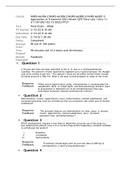
Course NURS-6630A-2/NURS-6630N-2/NURS-6630D-2/NURS-6630C-2-
Approaches to Treatment-2021-Winter-QTR-Term-wks-1-thru-11-
(11/29/2021-02/13/2022)-PT27
Test Final Exam - Week
11 Started 2/12/22 8:16 AM
Submitted 2/12/22 9:16 AM
Due Date 2/14/22 1:59 AM
Status Completed
Attempt 96 out of 100 points
Score
Time 59 minutes out of 2 hours and 30 minutes
Elapsed
Results Feedback
Displayed
• Question 1
A 59-year-old male has been admitted to the E. D. due to a methamphetamine
overdose. The patient’s friend reported he ingested up to 2 grams because “he thought
cops were coming to get him.” The patient’s vitals are all within normal limits, except
his blood pressure is 180/110. What is the best recommendation to make at this time?


Response "When severe hypertension arises, phentolamine is recommended for
Feedback: vasodilation. Beta- or mixed alpha- and beta-adrenergic blockers (such
as propranolol or labetalol) are to be avoided because they may
exacerbate stimulant-induced cardiovascular toxicity.”

• Question 2
Disorientation, tremor, hyperactivity, fever, hallucinations, marked wakefulness, and
increased autonomic tone are all features that are consistent with which part of alcohol
withdrawal?


Response "The principal features are disorientation (to time, place, or person),
Feedback: tremor, hyperactivity, marked wakefulness, fever, increased
autonomic tone, and hallucinations.”

• Question 3
Which medication(s) requires a test dose to determine accurate use of the drug (i.e.,
how addicted the patient truly is on a certain drug) before beginning a titration schedule
to withdrawal the patient?

I. Butalbital
II. Lorazepam
III. Hydrocodone

Response
“Treatment should begin with an oral test dose of 200 mg of
Feedback: pentobarbital, a short-acting-barbiturate.”

• Question 4

, Drug addiction includes many prescription medications and illegal substances. Of the
drugs listed, which ones can be withdrawn abruptly WITHOUT medical intervention to
prevent withdraw seizures?


Response “Amphetamines can be withdrawn
Feedback: abruptly”

• Question 5
What should our treatment goal be with our patients when it comes to managing chronic
pain?


Response “In general, treatment goals are reports of pain less than 5 out of
Feedback: 10 and an improvement in function.”

• Question 6
Which of the following psychiatric conditions is present in both domains (i.e., core
psychopathology & pain-related psychological symptoms) of chronic pain that will likely
lead to an outcome of disability, pain, and poor quality of life?


Response Figure 17-4 and in the text on the page discussing how anxiety is
Feedback: present in both, therefore, a review is needed of the exact cause of
the anxiety

• Question 7
Which of the following drugs is structurally similar to tramadol; thus, its opioid-mediated
analgesia can be reversed by naloxone in mice?


Response “Structurally, venlafaxine is similar to tramadol, and in mice,
Feedback: venlafaxine demonstrates opioid-mediated analgesia that is
reversed by naloxone.”

• Question 8
Daytrana is the MPH transdermal system of methylphenidate approved for the
treatment of ADHD in children aged 6 years and older. What is the difference in terms of
the metabolism compared to the other formulations in this class?


Response referring to MPH transdermal system (MTS; Daytrana): “Since the
Feedback: MPH is absorbed through the skin, it does not undergo first-pass
metabolism by CES-1 in the liver, resulting in higher plasma MPH
levels”

• Question 9
T. C. is an 88-year-old male who is diagnosed at your clinic with Dementia with Lewy
Bodies. He currently has some debilitating gait issues, which makes his quality of life
very poor. His memory is still intact with minor deficits. Which medication would likely
benefit T. C. as his initial therapy?

Escuela, estudio y materia

Institución
Estudio
Desconocido

Información del documento

Subido en
21 de abril de 2022
Número de páginas
11
Escrito en
2021/2022
Tipo
Examen
Contiene
Desconocido

Temas

$35.99
Accede al documento completo:

100% de satisfacción garantizada
Inmediatamente disponible después del pago
Tanto en línea como en PDF
No estas atado a nada


Documento también disponible en un lote

Conoce al vendedor

Seller avatar
Los indicadores de reputación están sujetos a la cantidad de artículos vendidos por una tarifa y las reseñas que ha recibido por esos documentos. Hay tres niveles: Bronce, Plata y Oro. Cuanto mayor reputación, más podrás confiar en la calidad del trabajo del vendedor.
studyguider55 Chamberlain College Nursing
Seguir Necesitas iniciar sesión para seguir a otros usuarios o asignaturas
Vendido
442
Miembro desde
5 año
Número de seguidores
313
Documentos
1565
Última venta
5 horas hace
StudyGuider

Study material including course and exam guide for College and University students in the United States.

3.9

121 reseñas

5
52
4
27
3
32
2
3
1
7

Documentos populares

Recientemente visto por ti

Por qué los estudiantes eligen Stuvia

Creado por compañeros estudiantes, verificado por reseñas

Calidad en la que puedes confiar: escrito por estudiantes que aprobaron y evaluado por otros que han usado estos resúmenes.

¿No estás satisfecho? Elige otro documento

¡No te preocupes! Puedes elegir directamente otro documento que se ajuste mejor a lo que buscas.

Paga como quieras, empieza a estudiar al instante

Sin suscripción, sin compromisos. Paga como estés acostumbrado con tarjeta de crédito y descarga tu documento PDF inmediatamente.

Student with book image

“Comprado, descargado y aprobado. Así de fácil puede ser.”

Alisha Student

Preguntas frecuentes