

EI management: Chapter 3 – Creativity and innovation
The theory of creativity
o Creativity = brain driven/thinking actions
o 80% of problems solve by creative thinking process
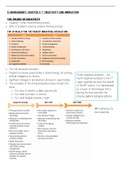
Top 10 skills for the fourth industrial revolution
o The 4iR demands innovation
o Presents immense opportunities in biotechnology, 3D printing,
Fourth industrial revolution – the
artificial intelligence & robotics
fourth industrial revolution is the 4th
o Significant changes in all industries will result in opportunities
major industrial era since the initial IR
o The principles of the entrepreneurial process remains the
of the 18th century. It is characterised
same
by a fusion of technologies that is
o You have to identify a viable oppourtunity
blurring the lines between the
o You need a product or service
physical, digital & biological spheres
o You need feasible business model
àTimeframes for
new industries
, o Creativity contains the following conditions:
o It is a product or the result of a thinking process, Creativity defined in 3 core fields of
resulting in value application (Sawyer 2012)
o This thinking process is time & energy consuming
o The initial problem is vague & unstructured. The problem 1. creativity creates newness (new
definition is thus integrated in the thinking process ideas, new problem-solving
o It is unusual, uncommon, unique, something with surprise techniques, & new products)
value 2. creativity is a combinator
o It is practical, functional, feasible (combines & associates unrelated
o It is understandable & could be used by others thoughts, ideas & concepts)
o Blanchard (2010) sees creativity as the ability to:
o Remove the fear of failure 3. creativity is articulated in the world
o Continuously investigate & test new horizons (creativity has to express & not
o Generate & test new ideas merely resemble dreams)
o Introduce society to something they have not
experienced before
o Acar, Burnett & Cabra summarises the basics of modern creativity into 4 ‘usefulness’ categories
o Originality
o Value
o Surprise
o Aesthetics
o Sawyer (2012) positions creativity in trends in the socioeconomic environment:
o Globalisation resulted in higher competitiveness & affected market environments that were
historically protected
o Product development cycles are shortening
o Non-creative occupations are continuously being replaced by automation techniques
o Increased wealth & leisure time of advanced nations increased demand for “creative” products
à types of
creativity
The theory of creativity
o Creativity = brain driven/thinking actions
o 80% of problems solve by creative thinking process
Top 10 skills for the fourth industrial revolution
o The 4iR demands innovation
o Presents immense opportunities in biotechnology, 3D printing,
Fourth industrial revolution – the
artificial intelligence & robotics
fourth industrial revolution is the 4th
o Significant changes in all industries will result in opportunities
major industrial era since the initial IR
o The principles of the entrepreneurial process remains the
of the 18th century. It is characterised
same
by a fusion of technologies that is
o You have to identify a viable oppourtunity
blurring the lines between the
o You need a product or service
physical, digital & biological spheres
o You need feasible business model
àTimeframes for
new industries
, o Creativity contains the following conditions:
o It is a product or the result of a thinking process, Creativity defined in 3 core fields of
resulting in value application (Sawyer 2012)
o This thinking process is time & energy consuming
o The initial problem is vague & unstructured. The problem 1. creativity creates newness (new
definition is thus integrated in the thinking process ideas, new problem-solving
o It is unusual, uncommon, unique, something with surprise techniques, & new products)
value 2. creativity is a combinator
o It is practical, functional, feasible (combines & associates unrelated
o It is understandable & could be used by others thoughts, ideas & concepts)
o Blanchard (2010) sees creativity as the ability to:
o Remove the fear of failure 3. creativity is articulated in the world
o Continuously investigate & test new horizons (creativity has to express & not
o Generate & test new ideas merely resemble dreams)
o Introduce society to something they have not
experienced before
o Acar, Burnett & Cabra summarises the basics of modern creativity into 4 ‘usefulness’ categories
o Originality
o Value
o Surprise
o Aesthetics
o Sawyer (2012) positions creativity in trends in the socioeconomic environment:
o Globalisation resulted in higher competitiveness & affected market environments that were
historically protected
o Product development cycles are shortening
o Non-creative occupations are continuously being replaced by automation techniques
o Increased wealth & leisure time of advanced nations increased demand for “creative” products
à types of
creativity



