
Food Systems & Sustainability summary
Lecture 1: Food systems & system thinking
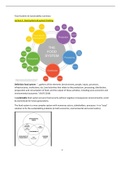
Definition food system: “…gathers all the elements (environment, people, inputs, processes,
infrastructures, institutions, etc.) and activities that relate to the production, processing, distribution,
preparation and consumption of food, and the output of these activities, including socio-economic and
environmental outcomes.” (HLPE 2014)
A sustainable food system ensures food security without negative consequences (environmental, social
& economical) for future generations.
The food system is a very complex system with numerous actors, stakeholders, processes → no “easy”
solution to fix the sustainability problems (in both economic, environmental and social realms).
1
,Key themes in a system:
• Interconnectedness (Everything is reliant on something else for survival) → food supply chain
• Synthesis (Combining two or more things to create something new) → soil + seeds + energy =
crop
• Emergence (Outcome of things coming together: synergies of parts) → revenue coming from
crops or livestock
• Feedback (Flows between system elements– reinforcing, balancing) → excess fertilizer leading
to soil degradation or GHG emissions that can boost plant growth
• Causality (One thing results in another thing in a system) → similar to feedback, but directly.
Diets → production → environmental impacts
Food system analysis are a set of different frameworks used to analyze the food system in different
contexts. For example, from a nutrition and sustainability perspective or the roles of different
stakeholders involved. Such frameworks can be linear, circular, nested.
Food system activities and outcomes are determined by drivers, environmental drivers and socio-
economic drivers. For example, climate (change) affects food quality and availability, geography of food
production, and productivity/outputs. Urbanization shapes consumer behavior and policy can influence
food systems via regulations.
2
,Food systems are key part of food/nutrition security (more in session 3). However, food security is a
complex issue with multiple environmental, social, political and economic determinants. It encompasses
components of availability, access and utilization. See figure on page 3 for the 9 food security
elements.
Food systems encompass a number of activities which give rise to a number of food security
outcomes.
3
, Food system activities are determined by a number of factors (‘determinants’). The determinants of
‘packaging and distributing’ food, for instance, include the desired appearance of the final product and
other demands of the retailer, the shelf life needed, cold chain and/ or other transportation
infrastructure, road, rail and shipping infrastructure, trade regulations, storage facilities, etc.
Undertaking these activities leads to a number of Outcomes, which not only contribute to food security,
but also relate to environmental and other social welfare issues. Both the activities and their outcomes
are influenced by the interacting GEC and socioeconomic ‘drivers’; and the environmental, food security
and other social outcomes of the activities feedback to the drivers (Fig. 2).
Food systems operate on different scales:
individual/household, local, regional, national and global. Of
course, different scales interact and they do not follow
state/country boundaries.
There are different food system types:
4
Lecture 1: Food systems & system thinking
Definition food system: “…gathers all the elements (environment, people, inputs, processes,
infrastructures, institutions, etc.) and activities that relate to the production, processing, distribution,
preparation and consumption of food, and the output of these activities, including socio-economic and
environmental outcomes.” (HLPE 2014)
A sustainable food system ensures food security without negative consequences (environmental, social
& economical) for future generations.
The food system is a very complex system with numerous actors, stakeholders, processes → no “easy”
solution to fix the sustainability problems (in both economic, environmental and social realms).
1
,Key themes in a system:
• Interconnectedness (Everything is reliant on something else for survival) → food supply chain
• Synthesis (Combining two or more things to create something new) → soil + seeds + energy =
crop
• Emergence (Outcome of things coming together: synergies of parts) → revenue coming from
crops or livestock
• Feedback (Flows between system elements– reinforcing, balancing) → excess fertilizer leading
to soil degradation or GHG emissions that can boost plant growth
• Causality (One thing results in another thing in a system) → similar to feedback, but directly.
Diets → production → environmental impacts
Food system analysis are a set of different frameworks used to analyze the food system in different
contexts. For example, from a nutrition and sustainability perspective or the roles of different
stakeholders involved. Such frameworks can be linear, circular, nested.
Food system activities and outcomes are determined by drivers, environmental drivers and socio-
economic drivers. For example, climate (change) affects food quality and availability, geography of food
production, and productivity/outputs. Urbanization shapes consumer behavior and policy can influence
food systems via regulations.
2
,Food systems are key part of food/nutrition security (more in session 3). However, food security is a
complex issue with multiple environmental, social, political and economic determinants. It encompasses
components of availability, access and utilization. See figure on page 3 for the 9 food security
elements.
Food systems encompass a number of activities which give rise to a number of food security
outcomes.
3
, Food system activities are determined by a number of factors (‘determinants’). The determinants of
‘packaging and distributing’ food, for instance, include the desired appearance of the final product and
other demands of the retailer, the shelf life needed, cold chain and/ or other transportation
infrastructure, road, rail and shipping infrastructure, trade regulations, storage facilities, etc.
Undertaking these activities leads to a number of Outcomes, which not only contribute to food security,
but also relate to environmental and other social welfare issues. Both the activities and their outcomes
are influenced by the interacting GEC and socioeconomic ‘drivers’; and the environmental, food security
and other social outcomes of the activities feedback to the drivers (Fig. 2).
Food systems operate on different scales:
individual/household, local, regional, national and global. Of
course, different scales interact and they do not follow
state/country boundaries.
There are different food system types:
4


