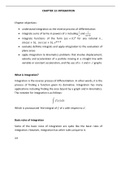
CHAPTER 13: INTEGRATION
Chapter objectives:
• understand integration as the reverse process of differentiation
/ /
• integrate sums of terms in powers of 𝑥 including and
T 6TU7
•
• integrate functions of the form (𝑎𝑥 + 𝑏) for any rational 𝑛 ,
sin(𝑎𝑥 + 𝑏), cos (𝑎𝑥 + 𝑏), 𝑒 6TU7
• evaluate definite integrals and apply integration to the evaluation of
plane areas
• apply integration to kinematics problems that involve displacement,
velocity and acceleration of a particle moving in a straight line with
variable or constant acceleration, and the use of 𝑥– 𝑡 and 𝑣– 𝑡 graphs
What is Integration?
Integration is the reverse process of differentiation. In other words, it is the
process of finding a function given its derivative. Integration has many
applications including finding the area bound by a graph and in kinematics.
The notation for integration is as follows:
] 𝑓(𝑥) 𝑑𝑥
Which is pronounced ‘the integral of 𝑓 of 𝑥 with respect to 𝑥’.
Basic rules of integration
Some of the basic rules of integration are quite like the basic rules of
integration. However, integration has other rules unique to it.
264
,1. If a function is the sum or difference of other functions, then its integral
is also the sum or difference of the integrals of those individual functions
i.e.:
𝑦 = 𝑓(𝑥 ) + 𝑔(𝑥 ) + ℎ(𝑥 ) + ⋯
→ ] 𝑦 𝑑𝑥 = ] 𝑓(𝑥) 𝑑𝑥 + ] 𝑔(𝑥) 𝑑𝑥 + ] ℎ(𝑥) 𝑑𝑥 + ⋯
2. A constant that multiplies or divides a function also multiplies or divides
its integral i.e.:
𝑦 = 𝑎𝑓 (𝑥 )
→ ] 𝑦 𝑑𝑥 = ] 𝑎 𝑓 (𝑥 )𝑑𝑥 = 𝑎 ] 𝑓(𝑥) 𝑑𝑥
3. Because the derivative of a constant is zero, the integral of zero should
then be a constant. Hence a constant of integration should always be
added in integration i.e.:
] 𝑓(𝑥) 𝑑𝑥 = 𝑔(𝑥 ) + 𝑐
(where 𝑐 is the constant of integration.)
4. Integration is the reverse process of differentiation. This means the
integral of the derivative of a function is the function itself (plus the
constant of integration)
] 𝑓 F (𝑥) 𝑑𝑥 = 𝑓 (𝑥 ) + 𝑐
OR:
𝑑𝑦
] 𝑑𝑥 = 𝑦 + 𝑐
𝑑𝑥
(where 𝑐 is the constant of integration)
265
,Example 13.1
a. Show that:
𝑑 sin 𝑥 1
‡ ˆ=
𝑑𝑥 cos 𝑥 − 1 1 − cos 𝑥
b. Hence find:
5
] 𝑑𝑥
1 − cos 𝑥
SOLUTION
a. The quotient rule of differentiation:
𝑑𝑢 𝑑𝑣
𝑑 𝑢 𝑣 −𝑢
x y = 𝑑𝑥 0 𝑑𝑥
𝑑𝑥 𝑣 𝑣
Hence:
𝑑 sin 𝑥
‡ ˆ
𝑑𝑥 cos 𝑥 − 1
(cos 𝑥 − 1)(cos 𝑥 ) − sin 𝑥 (− sin 𝑥)
=
(cos 𝑥 − 1)0
cos 0 𝑥 − cos 𝑥 + sin0 𝑥
=
(cos 𝑥 − 1)0
(cos 0 𝑥 + sin0 𝑥 ) − cos 𝑥
=
(cos 𝑥 − 1)0
1 − cos 𝑥
=
(cos 𝑥 − 1)0
266
, −(cos 𝑥 − 1)
=
(cos 𝑥 − 1)0
−1
=
cos 𝑥 − 1
1
=
−(cos 𝑥 − 1)
1
=
1 − cos 𝑥
(𝑠ℎ𝑜𝑤𝑛)
b. Using the knowledge that integration reverses differentiation and other
basic rules of integration the integral can be found.
∫ 𝑓 F (𝑥) 𝑑𝑥 = 𝑓(𝑥 ) + 𝑐
1 sin 𝑥
→] 𝑑𝑥 = +𝑐
1 − cos 𝑥 cos 𝑥 − 1
1 5 sin 𝑥
→ 5] 𝑑𝑥 = +𝑘 (∗ 𝑘 = 5𝑐 )
1 − cos 𝑥 cos 𝑥 − 1
5 5 sin 𝑥
∴] 𝑑𝑥 = +𝑘
1 − cos 𝑥 cos 𝑥 − 1
(where 𝑘 is the constant of integration)
*a multiple of a constant is also a constant.
Exercise 13.1
1. Using the fact that integration is the reverse process of differentiation
show that ∫ sin 𝑥 𝑑𝑥 = cos 𝑥.
267
Chapter objectives:
• understand integration as the reverse process of differentiation
/ /
• integrate sums of terms in powers of 𝑥 including and
T 6TU7
•
• integrate functions of the form (𝑎𝑥 + 𝑏) for any rational 𝑛 ,
sin(𝑎𝑥 + 𝑏), cos (𝑎𝑥 + 𝑏), 𝑒 6TU7
• evaluate definite integrals and apply integration to the evaluation of
plane areas
• apply integration to kinematics problems that involve displacement,
velocity and acceleration of a particle moving in a straight line with
variable or constant acceleration, and the use of 𝑥– 𝑡 and 𝑣– 𝑡 graphs
What is Integration?
Integration is the reverse process of differentiation. In other words, it is the
process of finding a function given its derivative. Integration has many
applications including finding the area bound by a graph and in kinematics.
The notation for integration is as follows:
] 𝑓(𝑥) 𝑑𝑥
Which is pronounced ‘the integral of 𝑓 of 𝑥 with respect to 𝑥’.
Basic rules of integration
Some of the basic rules of integration are quite like the basic rules of
integration. However, integration has other rules unique to it.
264
,1. If a function is the sum or difference of other functions, then its integral
is also the sum or difference of the integrals of those individual functions
i.e.:
𝑦 = 𝑓(𝑥 ) + 𝑔(𝑥 ) + ℎ(𝑥 ) + ⋯
→ ] 𝑦 𝑑𝑥 = ] 𝑓(𝑥) 𝑑𝑥 + ] 𝑔(𝑥) 𝑑𝑥 + ] ℎ(𝑥) 𝑑𝑥 + ⋯
2. A constant that multiplies or divides a function also multiplies or divides
its integral i.e.:
𝑦 = 𝑎𝑓 (𝑥 )
→ ] 𝑦 𝑑𝑥 = ] 𝑎 𝑓 (𝑥 )𝑑𝑥 = 𝑎 ] 𝑓(𝑥) 𝑑𝑥
3. Because the derivative of a constant is zero, the integral of zero should
then be a constant. Hence a constant of integration should always be
added in integration i.e.:
] 𝑓(𝑥) 𝑑𝑥 = 𝑔(𝑥 ) + 𝑐
(where 𝑐 is the constant of integration.)
4. Integration is the reverse process of differentiation. This means the
integral of the derivative of a function is the function itself (plus the
constant of integration)
] 𝑓 F (𝑥) 𝑑𝑥 = 𝑓 (𝑥 ) + 𝑐
OR:
𝑑𝑦
] 𝑑𝑥 = 𝑦 + 𝑐
𝑑𝑥
(where 𝑐 is the constant of integration)
265
,Example 13.1
a. Show that:
𝑑 sin 𝑥 1
‡ ˆ=
𝑑𝑥 cos 𝑥 − 1 1 − cos 𝑥
b. Hence find:
5
] 𝑑𝑥
1 − cos 𝑥
SOLUTION
a. The quotient rule of differentiation:
𝑑𝑢 𝑑𝑣
𝑑 𝑢 𝑣 −𝑢
x y = 𝑑𝑥 0 𝑑𝑥
𝑑𝑥 𝑣 𝑣
Hence:
𝑑 sin 𝑥
‡ ˆ
𝑑𝑥 cos 𝑥 − 1
(cos 𝑥 − 1)(cos 𝑥 ) − sin 𝑥 (− sin 𝑥)
=
(cos 𝑥 − 1)0
cos 0 𝑥 − cos 𝑥 + sin0 𝑥
=
(cos 𝑥 − 1)0
(cos 0 𝑥 + sin0 𝑥 ) − cos 𝑥
=
(cos 𝑥 − 1)0
1 − cos 𝑥
=
(cos 𝑥 − 1)0
266
, −(cos 𝑥 − 1)
=
(cos 𝑥 − 1)0
−1
=
cos 𝑥 − 1
1
=
−(cos 𝑥 − 1)
1
=
1 − cos 𝑥
(𝑠ℎ𝑜𝑤𝑛)
b. Using the knowledge that integration reverses differentiation and other
basic rules of integration the integral can be found.
∫ 𝑓 F (𝑥) 𝑑𝑥 = 𝑓(𝑥 ) + 𝑐
1 sin 𝑥
→] 𝑑𝑥 = +𝑐
1 − cos 𝑥 cos 𝑥 − 1
1 5 sin 𝑥
→ 5] 𝑑𝑥 = +𝑘 (∗ 𝑘 = 5𝑐 )
1 − cos 𝑥 cos 𝑥 − 1
5 5 sin 𝑥
∴] 𝑑𝑥 = +𝑘
1 − cos 𝑥 cos 𝑥 − 1
(where 𝑘 is the constant of integration)
*a multiple of a constant is also a constant.
Exercise 13.1
1. Using the fact that integration is the reverse process of differentiation
show that ∫ sin 𝑥 𝑑𝑥 = cos 𝑥.
267