NEURONAL CONTROL
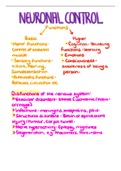
Functions
1 I
Basic Higher
Motor functions Cognition Thinking
control of skeletal functions learning
muscle Emotions
Sensory functions Consciousness
vision of
hearing awareness
being a
Somatosensation person
Automatic functions
Reflexes circulation etc
Dis functions of the nervous
system
Vascular disorders stroke ischaemic 1
hae
Infections
orrhage
encephalitis polio
meningitis
structural disorders Brain or spinal chord
injury Humour carpal tunnel
Nerve hyperactivity Epilepsy migraines
Degeneration e.g Alzeinmers Parkinson
, HOW NEURONAL CONTROL OCCURS
All neurons have three basic functions
1 Receivesignals
2
Integrate incomingsignals
3 Communicate signals to cells
target
The interaction between multiple neurons is
known as the neuronal circuit I network
Neural circuits
Process incoming information and
carry out a
response
Can be simple or composed of lots of neurons
Neuronal circuits are composed of 3 classes
of neurons
Afferent neurons Transmit signals towards
the CNS
Connect to
organs directly respond to
sense or
sensory stimulation sensory neurons
Efferent neurons Transmit signals towards
the periphery
They synapse with motor neurons
Responsible for glandular secretions secrete motor
Interneurons Transform input to output
make up the network between afferent and efferent
neurons
Functions
1 I
Basic Higher
Motor functions Cognition Thinking
control of skeletal functions learning
muscle Emotions
Sensory functions Consciousness
vision of
hearing awareness
being a
Somatosensation person
Automatic functions
Reflexes circulation etc
Dis functions of the nervous
system
Vascular disorders stroke ischaemic 1
hae
Infections
orrhage
encephalitis polio
meningitis
structural disorders Brain or spinal chord
injury Humour carpal tunnel
Nerve hyperactivity Epilepsy migraines
Degeneration e.g Alzeinmers Parkinson
, HOW NEURONAL CONTROL OCCURS
All neurons have three basic functions
1 Receivesignals
2
Integrate incomingsignals
3 Communicate signals to cells
target
The interaction between multiple neurons is
known as the neuronal circuit I network
Neural circuits
Process incoming information and
carry out a
response
Can be simple or composed of lots of neurons
Neuronal circuits are composed of 3 classes
of neurons
Afferent neurons Transmit signals towards
the CNS
Connect to
organs directly respond to
sense or
sensory stimulation sensory neurons
Efferent neurons Transmit signals towards
the periphery
They synapse with motor neurons
Responsible for glandular secretions secrete motor
Interneurons Transform input to output
make up the network between afferent and efferent
neurons