8/20/2020 Sophia :: Welcome
Score 21/21
You passed this Milestone
21 questions were answered correctly.
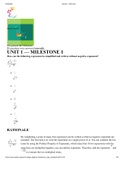
UNIT 1 — MILESTONE 1
1
How can the following expression be simplified and written without negative exponents?
RATIONALE
By completing a series of steps, this expression can be written so that no negative exponents are
included. The first step is to write the numerator as a single power of . You can combine the two
terms by using the Product Property of Exponents, which states that if two expressions with the
same base are multiplied together, you can add the exponents. Therefore, add the exponents and
to evaluate the two multiplied terms.
https://www.sophia.org/spcc/college-algebra-3/milestone_take_feedbacks/4014144 1/21
,8/20/2020 Sophia :: Welcome
plus equals , which becomes the new exponent in the numerator. Next, divide the
numerator by the denominator and write this as a single power of . To do this, use the Quotient
Property of Exponents, which says that when you divide two expressions with the same base, you
can subtract the exponents. Therefore, evaluate minus .
Be careful when subtracting negative numbers! minus can be thought of as plus
.
plus is equal to . This is the new exponent for . Lastly, write this without any
negative exponents.
Write the expression as a fraction with 1 in the numerator, and change the sign of the exponent
from negative to positive. This is the simplified expression without any negative exponents.
CONCEPT
Negative Exponents
2
Consider the following set of real numbers:
Which of the following contains all of the irrational numbers in the set?
RATIONALE
Rational numbers can be expressed as a ratio of two integers, and are
characterized by either terminating or repeating decimal patterns,
https://www.sophia.org/spcc/college-algebra-3/milestone_take_feedbacks/4014144 2/21
, 8/20/2020 Sophia :: Welcome
such as 0.375 or 0.3333... Irrational numbers are characterized by a
non-terminating, non-repeating decimal pattern. Evaluate each
number and determine whether it is rational or irrational.
Irrational: pi has a non-terminating, non-repeating decimal pattern.
Irrational: evaluates to . It has a non-
terminating, non-repeating decimal pattern.
Rational: The digits terminate after the 5 in the tenths place.
Rational: The digits terminate after 0.
Rational: This is a ratio of two integers, 1 and 7.
Irrational: This evaluates to . It has a non-terminating,
non-repeating decimal pattern.
Rational: The square root of 9 evaluates to the integer 3.
Rational: This has a repeating decimal pattern.
The irrational numbers in the set are .
CONCEPT
Real Number Types
3
What is the following expression equivalent to?
RATIONALE
https://www.sophia.org/spcc/college-algebra-3/milestone_take_feedbacks/4014144 3/21
Score 21/21
You passed this Milestone
21 questions were answered correctly.
UNIT 1 — MILESTONE 1
1
How can the following expression be simplified and written without negative exponents?
RATIONALE
By completing a series of steps, this expression can be written so that no negative exponents are
included. The first step is to write the numerator as a single power of . You can combine the two
terms by using the Product Property of Exponents, which states that if two expressions with the
same base are multiplied together, you can add the exponents. Therefore, add the exponents and
to evaluate the two multiplied terms.
https://www.sophia.org/spcc/college-algebra-3/milestone_take_feedbacks/4014144 1/21
,8/20/2020 Sophia :: Welcome
plus equals , which becomes the new exponent in the numerator. Next, divide the
numerator by the denominator and write this as a single power of . To do this, use the Quotient
Property of Exponents, which says that when you divide two expressions with the same base, you
can subtract the exponents. Therefore, evaluate minus .
Be careful when subtracting negative numbers! minus can be thought of as plus
.
plus is equal to . This is the new exponent for . Lastly, write this without any
negative exponents.
Write the expression as a fraction with 1 in the numerator, and change the sign of the exponent
from negative to positive. This is the simplified expression without any negative exponents.
CONCEPT
Negative Exponents
2
Consider the following set of real numbers:
Which of the following contains all of the irrational numbers in the set?
RATIONALE
Rational numbers can be expressed as a ratio of two integers, and are
characterized by either terminating or repeating decimal patterns,
https://www.sophia.org/spcc/college-algebra-3/milestone_take_feedbacks/4014144 2/21
, 8/20/2020 Sophia :: Welcome
such as 0.375 or 0.3333... Irrational numbers are characterized by a
non-terminating, non-repeating decimal pattern. Evaluate each
number and determine whether it is rational or irrational.
Irrational: pi has a non-terminating, non-repeating decimal pattern.
Irrational: evaluates to . It has a non-
terminating, non-repeating decimal pattern.
Rational: The digits terminate after the 5 in the tenths place.
Rational: The digits terminate after 0.
Rational: This is a ratio of two integers, 1 and 7.
Irrational: This evaluates to . It has a non-terminating,
non-repeating decimal pattern.
Rational: The square root of 9 evaluates to the integer 3.
Rational: This has a repeating decimal pattern.
The irrational numbers in the set are .
CONCEPT
Real Number Types
3
What is the following expression equivalent to?
RATIONALE
https://www.sophia.org/spcc/college-algebra-3/milestone_take_feedbacks/4014144 3/21