
• ¿Documento equivocado? Cámbialo gratis
  • Escrito por estudiantes que aprobaron
  • Inmediatamente disponible después del pago
  • Leer en línea o como PDF
Vender
¿Dónde estudias?
Tu idioma
Document preview thumbnail
Vista previa 2 fuera de 8 páginas
Examen

Meiosi

Document preview thumbnail
Vista previa 2 fuera de 8 páginas

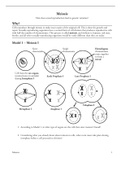
Meiosis 1 Meiosis How does sexual reproduction lead to genetic variation? Why? Cells reproduce through mitosis to make exact copies of the original cell. This is done for growth and repair. Sexually-reproducing organisms have a second form of cell division that produces reproductive cells with half the number of chromosomes. This process is called meiosis, and without it, humans, oak trees, beetles, and all other sexually-reproducing organisms would be vastly different than they are today. Model 1 – Meiosis I Early Prophase I Metaphase I Anaphase I Telophase I Late Prophase I Sister chromatids Single chromosome Homologous chromosomes come together to form a tetrad Cell from the sex organs (ovaries/testes in animals) during Interphase I 1. According to Model 1, in what type of organs are the cells that enter meiosis I found? 2. Considering what you already know about mitosis in cells, what event must take place during interphase before a cell proceeds to division? 2 POGIL™ Activities for High School Biology 3. What two structures make up a single replicated chromosome? 4. In Model 1, how many replicated chromosomes does the cell contain during prophase? Read This! Alleles are alternative forms of the same gene. For example, gene A may contain the information for fur color. One allele “A” may result in white fur, while the alternative allele “a” may result in black fur. Homologous chromosomes are chromosomes that contain the same genes, although each chromosome in the homologous pair may have different alleles. 5. At which stage in meiosis I do the pairs of homologous chromosomes come together? 6. Once the chromosomes have formed a pair, what are they called? 7. At the end of meiosis I, two cells have been produced. How many replicated chromosomes are in each of these cells? 8. Cells with a full set of chromosomes are referred to as diploid or 2n, whereas cells with half the chromosomes are haploid or n. At which stage(s) of meiosis I are the cells diploid and at which stage(s) are they haploid? 9. Which of the statements below correctly describes the relationship between the cells at the end of telophase I and the original cell? a. The new cells have one copy of all of the genetic information in the original cell. b. The new cells have two copies of all of the genetic information in the original cell. c. The new cells have one copy of half of the genetic information in the original cell. d. The new cells have two copies of half of the genetic information in the original cell. 10. Considering the genetic makeup of the homologous pairs, will the cells at the end of telophase I be genetically identical to each other? Meiosis 3 Model 2 – Meiosis II Two cells from Meiosis I in Prophase II Metaphase II Anaphase II Telophase II 11. According to Model 2, where did each of the cells come from that started meiosis II? 12. In meiosis I, during anaphase I, which structures separated—homologous chromosomes or sister chromatids? 13. In meiosis II, during anaphase II, which structures separated—homologous chromosomes or sister chromatids? 14. At the end of the meiosis II are four daughter cells. Are they haploid or diploid? Explain your answer in a complete sentence. 15. Which of the statements below correctly describes the relationship between the cells at the end of meiosis II and the original cell? a. The new cells have one copy of all of the genetic information in the original cell. b. The new cells have two copies of all of the genetic information in the original cell. c. The new cells have one copy of half of the genetic information in the original cell. d. The new cells have two copies of half of the genetic information in the original cell. 4 POGIL™ Activities for High School Biology Model 3 – Gametogenesis and Fertilization (Human) Secondary spermatocyte (end of meiosis I) Spermatids (end of meiosis II) Mature sperm Secondary oocyte (end of meiosis I) Polar body eventually degenerates Oocyte proceeds to meiosis II Fertilization Zygote with half its chromosmes from the female (maternal) and half from the male (paternal) Males Females 16. According to Model 3, what is the name given to the cells produced at the end of meiosis I in males? 17. What is the name given to the cells produced at the end of meiosis I in females? 18. Refer to Model 3. a. At the end of meiosis II in males, what cells are produced? b. What do these cells (from the previous question) eventually become? 19. Before fertilization, what happens to the secondary oocyte? 20. During fertilization which two cells come together? Be specific in your answer. Meiosis 5 21. During meiosis II, the secondary oocyte divides unevenly, with one cell (the ovum) receiving half of the chromosomes and nearly all the cytoplasm and organelles, while the other cell, the polar body, is much smaller and eventually degenerates. With your group, propose an explanation to explain why the secondary oocyte divides in this way. 22. What is the ploidy of the zygote produced by fertilization—haploid or diploid? 23. What would the ploidy of the zygote be if egg and sperm were produced by mitosis rather than meiosis? How would this affect the ploidy of each successive generation? 24. With your group write a statement to explain the origin of the chromosomes found in the zygote. Your statement must include the term homologous pair. 6 POGIL™ Activities for High School Biology Extension Questions Model 4 – Crossover of DNA in Chromosomes Chiasma Homologous pair of chromosomes (tetrad) during Prophase I Recombinant chromatids 25. At which stage of meiosis are the chromosomes in Model 4? 26. When the chromosomes come together as homologous pairs, the arms of the sister chromatids may cross over. a. What are these crossover points called? b. Describe what happens to the chromatids during crossover. 27. What phrase is used to describe the chromatids after crossing over takes place and the homologous chromosomes separate? 28. Compare the recombinant chromatids with the original pair. a. Are the genes on a recombinant chromatid the same as the original chromatid? b. Are the alleles on a recombinant chromatid the same as the original chromatid? Meiosis 7 Model 5 – Genetic Variation OR Early Prophase I Late Prophase I Late Telophase I OR OR 29. Model 5 is a condensed version of meiosis I. Notice the two possible arrangements of chromosomes in late prophase I. Considering what you know about DNA replication and meiosis, is either arrangement equally likely during the formation of tetrads in late prophase I? Explain. 30. If there were three sets of homologous chromosomes in the cell in Model 5, how many possible arrangements would there be for the tetrads in late prophase I? Read This! When homologous chromosome pairs align on the spindle during metaphase I the orientation of one pair is independent of the orientation of any other pair. This is known as independent assortment. Humans have 46 chromosomes, arranged as 23 pairs. During metaphase I each pair lines up independently, which results in 223 possible combinations. 31. With your group, calculate the number of possible genetic combinations due to independent assortment. 8 POGIL™ Activities for High School Biology 32. As a group, choose one set of daughter cells in late telophase I from Model 5. Imagine that those cells now undergo meiosis II. Draw at least four resulting haploid cells that could result. 33. Meiosis and sexual reproduction each lead to variation in the genetic make-up of every person. With your group, explain how meiotic events, as well as the random fertilization of eggs and sperm, together lead to this genetic variation.

Vista previa del contenido

Meiosis
How does sexual reproduction lead to genetic variation?

Why?
Cells reproduce through mitosis to make exact copies of the original cell. This is done for growth and
repair. Sexually-reproducing organisms have a second form of cell division that produces reproductive cells
with half the number of chromosomes. This process is called meiosis, and without it, humans, oak trees,
beetles, and all other sexually-reproducing organisms would be vastly different than they are today.


Model 1 – Meiosis I
Sister Single Homologous
chromatids chromosome chromosomes
come together
to form a
tetrad


Cell from the sex organs
(ovaries/testes in animals) Early Prophase I Late Prophase I
during Interphase I


Telophase I
Metaphase I Anaphase I


1. According to Model 1, in what type of organs are the cells that enter meiosis I found?


2. Considering what you already know about mitosis in cells, what event must take place during
interphase before a cell proceeds to division?


Meiosis 1

, 3. What two structures make up a single replicated chromosome?


4. In Model 1, how many replicated chromosomes does the cell contain during prophase?


Read This!
Alleles are alternative forms of the same gene. For example, gene A may contain the information for
fur color. One allele “A” may result in white fur, while the alternative allele “a” may result in black fur.
Homologous chromosomes are chromosomes that contain the same genes, although each chromosome
in the homologous pair may have different alleles.
5. At which stage in meiosis I do the pairs of homologous chromosomes come together?


6. Once the chromosomes have formed a pair, what are they called?


7. At the end of meiosis I, two cells have been produced. How many replicated chromosomes are in
each of these cells?


8. Cells with a full set of chromosomes are referred to as diploid or 2n, whereas cells with half the
chromosomes are haploid or n. At which stage(s) of meiosis I are the cells diploid and at which
stage(s) are they haploid?


9. Which of the statements below correctly describes the relationship between the cells at the end of
telophase I and the original cell?
a. The new cells have one copy of all of the genetic information in the original cell.
b. The new cells have two copies of all of the genetic information in the original cell.
c. The new cells have one copy of half of the genetic information in the original cell.
d. The new cells have two copies of half of the genetic information in the original cell.


10. Considering the genetic makeup of the homologous pairs, will the cells at the end of telophase I
be genetically identical to each other?


2 POGIL™ Activities for High School Biology

Información del documento

Subido en
21 de febrero de 2022
Número de páginas
8
Escrito en
2021/2022
Tipo
Examen
Contiene
Preguntas y respuestas
$7.99

¿Documento equivocado? Cámbialo gratis Dentro de los 14 días posteriores a la compra y antes de descargarlo, puedes elegir otro documento. Puedes gastar el importe de nuevo.
Escrito por estudiantes que aprobaron
Inmediatamente disponible después del pago
Leer en línea o como PDF

Seller avatar
Los indicadores de reputación están sujetos a la cantidad de artículos vendidos por una tarifa y las reseñas que ha recibido por esos documentos. Hay tres niveles: Bronce, Plata y Oro. Cuanto mayor reputación, más podrás confiar en la calidad del trabajo del vendedor.
NURSEREP
4.7
(328)
Vendido
602
Seguidores
424
Artículos
2671
Última venta
1 semana hace


Por qué los estudiantes eligen Stuvia

Creado por compañeros estudiantes, verificado por reseñas

Calidad en la que puedes confiar: escrito por estudiantes que aprobaron y evaluado por otros que han usado estos resúmenes.

¿No estás satisfecho? Elige otro documento

¡No te preocupes! Puedes elegir directamente otro documento que se ajuste mejor a lo que buscas.

Paga como quieras, empieza a estudiar al instante

Sin suscripción, sin compromisos. Paga como estés acostumbrado con tarjeta de crédito y descarga tu documento PDF inmediatamente.

Student with book image

“Comprado, descargado y aprobado. Así de fácil puede ser.”

Alisha Student

Preguntas frecuentes
