
- GENETICS
GENETICS: a branch of biology that studies heredity and variation in organisms
- Explains the similarities and differences between parents and offspring
HEREDITY: passing on of traits/characteristics from one generation to the next
GREGOR MENDEL: THE FATHER OF GENETICS
- Life: [1822-1884] + Austrian monk
- Responsible for the first major breakthrough in the study of heredity by
investigating the transfer of characteristics from one generation to the
next
- Realised that ‘factors’ passed from parent to offspring, that sexual
reproduction combines theses ‘factors’ from each parent to produce
unique, yet the same offspring
- The ‘factors’, we now know, are genes
- Published work in 1866 but only scientifically recognised in 1900s
GENES & ALLELES
GENES
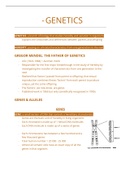
GENE: a small section of DNA that controls a hereditary characteristic
- Genes are the basic unit of heredity in living organisms
- Each chromatid is made up of 1 helical DNA molecules
- Each DNA molecule is made up of a series of genes
- Each chromosome has between a few hundred and a
few thousand genes
- Total human number = 20 000 - 25 000
- Almost all somatic cells have an exact copy of all the
genes in that orgaisms
, - Mature erythrocytes have no nuclei, therefore have no
chromosomes or genes
- There are 2 of each kind of chromosome - maternal and paternal
chromosomes
- Each cell contains 2 of each kind of gene
- These versions of a gene = alleles
GENE POOL: the set of all genes OR genetic information, in a population of
sexually reproducing organisms
- Large gene pool = high genetic diversity + increased survival chances
- Small gene pool = low genetic diversity + increased extinction possibility
HOW ACTIVE ARE GENES?
- Even though each cell contains a full complement of DNA, only the genes
that are needed are activated
- Thus the unneeded genes are suppressed
- Therefore different genes are activated in diff cells → creating
specific proteins that give a specific cell type its character
- Some genes play a role in the early development of the embryo and are
inactive thereafter
HOUSEKEEPING GENES: genes that are active in many types of cells, making
proteins needed for basic functions
NON-CODING GENES: genes that do not code for proteins and occur in between
the coding sections
- Only 2% of DNA codes for proteins
HOX GENES: master control genes that determine the way in which the body
develops from a single zygote
EPIGENETICS: the control of genes
- Human Epigenome Project aims to document what switches genes on/off
- If all genes are known, we can cure all genetic diseases
ALLELES
,ALLELE: one of two/more forms of a gene
- Responsible for controlling different versions of a trait found in the same
locus on the homologous chromosomes
- EG: the colour of the coat of a cow
HOW ALLELES ARE REPRESENTED:
- Capital letter = dominant allele
- Lowercase = recessive allele
HOW ALLELES ARE PASSED FROM PARENT TO OFFSPRING:
- Passed by way of chromosomes in the gametes that are made through
meiosis in the gonads
GAMETE: a reproductive cell/sex cell
Somatic cells are diploid [2n] because
they have:
- A pair of homologous
chromosomes
- 2 alleles which can either be the
same or different
Gametes are haploid [n] because they
have:
- 1A single set of unpaired
chromosomes
- 1 of each pair of alleles
, WHAT HAPPENS TO THE GAMETES:
- During fertilisation, a male and female gamete (both with their alleles)
fuse together to form a diploid zygote
- Zygote then divides by mitosis to form a new organism made up of cells
- Each cell has the same set of chromosomes and alleles as in the
zygote
GENOTYPES AND PHENOTYPES
GENOTYPE: made up of all the genes an organism carries on its chromosomes,
which it has inherited from its parents
PHENOTYPE: the physical appearance of an organism.
- Partly programmed by genes (its genotype)
- Is also shaped by external factors (exercise / diet / environment)
HOMOZYGOUS AND HETEROZYGOUS
After fertilisation, the zygote (& all the cells that develop from it) has 2 alleles for
each gene - 1 from each parent
- These alleles will be on the same locus on each chromosome of a
homologous pair
HOMOZYGOUS: pair of alleles at a locus are the same [bb / BB]
If the alleles for a characteristic are the same
HETEROZYGOUS: pair of alleles at a locus are different [Bb]
If the alleles for a characteristic are different
DOMINANT & RECESSIVE ALLELES
In heterozygous pairing, one allele of a pair can be:
- DOMINANT: The allele for a gene which is expressed if it is present in the
heterozygous state (Bb) or the homozygous state (BB). It masks the
presence of the recessive allele in the heterozygous state Bb.
- RECESSIVE: the allele for a gene which is not expressed in the presence of
a dominant allele and can thus only be expressed homozygously
GENETICS: a branch of biology that studies heredity and variation in organisms
- Explains the similarities and differences between parents and offspring
HEREDITY: passing on of traits/characteristics from one generation to the next
GREGOR MENDEL: THE FATHER OF GENETICS
- Life: [1822-1884] + Austrian monk
- Responsible for the first major breakthrough in the study of heredity by
investigating the transfer of characteristics from one generation to the
next
- Realised that ‘factors’ passed from parent to offspring, that sexual
reproduction combines theses ‘factors’ from each parent to produce
unique, yet the same offspring
- The ‘factors’, we now know, are genes
- Published work in 1866 but only scientifically recognised in 1900s
GENES & ALLELES
GENES
GENE: a small section of DNA that controls a hereditary characteristic
- Genes are the basic unit of heredity in living organisms
- Each chromatid is made up of 1 helical DNA molecules
- Each DNA molecule is made up of a series of genes
- Each chromosome has between a few hundred and a
few thousand genes
- Total human number = 20 000 - 25 000
- Almost all somatic cells have an exact copy of all the
genes in that orgaisms
, - Mature erythrocytes have no nuclei, therefore have no
chromosomes or genes
- There are 2 of each kind of chromosome - maternal and paternal
chromosomes
- Each cell contains 2 of each kind of gene
- These versions of a gene = alleles
GENE POOL: the set of all genes OR genetic information, in a population of
sexually reproducing organisms
- Large gene pool = high genetic diversity + increased survival chances
- Small gene pool = low genetic diversity + increased extinction possibility
HOW ACTIVE ARE GENES?
- Even though each cell contains a full complement of DNA, only the genes
that are needed are activated
- Thus the unneeded genes are suppressed
- Therefore different genes are activated in diff cells → creating
specific proteins that give a specific cell type its character
- Some genes play a role in the early development of the embryo and are
inactive thereafter
HOUSEKEEPING GENES: genes that are active in many types of cells, making
proteins needed for basic functions
NON-CODING GENES: genes that do not code for proteins and occur in between
the coding sections
- Only 2% of DNA codes for proteins
HOX GENES: master control genes that determine the way in which the body
develops from a single zygote
EPIGENETICS: the control of genes
- Human Epigenome Project aims to document what switches genes on/off
- If all genes are known, we can cure all genetic diseases
ALLELES
,ALLELE: one of two/more forms of a gene
- Responsible for controlling different versions of a trait found in the same
locus on the homologous chromosomes
- EG: the colour of the coat of a cow
HOW ALLELES ARE REPRESENTED:
- Capital letter = dominant allele
- Lowercase = recessive allele
HOW ALLELES ARE PASSED FROM PARENT TO OFFSPRING:
- Passed by way of chromosomes in the gametes that are made through
meiosis in the gonads
GAMETE: a reproductive cell/sex cell
Somatic cells are diploid [2n] because
they have:
- A pair of homologous
chromosomes
- 2 alleles which can either be the
same or different
Gametes are haploid [n] because they
have:
- 1A single set of unpaired
chromosomes
- 1 of each pair of alleles
, WHAT HAPPENS TO THE GAMETES:
- During fertilisation, a male and female gamete (both with their alleles)
fuse together to form a diploid zygote
- Zygote then divides by mitosis to form a new organism made up of cells
- Each cell has the same set of chromosomes and alleles as in the
zygote
GENOTYPES AND PHENOTYPES
GENOTYPE: made up of all the genes an organism carries on its chromosomes,
which it has inherited from its parents
PHENOTYPE: the physical appearance of an organism.
- Partly programmed by genes (its genotype)
- Is also shaped by external factors (exercise / diet / environment)
HOMOZYGOUS AND HETEROZYGOUS
After fertilisation, the zygote (& all the cells that develop from it) has 2 alleles for
each gene - 1 from each parent
- These alleles will be on the same locus on each chromosome of a
homologous pair
HOMOZYGOUS: pair of alleles at a locus are the same [bb / BB]
If the alleles for a characteristic are the same
HETEROZYGOUS: pair of alleles at a locus are different [Bb]
If the alleles for a characteristic are different
DOMINANT & RECESSIVE ALLELES
In heterozygous pairing, one allele of a pair can be:
- DOMINANT: The allele for a gene which is expressed if it is present in the
heterozygous state (Bb) or the homozygous state (BB). It masks the
presence of the recessive allele in the heterozygous state Bb.
- RECESSIVE: the allele for a gene which is not expressed in the presence of
a dominant allele and can thus only be expressed homozygously



