
THE SKELETON
- Supports
- Protects
- Enables movement
Types of skeletons:
HYDROSTATIC:
- Fluid-filled, closed chambers within an organism.
- Made of water.
Advantages:
- Changes shape – this allows movement.
o Muscles contract & push against water
▪ Creates pressure
Disadvantages:
- No protection (skeletal defence mechanism)
- Restricted movement.
- Confined to water.
- Remain small.
Examples:
- Soft-bodied invertebrates.
- Coelenterates
o Jellyfish
o Anemones
- Annelids
o Earthworms
- Nematodes
o Roundworms
How they move:
- Contracting muscles surrounding fluid-filled cavity creates pressure
causing change in shape
- Causes movement
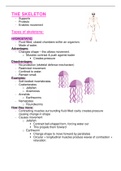
o Jellyfish
▪ Contract bell-shaped form, forcing water out
▪ This propels them forward
o Earthworm
▪ Change shape to move forward by peristalsis
▪ Circular + longitudinal muscles produce waves of contraction +
relaxation.
, EXOSKELETONS:
- Surround the body of an organism
- Made of chitin outside of the body
o Chitin – substance found in cell walls of plants – it is light and strong
Advantages:
- Support + protection.
- Muscle attachment – allows movement.
- Joints – move easily.
- Waxy cuticle – reduces loss of water loss.
Disadvantages:
- Rigid – limits movement.
- Heavy – limits growth so remains small.
- Vulnerable while moulting.
How disadvantages are overcome:
- Moult / ecdysis (shed skeleton) – grow bigger.
- Jointed limbs – range of movements.
Examples:
- Arthropods
o Insects
o Crustaceans
ENDOSKELETON:
- Made of bone within the body.
Advantages:
- Support.
- Shape.
- Can grow – in living tissue.
- Protects internal organs.
- Muscle attachment allows movement.
Disadvantages:
- Not all soft tissues protected.
Examples:
- Mammals
o Humans.
Tissues that make up the skeleton:
- CARTILAGE
- BONE
- Supports
- Protects
- Enables movement
Types of skeletons:
HYDROSTATIC:
- Fluid-filled, closed chambers within an organism.
- Made of water.
Advantages:
- Changes shape – this allows movement.
o Muscles contract & push against water
▪ Creates pressure
Disadvantages:
- No protection (skeletal defence mechanism)
- Restricted movement.
- Confined to water.
- Remain small.
Examples:
- Soft-bodied invertebrates.
- Coelenterates
o Jellyfish
o Anemones
- Annelids
o Earthworms
- Nematodes
o Roundworms
How they move:
- Contracting muscles surrounding fluid-filled cavity creates pressure
causing change in shape
- Causes movement
o Jellyfish
▪ Contract bell-shaped form, forcing water out
▪ This propels them forward
o Earthworm
▪ Change shape to move forward by peristalsis
▪ Circular + longitudinal muscles produce waves of contraction +
relaxation.
, EXOSKELETONS:
- Surround the body of an organism
- Made of chitin outside of the body
o Chitin – substance found in cell walls of plants – it is light and strong
Advantages:
- Support + protection.
- Muscle attachment – allows movement.
- Joints – move easily.
- Waxy cuticle – reduces loss of water loss.
Disadvantages:
- Rigid – limits movement.
- Heavy – limits growth so remains small.
- Vulnerable while moulting.
How disadvantages are overcome:
- Moult / ecdysis (shed skeleton) – grow bigger.
- Jointed limbs – range of movements.
Examples:
- Arthropods
o Insects
o Crustaceans
ENDOSKELETON:
- Made of bone within the body.
Advantages:
- Support.
- Shape.
- Can grow – in living tissue.
- Protects internal organs.
- Muscle attachment allows movement.
Disadvantages:
- Not all soft tissues protected.
Examples:
- Mammals
o Humans.
Tissues that make up the skeleton:
- CARTILAGE
- BONE



