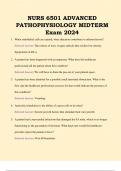
NURS 6501 ADVANCED
PATHOPHYSIOLOGY MIDTERM
Exam 2024
1. When endothelial cells are injured, what alteration contributes to atherosclerosis?
Selected Answer: The release of toxic oxygen radicals that oxidize low-density
lipoproteins (LDLs).
2. A patient has been diagnosed with an empyema. What does the healthcare
professional tell the patient about this condition?
Selected Answer: We will have to drain the pus out of your pleural space.
3. A patient has been admitted for a possible small intestinal obstruction. What is the
first sign the healthcare professional assesses for that would indicate the presence of
this condition?
Selected Answer: Vomiting.
4. Autocrine stimulation is the ability of cancer cells to do what?
Selected Answer: Secrete growth factors that stimulate their own growth.
5. A patient had a myocardial infarction that damaged the SA node, which is no longer
functioning as the pacemaker of the heart. What heart rate would the healthcare
provider expect the patient to have?
Selected Answer: 40 to 60 beats/min.
,6. Which type of immunity is produced by an individual after either natural exposure to
the antigen or after immunization against the antigen?
Selected Answer: Active-acquired immunity.
7. In teaching a women's community group, which risk factor does the healthcare
professional teach is related to high morbidity of cancer of the colon, uterus, and
kidney?
Selected Answer: Women who have a high body mass index.
8. A student asks the healthcare professional to describe exotoxins. Which statement by
the professional is best?
Selected Answer: Exotoxins are released during the lysis of bacteria.
9. A student studying biology asks the professor to describe how the ras gene is involved
in cancer proliferation. What explanation by the professor is best?
Selected Answer: A mutation in this gene allows continuous cell growth.
10. A healthcare professional cares for older adults in a skilled nursing facility. What
should the professional assess for in these individuals related to cardiovascular
functioning?
Selected Answer: Increased rate of falling and dizzy spells.
11. A healthcare professional is educating a patient on asthma. The professional tells the
patient that the most successful treatment for chronic asthma begins with which
, action?
Selected Answer: Avoidance of the causative agent.
12. A healthcare professional is conducting community education on vaccinations. Which
statement about vaccines does the professional include in the presentation?
Selected Answer: Most bacterial vaccines contain attenuated organisms.
13. Renal failure is the most common cause of which type of hyperparathyroidism?
Selected Answer: Secondary.
14. Which renal change is found in older adults?
Selected Answer: Decrease in the number of nephrons.
15. What is the single most common cause of cellular injury?
Selected Answer: Hypoxic injury.
16. What organic compound facilitates transportation across cell membranes by acting as
receptors, transport channels for electrolytes, and enzymes to drive active pumps?
Selected Answer: Proteins.
17. In regulating vascular mediators released from mast cells, the role of eosinophils is to
release what?
Selected Answer: Histaminase, which limits the effects of histamine during acute
inflammation.
18. A patient in the clinic reports projectile vomiting without nausea or other
gastrointestinal symptoms. What action by the healthcare professional is most
PATHOPHYSIOLOGY MIDTERM
Exam 2024
1. When endothelial cells are injured, what alteration contributes to atherosclerosis?
Selected Answer: The release of toxic oxygen radicals that oxidize low-density
lipoproteins (LDLs).
2. A patient has been diagnosed with an empyema. What does the healthcare
professional tell the patient about this condition?
Selected Answer: We will have to drain the pus out of your pleural space.
3. A patient has been admitted for a possible small intestinal obstruction. What is the
first sign the healthcare professional assesses for that would indicate the presence of
this condition?
Selected Answer: Vomiting.
4. Autocrine stimulation is the ability of cancer cells to do what?
Selected Answer: Secrete growth factors that stimulate their own growth.
5. A patient had a myocardial infarction that damaged the SA node, which is no longer
functioning as the pacemaker of the heart. What heart rate would the healthcare
provider expect the patient to have?
Selected Answer: 40 to 60 beats/min.
,6. Which type of immunity is produced by an individual after either natural exposure to
the antigen or after immunization against the antigen?
Selected Answer: Active-acquired immunity.
7. In teaching a women's community group, which risk factor does the healthcare
professional teach is related to high morbidity of cancer of the colon, uterus, and
kidney?
Selected Answer: Women who have a high body mass index.
8. A student asks the healthcare professional to describe exotoxins. Which statement by
the professional is best?
Selected Answer: Exotoxins are released during the lysis of bacteria.
9. A student studying biology asks the professor to describe how the ras gene is involved
in cancer proliferation. What explanation by the professor is best?
Selected Answer: A mutation in this gene allows continuous cell growth.
10. A healthcare professional cares for older adults in a skilled nursing facility. What
should the professional assess for in these individuals related to cardiovascular
functioning?
Selected Answer: Increased rate of falling and dizzy spells.
11. A healthcare professional is educating a patient on asthma. The professional tells the
patient that the most successful treatment for chronic asthma begins with which
, action?
Selected Answer: Avoidance of the causative agent.
12. A healthcare professional is conducting community education on vaccinations. Which
statement about vaccines does the professional include in the presentation?
Selected Answer: Most bacterial vaccines contain attenuated organisms.
13. Renal failure is the most common cause of which type of hyperparathyroidism?
Selected Answer: Secondary.
14. Which renal change is found in older adults?
Selected Answer: Decrease in the number of nephrons.
15. What is the single most common cause of cellular injury?
Selected Answer: Hypoxic injury.
16. What organic compound facilitates transportation across cell membranes by acting as
receptors, transport channels for electrolytes, and enzymes to drive active pumps?
Selected Answer: Proteins.
17. In regulating vascular mediators released from mast cells, the role of eosinophils is to
release what?
Selected Answer: Histaminase, which limits the effects of histamine during acute
inflammation.
18. A patient in the clinic reports projectile vomiting without nausea or other
gastrointestinal symptoms. What action by the healthcare professional is most