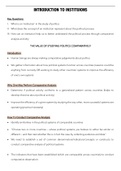
INTRODUCTION TO INSTITUIONS
Key Questions:
I. What is an ‘institution’ in the study of politics
II. What does the concept of an institution represent about the political process
III. How can an institution help us to better understand the political process through comparative
analysis and why
THE VALUE OF STUDYING POLITICS COMPARATIVELY
Introduction:
• Human beings are always making comparative judgements about politics
• We gather information about how political systems function across countries (reasons could be
anything from curiosity OR wanting to study other countries’ systems to improve the efficiency
of one’s own system)
Why One May Perform Comparative Analysis:
• Determine if political activity conforms to a generalized pattern across countries (helps to
develop theories about political activity)
• Improve the efficiency of a given system by studying the way other, more successful systems are
operating (practical necessity)
How To Conduct Comparative Analysis:
• Identify similarities in the political systems of comparable countries
• “Choose two or more countries – whose political systems you believe to either be similar or
different – and then test whether this is in fact the case by collecting evidence and data”
• We need to establish a set of common denominators/indicators/concepts or constructs to
conduct comparative analysis of political systems
• The indicators that have been established (which are comparable across countries) to conduct
comparative observation:
Key Questions:
I. What is an ‘institution’ in the study of politics
II. What does the concept of an institution represent about the political process
III. How can an institution help us to better understand the political process through comparative
analysis and why
THE VALUE OF STUDYING POLITICS COMPARATIVELY
Introduction:
• Human beings are always making comparative judgements about politics
• We gather information about how political systems function across countries (reasons could be
anything from curiosity OR wanting to study other countries’ systems to improve the efficiency
of one’s own system)
Why One May Perform Comparative Analysis:
• Determine if political activity conforms to a generalized pattern across countries (helps to
develop theories about political activity)
• Improve the efficiency of a given system by studying the way other, more successful systems are
operating (practical necessity)
How To Conduct Comparative Analysis:
• Identify similarities in the political systems of comparable countries
• “Choose two or more countries – whose political systems you believe to either be similar or
different – and then test whether this is in fact the case by collecting evidence and data”
• We need to establish a set of common denominators/indicators/concepts or constructs to
conduct comparative analysis of political systems
• The indicators that have been established (which are comparable across countries) to conduct
comparative observation: