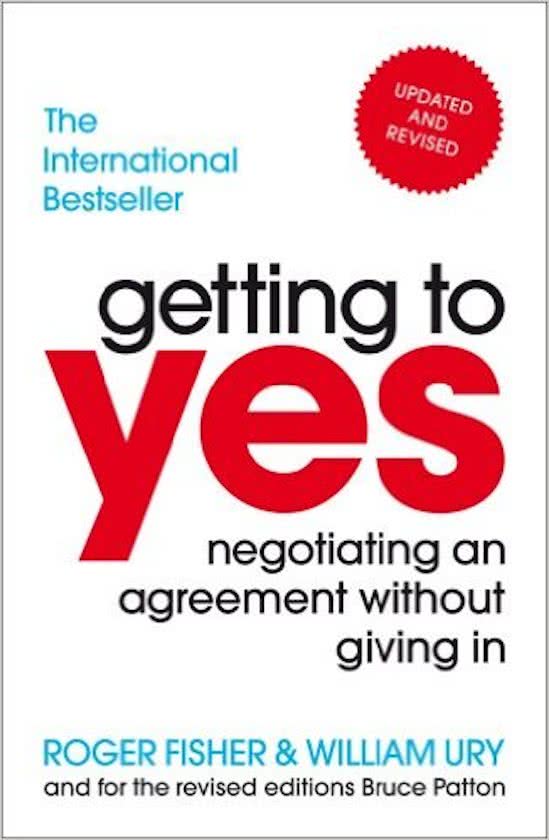
Managing negotiations: getting to yes
Inhoudsopgave
Lecture 1 – Introduction and essentials .......................................................................................................... 2
Lecture 2 – Game theoretic approach to negotiations .................................................................................... 4
Video 1 – Bargaining: The ultimatum game (discrete)....................................................................................... 7
Video 2 – Other solutions to the ultimatum game ............................................................................................. 7
Video 3 – Continuous ultimatum game .............................................................................................................. 8
Lecture 3 – Game theoretic approach to negotiations part 2 .......................................................................... 9
Lecture 4 – Slicing the pie ............................................................................................................................. 11
Lecture 5 – Expanding the pie ....................................................................................................................... 14
Lecture 6 – Principles of negotiation Part 1................................................................................................... 16
Lecture 7 – Principled negotiation part 2 ...................................................................................................... 18
Lecture 8 – Ethics and fairness in negotiations .............................................................................................. 21
Lecture 9 – Biases, Power, and gender.......................................................................................................... 24
Lecture 10 – Cultural aspects of negotiation ................................................................................................. 27
Lecture 11 – Cross cultural communication .................................................................................................. 30
Headlines
Key definitions
Key sentences/words
Examples
,Lecture 1 – Introduction and essentials
Definitions of negotiation
‘A process in which two or more parties exchange goods or services and attempt to agree
upon the exchange rate for them’ (Robbins, 2001)
More broad: ‘Negotiation is an interpersonal decision-making process necessary whenever
we cannot achieve our objectives single-handedly’ (Thompson, 2015)
Scope
One-on-one <> Multiparty
Few dollars <> Billions of dollars
Few minutes <> Years
Single encounter <> Long-term relationship
Single issue <> Multiple issues
Types
Between two/multiple persons: Salary negotiations, division of tasks within a team
Between two/multiple organizations: Mergers and acquisitions, joint ventures
Between two/multiple countries: Border-conflicts, EU negotiations (Brexit)
Between an organization and a social movement: Shell vs climate activists
Between an organization and a state: UN vs Israel
Single issue, distributive negotiation; one party’s gain is the other party’s loss
Target points, reservation points & bargaining zone
Target point/ aspiration point: Price you would be happy with
Reservation point: Price at which you are indifferent between getting the deal or not getting
the deal (worst acceptable outcome)
Bargaining zone/ zone of possible agreements: Range between reservation points of both
negotiators = where negotiations happen
How to determine aspiration point?
Determining target/aspiration point sounds straightforward, but three problems might arise:
1. Under aspiring negotiator: Settles for too low; often first offer accepted immediately
2. Overaspiring negotiator: Wants to settle for too high; refuses to make concessions
3. Grass is greener negotiator: Doesn’t know what s/he wants to settle for, only that
it’s more/different than what the other party is willing to offer (reactive)
,How to determine reservation point?
Before you start negotiating, you should determine your reservation point (price at which
you are indifferent between getting the deal or not getting the deal).
Consider the consequences of failing to reach an agreement and know your alternatives.
Determine your BATNA (Your Best Alternative To a Negotiated Agreement) and quantify it.
What is the purpose of a BATNA?
Your BATNA protects you against:
- Accepting an agreement, you should reject
- Rejecting an agreement, you should accept
Characteristics of the BATNA:
- Determines lowest value acceptable
- If you don’t reach agreement, settle for your BATNA
- Any deal higher than your BATNA is better than impasse
Be aware: BATNAs are time-sensitive
BATNA: Example selling a house
You want EUR 350.000 for the house (aspiration point)
What is the lowest offer that you would accept (reservation point)?
Think about your alternative if you don’t sell the house (by a certain time)?
- Rent it?
- Tear it down and sell the land?
- Keep the house on the market indefinitely?
BATNA: your best alternative to not selling the house
The better your BATNA, the greater your power!
Negotiation is not (directly) defined by:
- Wealth
- Political connections
- Physical strength
- Friends
- Military might
It is defined by: Your alternative (attractiveness of not reaching this specific agreement)
‘Falling in love’ – Rule
Never fall in love with one job, house, etc.
Always keep multiple options open
Constantly try to improve your BATNA
, Lecture 2 – Game theoretic approach to negotiations
Your BATNA should be based on facts
Your BATNA is not something that you wish for; it is determined by objective reality!
Don’t let your BATNA be influenced by the other party’s persuasion techniques
Of course, in real life you deal with:
- Incomplete information
- Uncertainty (e.g. unverifiable information)
- Multi-dimension agreements
What you can do in practice
1. Brainstorm your alternatives
2. Evaluate each alternative
3. Attempt to improve your BATNA
4. Determine your reservation price
BATNA of the other side
- Often, the aspiration point of the other is quite clear
- More important: what is their reservation price?
- Try to estimate the BATNA of the other side
- But: also, be modest about what you really know
What if the bargaining zone is very small?
You need very skilled negotiators!
Lose-Lose scenario
‘Trades would not take place unless it were advantageous to the parties concerned. Of
course, it is better to strike as good a bargain as one’s bargaining position permits.
The worst outcome is when, by overreaching greed, no bargain is struck, and a trade that
could have been advantageous to both parties does not come off at all’ (Benjamin Franklin)
What if the bargaining zone is negative?
No deal à Both parties will exercise their
BATNA
Inhoudsopgave
Lecture 1 – Introduction and essentials .......................................................................................................... 2
Lecture 2 – Game theoretic approach to negotiations .................................................................................... 4
Video 1 – Bargaining: The ultimatum game (discrete)....................................................................................... 7
Video 2 – Other solutions to the ultimatum game ............................................................................................. 7
Video 3 – Continuous ultimatum game .............................................................................................................. 8
Lecture 3 – Game theoretic approach to negotiations part 2 .......................................................................... 9
Lecture 4 – Slicing the pie ............................................................................................................................. 11
Lecture 5 – Expanding the pie ....................................................................................................................... 14
Lecture 6 – Principles of negotiation Part 1................................................................................................... 16
Lecture 7 – Principled negotiation part 2 ...................................................................................................... 18
Lecture 8 – Ethics and fairness in negotiations .............................................................................................. 21
Lecture 9 – Biases, Power, and gender.......................................................................................................... 24
Lecture 10 – Cultural aspects of negotiation ................................................................................................. 27
Lecture 11 – Cross cultural communication .................................................................................................. 30
Headlines
Key definitions
Key sentences/words
Examples
,Lecture 1 – Introduction and essentials
Definitions of negotiation
‘A process in which two or more parties exchange goods or services and attempt to agree
upon the exchange rate for them’ (Robbins, 2001)
More broad: ‘Negotiation is an interpersonal decision-making process necessary whenever
we cannot achieve our objectives single-handedly’ (Thompson, 2015)
Scope
One-on-one <> Multiparty
Few dollars <> Billions of dollars
Few minutes <> Years
Single encounter <> Long-term relationship
Single issue <> Multiple issues
Types
Between two/multiple persons: Salary negotiations, division of tasks within a team
Between two/multiple organizations: Mergers and acquisitions, joint ventures
Between two/multiple countries: Border-conflicts, EU negotiations (Brexit)
Between an organization and a social movement: Shell vs climate activists
Between an organization and a state: UN vs Israel
Single issue, distributive negotiation; one party’s gain is the other party’s loss
Target points, reservation points & bargaining zone
Target point/ aspiration point: Price you would be happy with
Reservation point: Price at which you are indifferent between getting the deal or not getting
the deal (worst acceptable outcome)
Bargaining zone/ zone of possible agreements: Range between reservation points of both
negotiators = where negotiations happen
How to determine aspiration point?
Determining target/aspiration point sounds straightforward, but three problems might arise:
1. Under aspiring negotiator: Settles for too low; often first offer accepted immediately
2. Overaspiring negotiator: Wants to settle for too high; refuses to make concessions
3. Grass is greener negotiator: Doesn’t know what s/he wants to settle for, only that
it’s more/different than what the other party is willing to offer (reactive)
,How to determine reservation point?
Before you start negotiating, you should determine your reservation point (price at which
you are indifferent between getting the deal or not getting the deal).
Consider the consequences of failing to reach an agreement and know your alternatives.
Determine your BATNA (Your Best Alternative To a Negotiated Agreement) and quantify it.
What is the purpose of a BATNA?
Your BATNA protects you against:
- Accepting an agreement, you should reject
- Rejecting an agreement, you should accept
Characteristics of the BATNA:
- Determines lowest value acceptable
- If you don’t reach agreement, settle for your BATNA
- Any deal higher than your BATNA is better than impasse
Be aware: BATNAs are time-sensitive
BATNA: Example selling a house
You want EUR 350.000 for the house (aspiration point)
What is the lowest offer that you would accept (reservation point)?
Think about your alternative if you don’t sell the house (by a certain time)?
- Rent it?
- Tear it down and sell the land?
- Keep the house on the market indefinitely?
BATNA: your best alternative to not selling the house
The better your BATNA, the greater your power!
Negotiation is not (directly) defined by:
- Wealth
- Political connections
- Physical strength
- Friends
- Military might
It is defined by: Your alternative (attractiveness of not reaching this specific agreement)
‘Falling in love’ – Rule
Never fall in love with one job, house, etc.
Always keep multiple options open
Constantly try to improve your BATNA
, Lecture 2 – Game theoretic approach to negotiations
Your BATNA should be based on facts
Your BATNA is not something that you wish for; it is determined by objective reality!
Don’t let your BATNA be influenced by the other party’s persuasion techniques
Of course, in real life you deal with:
- Incomplete information
- Uncertainty (e.g. unverifiable information)
- Multi-dimension agreements
What you can do in practice
1. Brainstorm your alternatives
2. Evaluate each alternative
3. Attempt to improve your BATNA
4. Determine your reservation price
BATNA of the other side
- Often, the aspiration point of the other is quite clear
- More important: what is their reservation price?
- Try to estimate the BATNA of the other side
- But: also, be modest about what you really know
What if the bargaining zone is very small?
You need very skilled negotiators!
Lose-Lose scenario
‘Trades would not take place unless it were advantageous to the parties concerned. Of
course, it is better to strike as good a bargain as one’s bargaining position permits.
The worst outcome is when, by overreaching greed, no bargain is struck, and a trade that
could have been advantageous to both parties does not come off at all’ (Benjamin Franklin)
What if the bargaining zone is negative?
No deal à Both parties will exercise their
BATNA