
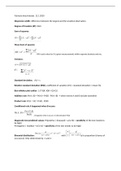
Formula sheet biostat. 12.1.2020
Dispersion width: difference between the largest and the smallest observation.
Degree of freedom (df) = N-1
Sum of squares:
Mean Sum of squares:
fill in each value for X (a given measurement) within separate brackets and mu.
Variance:
σ =√ n∗π (1− p)
S2 =
Standard deviation: √s2 = s
Relative standard deviation (RSD), coefficient of variation (CV) = standard deviation / mean (%).
Box-whisker plot outlier: 1.5*IQR. IQR = Q3-Q1
Addition rule: Pr(AB) = Pr(A) + Pr(B) - Pr(AB) -> when events A and B exclude eachother
Product rule: Pr(A B) = Pr(A) · Pr(B)
Conditional rule A happened when B occurs:
. B happens when A occurs: in denominator Pr(A)
Diagnostic test predicted values: Pr(positive | diseased) = a/(a+b) = sensitivity of the test (needs to
be high)
Pr(negative | healthy) = d/(c+d) = specificity of the test (needs to be high)
Binomial distribution: with pi is proportion (chance of
occurance). Only determined by n and π
, Poisson distribution 1: Use chi-squared test after poisson
2
σ
e is euler: 2,71828. When n is large (>15), use normal distribution. In poisson,
= µ. Correct with + of – 0.5
Goodness-of-fit/Chi-squared (table 5):
O = observed. E is expected value.
If calculated X2 is smaller than table 5, do not reject H0.
Normal distribution: Dependent on µ and variance.
Z-test: (table 2). If calculated Z is bigger than table 2 says, reject H0. Z is linear transformation
Z-transformation (Z-test)
Poisson distribution 2 McNemar. Comparison of 2 independent sample
with 2 means(table 2B)
| X 1−X 2|−1
Zc=
√ X 1+ X 2
1
Zc=| p1− p2|− ¿ ¿ The part in big brackets, only use when compare 1 sample/variable to a
2
statement/reference
Standard error of difference between two sample means:
Standard error for proportions:
Dispersion width: difference between the largest and the smallest observation.
Degree of freedom (df) = N-1
Sum of squares:
Mean Sum of squares:
fill in each value for X (a given measurement) within separate brackets and mu.
Variance:
σ =√ n∗π (1− p)
S2 =
Standard deviation: √s2 = s
Relative standard deviation (RSD), coefficient of variation (CV) = standard deviation / mean (%).
Box-whisker plot outlier: 1.5*IQR. IQR = Q3-Q1
Addition rule: Pr(AB) = Pr(A) + Pr(B) - Pr(AB) -> when events A and B exclude eachother
Product rule: Pr(A B) = Pr(A) · Pr(B)
Conditional rule A happened when B occurs:
. B happens when A occurs: in denominator Pr(A)
Diagnostic test predicted values: Pr(positive | diseased) = a/(a+b) = sensitivity of the test (needs to
be high)
Pr(negative | healthy) = d/(c+d) = specificity of the test (needs to be high)
Binomial distribution: with pi is proportion (chance of
occurance). Only determined by n and π
, Poisson distribution 1: Use chi-squared test after poisson
2
σ
e is euler: 2,71828. When n is large (>15), use normal distribution. In poisson,
= µ. Correct with + of – 0.5
Goodness-of-fit/Chi-squared (table 5):
O = observed. E is expected value.
If calculated X2 is smaller than table 5, do not reject H0.
Normal distribution: Dependent on µ and variance.
Z-test: (table 2). If calculated Z is bigger than table 2 says, reject H0. Z is linear transformation
Z-transformation (Z-test)
Poisson distribution 2 McNemar. Comparison of 2 independent sample
with 2 means(table 2B)
| X 1−X 2|−1
Zc=
√ X 1+ X 2
1
Zc=| p1− p2|− ¿ ¿ The part in big brackets, only use when compare 1 sample/variable to a
2
statement/reference
Standard error of difference between two sample means:
Standard error for proportions:


