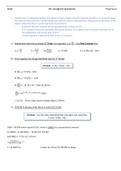
Date #1: Assigned Questions Your Name
1. Fluorine-18 is a radioactive isotope that decays to form oxygen-18 with a half-life of 1.83 hr. 18F is used to study
the brain by injecting fluoro-substituted glucose into the patient’s bloodstream. The glucose accumulates in the
regions where the brain is active and needs nourishment.
a) What is the rate constant for the decomposition of fluorine-18?
b) If a sample of glucose containing radioactive fluorine-18 is injected into the blood, what percent of
the radioactivity will remain after 5.59 h?
c) How long does it take for 99.99% of the 18F to decay?
𝑙𝑛2
a) Radioactive materials are always 1st Order. Use equation t1/2= 𝑘
. Find Rate Constant first:
𝑙𝑛2 ln(2) ln(2)
t1/2= k= 1 k= k = 0.378 k = 3.78 x 10⁻¹ 1/hr
𝑘 𝑡 1.83 ℎ𝑟
2
b) This requires the Integrated Rate Law for 1st Order:
Formula: ln [A]t = ln[A]0 - k(t)
ln [F]5.59 = ln [F]0 – k(t)
ln [F]5.59 – ln [F]0 = - k (t)
[F]
ln ([F]) = - (3.78 x 10⁻¹ 1/hr) (5.59 hr)
[F]
([F]) = e-(3.78 x 10⁻¹ 1/hr)(5.59 hr) x100
= 12.1% This is how much remains after 5.59 hrs
c) If 99.99 % decays, then there is only 0.01 % left:
Formula: Use the same Integrated Rate Law again, but need time
ln [A]t = ln[A]0 - k(t)
100% - 99.99% which equals 0.01%. which is 0.0001 in a concentration amount:
ln (100%) – ln (99.99%) = - (3.78 x 10⁻¹ 1/hr)(t)
ln(0.0001) = -3.78 x 10⁻¹ 1/hr (t)
ln(0.0001)
=t
−3.78 x 10⁻¹ 1/hr
t = 24.3659 hrs It takes 24.4 hours for 99.99% to decay.
, Date #1: Assigned Questions Your Name
2. The following reaction has the reaction coordinate diagram shown below. According to collision theory, what
conditions must be met in order for the forward reaction to occur? Explain energetic and geometric
requirements.
Since this pertains to collision theory, there are 2 main requirements:
1. The molecules need to have proper orientation when colliding
2. The molecules need enough energy to overcome the reaction barrier in
order to become a product.
This reaction barrier requires the molecules to successfully surmount
the activation barrier to actually become a product. Molecules may approach the
barrier many times but may not have enough energy to get over the barrier.
3. The production of ammonia via the Haber-Bosch process is an important industrial process. The Haber-Bosch
process follows the reaction: 𝑁2(𝑔)+3𝐻2(𝑔)→2𝑁𝐻3(𝑔)
a) Explain why we can say with certainty that the reaction occurs in multiple steps
b) The reaction is usually carried out in the presence of iron. Why do you think iron is including in the reaction chamber?
a) The reactants have 4 moles reacting, and the probability of all 4 molecules colliding successfully at the same
time is very low. They would need to collide at the same time, with the proper geometry, and the right energy,
and according to collision theory, this would be extremely improbable. There would need to be at least 2
elementary steps.
b) Iron is used as a catalyst in the reaction. This speeds up the reaction between nitrogen and hydrogen gases, and
this allows for the reaction to be carried out at a lower temperature. If this occurs, more molecules collide and
more product is formed.
4. You are studying the following reaction: 2NO(g)+2H2(g)⟶N2(g)+2H2O(g)
To study this reaction in the lab, you can monitor how the concentration of NO changes over time.
The following table shows the different conditions of the experiments you performed.
Experiment # Initial [NO] M Initial [H₂] M Temperature (K)
1 0.0060 0.0010 298
2 0.0060 0.0020 298
3 0.0010 0.0060 298
4 0.0020 0.0060 298
5 0.0060 0.0010 278
6 0.0060 0.0010 288
7 0.0060 0.0010 318
1. Fluorine-18 is a radioactive isotope that decays to form oxygen-18 with a half-life of 1.83 hr. 18F is used to study
the brain by injecting fluoro-substituted glucose into the patient’s bloodstream. The glucose accumulates in the
regions where the brain is active and needs nourishment.
a) What is the rate constant for the decomposition of fluorine-18?
b) If a sample of glucose containing radioactive fluorine-18 is injected into the blood, what percent of
the radioactivity will remain after 5.59 h?
c) How long does it take for 99.99% of the 18F to decay?
𝑙𝑛2
a) Radioactive materials are always 1st Order. Use equation t1/2= 𝑘
. Find Rate Constant first:
𝑙𝑛2 ln(2) ln(2)
t1/2= k= 1 k= k = 0.378 k = 3.78 x 10⁻¹ 1/hr
𝑘 𝑡 1.83 ℎ𝑟
2
b) This requires the Integrated Rate Law for 1st Order:
Formula: ln [A]t = ln[A]0 - k(t)
ln [F]5.59 = ln [F]0 – k(t)
ln [F]5.59 – ln [F]0 = - k (t)
[F]
ln ([F]) = - (3.78 x 10⁻¹ 1/hr) (5.59 hr)
[F]
([F]) = e-(3.78 x 10⁻¹ 1/hr)(5.59 hr) x100
= 12.1% This is how much remains after 5.59 hrs
c) If 99.99 % decays, then there is only 0.01 % left:
Formula: Use the same Integrated Rate Law again, but need time
ln [A]t = ln[A]0 - k(t)
100% - 99.99% which equals 0.01%. which is 0.0001 in a concentration amount:
ln (100%) – ln (99.99%) = - (3.78 x 10⁻¹ 1/hr)(t)
ln(0.0001) = -3.78 x 10⁻¹ 1/hr (t)
ln(0.0001)
=t
−3.78 x 10⁻¹ 1/hr
t = 24.3659 hrs It takes 24.4 hours for 99.99% to decay.
, Date #1: Assigned Questions Your Name
2. The following reaction has the reaction coordinate diagram shown below. According to collision theory, what
conditions must be met in order for the forward reaction to occur? Explain energetic and geometric
requirements.
Since this pertains to collision theory, there are 2 main requirements:
1. The molecules need to have proper orientation when colliding
2. The molecules need enough energy to overcome the reaction barrier in
order to become a product.
This reaction barrier requires the molecules to successfully surmount
the activation barrier to actually become a product. Molecules may approach the
barrier many times but may not have enough energy to get over the barrier.
3. The production of ammonia via the Haber-Bosch process is an important industrial process. The Haber-Bosch
process follows the reaction: 𝑁2(𝑔)+3𝐻2(𝑔)→2𝑁𝐻3(𝑔)
a) Explain why we can say with certainty that the reaction occurs in multiple steps
b) The reaction is usually carried out in the presence of iron. Why do you think iron is including in the reaction chamber?
a) The reactants have 4 moles reacting, and the probability of all 4 molecules colliding successfully at the same
time is very low. They would need to collide at the same time, with the proper geometry, and the right energy,
and according to collision theory, this would be extremely improbable. There would need to be at least 2
elementary steps.
b) Iron is used as a catalyst in the reaction. This speeds up the reaction between nitrogen and hydrogen gases, and
this allows for the reaction to be carried out at a lower temperature. If this occurs, more molecules collide and
more product is formed.
4. You are studying the following reaction: 2NO(g)+2H2(g)⟶N2(g)+2H2O(g)
To study this reaction in the lab, you can monitor how the concentration of NO changes over time.
The following table shows the different conditions of the experiments you performed.
Experiment # Initial [NO] M Initial [H₂] M Temperature (K)
1 0.0060 0.0010 298
2 0.0060 0.0020 298
3 0.0010 0.0060 298
4 0.0020 0.0060 298
5 0.0060 0.0010 278
6 0.0060 0.0010 288
7 0.0060 0.0010 318