
• ¿Documento equivocado? Cámbialo gratis
  • Escrito por estudiantes que aprobaron
  • Inmediatamente disponible después del pago
  • Leer en línea o como PDF
Vender
¿Dónde estudias?
Tu idioma
Document preview thumbnail
Vista previa 1 fuera de 4 páginas
Notas de lectura

Probabilty

Document preview thumbnail
Vista previa 1 fuera de 4 páginas

Master Probability and Counting Principles with comprehensive, colour-coordinated study notes designed to help Grade 12 Mathematics learners develop a strong understanding of probability concepts and their applications. These notes cover fundamental probability rules, mutually exclusive and independent events, complementary events, Venn diagrams, tree diagrams, the fundamental counting principle, factorial notation and permutations. Particular emphasis is placed on arrangements involving restrictions, identical elements, fixed positions and grouped objects. Clearly labelled diagrams, detailed explanations, highlighted formulas and step-by-step worked examples simplify complex concepts and demonstrate effective strategies for approaching challenging examination questions. Designed to strengthen logical reasoning, analytical thinking and problem-solving skills, these notes provide a structured and visually engaging approach to mastering probability and counting principles. Ideal for independent study, classroom revision and final examination preparation.

Vista previa del contenido

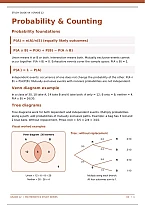
STUDY GUIDE 04 / GRADE 12


Probability & Counting
Probability foundations

P(A) = n(A)/n(S) (equally likely outcomes)


P(A ∪ B) = P(A) + P(B) − P(A ∩ B)

Union means A or B or both. Intersection means both. Mutually exclusive events cannot
occur together: P(A ∩ B) = 0. Exhaustive events cover the sample space: P(A ∪ B) = 1.


P(A′) = 1 − P(A)

Independent events: occurrence of one does not change the probability of the other. P(A ∩
B) = P(A)P(B). Mutually exclusive events with nonzero probabilities are not independent.

Venn diagram example
In a class of 30, 18 take A, 14 take B and 6 take both. A only = 12; B only = 8; neither = 4.
P(A ∪ B) = 26/30.

Tree diagrams
Tree diagrams work for both dependent and independent events. Multiply probabilities
along a path; add probabilities of mutually exclusive paths. Example: a bag has 3 red and
2 blue balls. Without replacement, P(two red) = 3/5 × 2/4 = 3/10.

Visual worked examples

Venn diagram | 30 learners Tree | without replacement

A B 2/4 R 3/10
R
3/5
2/4 B 3/10
12 6 8

3/4 R 3/10
2/5

4 B
1/4 B 1/10

Union = 12 + 6 + 8 = 26 Multiply along each branch.
Neither = 30 - 26 = 4 All four outcomes sum to 1.


GRADE 12 / MATHEMATICS STUDY SERIES 04 • 1

Información del documento

Schooljaar
202
Subido en
26 de noviembre de 2026
Número de páginas
4
Escrito en
2026/2027
Tipo
Notas de lectura
Profesor(es)
Miss smith
Contiene
Todas las clases
$4.75

¿Documento equivocado? Cámbialo gratis Dentro de los 14 días posteriores a la compra y antes de descargarlo, puedes elegir otro documento. Puedes gastar el importe de nuevo.
Escrito por estudiantes que aprobaron
Inmediatamente disponible después del pago
Leer en línea o como PDF

Vendido
0
Seguidores
0
Artículos
12
Última venta
-


Por qué los estudiantes eligen Stuvia

Creado por compañeros estudiantes, verificado por reseñas

Calidad en la que puedes confiar: escrito por estudiantes que aprobaron y evaluado por otros que han usado estos resúmenes.

¿No estás satisfecho? Elige otro documento

¡No te preocupes! Puedes elegir directamente otro documento que se ajuste mejor a lo que buscas.

Paga como quieras, empieza a estudiar al instante

Sin suscripción, sin compromisos. Paga como estés acostumbrado con tarjeta de crédito y descarga tu documento PDF inmediatamente.

Student with book image

“Comprado, descargado y aprobado. Así de fácil puede ser.”

Alisha Student

Preguntas frecuentes
