NURS615 Advanced Pharmacotherapuetics Exam I Study Guide
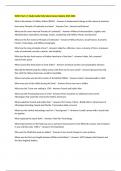
1. Identify the stages of drug development and how the drugs are tested at each phase. Pg. 33 Phase 1: (establish biological effects as well as safe dosages and pharmacokinetics in small numbers of health patients-p. 12). Testing of a new compound in health subjects, for the purpose of establishing the tolerance of health human subjects at different doses, defining its pharmacological effects at anticipated therapeutic levels, and studying its absorption, distribution, metabolism, and excretion patterns in humans. Phase 2: Controlled clinical evaluation is done on patients with a specific disease or disorder to determine the medications possible uses and short term risks. Usually the study is conducted on only several hundred subjects or less. Phase 3: Controlled and uncontrolled clinical trials of a drug’s safety and efficacy in hospital and outpatient settings. Gather precise information on drugs efficacy for specific indications to determine if there is a wider range of adverse effects on those that it did in a small study. They try to identify what way the drug is best administered (PO,IV,IM).If the drug is approved this information forms what goes on the drug label. Phase 3 solidifies phase 2. 2. Differentiate between the prescribing of medications by physicians, nurses, and physician’s assistants. PAGES 4, 6, 7, 8 Physicians can prescribe prescriptions as long as they have a current license; must have a DEA for narcotics-schedule l & ll and they must follow the rules and regs of their states medical board. Nurses cannot prescribe prescriptions unless they are a licensed APRN and have prescriptive authority-must follow their state laws-each state varies; APRN’s must have a DEA for prescribing narcotics. Physician assistants can prescribe as long as they have a currentlicense/work under a physician and have a DEA for narcotics and follow their states prescribing rules. Research has shown that adherence is better for prescriptions given by NPs, as they have a holistic approach in care and educate their patients. All states have title protection. Depending upon state, practice may be autonomous in prescriptive authority. NPs have their own DEA number and most states permit schedules II to V prescribing. PAs have title protection in all states. Depending upon state, some have limits by protocol created by the supervising physician. Some states permit PA prescribing of schedule III to V drugs. Practice oversight or supervision must be present by physician. Pas often have their own DEA number with wide scope of practice that is defined by their supervising physician. 3. What factors are associated with clinical judgment when prescribing medications? Pg 25-26 Evidenced-based guidelines are the gold standard for initial drug selection, but providers need to examine the drugs recommended in the guideline for their clinical utility with the individual patient. The provider must consider several factors regarding the drug and the patient who will be receiving the medications: pharmacokinetics, pharmacodynamics, therapeutic issues, safety, and cost. Pharmacodynamic factors of a drug must be specific and selective to the target tissues affected by the disease to have the greatest therapeutic effect with the least adverse effects. The relationship between the drugs desired therapeutic effects and its adverse effects is called its therapeutic index. Drugs with the low therapeutic index may require close monitoring for toxicity and versus facts, where drugs with a wide therapeutic index are fairly safe and require less monitoring. Pharmacodynamics means the study of the effects of the drug on the body. Pharmacokinetic factors. This is how the body reacts to the drug. It is the study and analysis ofthe time course of the drug in the body. How well are the drugs absorbed and eliminated? 3.)therapeutic factors 4.)safety 5.)Cost 6.) patient factors 7.) adverse drug reactions 8.) Provider factors
Escuela, estudio y materia
- Institución
- NURS615 Advanced Pharmacotherapuetics Exam I Study Guide
- Grado
- NURS615 Advanced Pharmacotherapuetics Exam I Study Guide
Información del documento
- Subido en
- 4 de octubre de 2021
- Número de páginas
- 26
- Escrito en
- 2020/2021
- Tipo
- OTRO
- Personaje
- Desconocido
Temas
- nurs615
-
nurs615 advanced pharmacotherapuetics exam i study guide