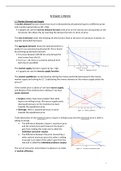
BJ Chapter 1: Markets
1.1 Market Demand and Supply
A market demand function shows how much is demanded by all potential buyers at different prices
and is written generically as Qd = D(p).
• In graphs we use the inverse demand function with price on the vertical axis and quantity on the
horizontal. We obtain this by rewriting the demand function in terms of price.
The law of demand states that keeping all other factors fixed as the price of a product increases, its
quantity demanded decreases
The aggregate demand shows the total demand for a
product in an economy/country/world. This is found
by summing up demand functions.
• For prices between $45-60 the only demand for
steel comes from the US.
• For 0 ≤ p < 45, there is a positive demand from
both the US and ROW.
The market supply function is given by Qs = S(p)
• In graphs we use the inverse supply function
The market equilibrium can be found by setting the inverse world demand equal to the inverse
market supply and solving for Q*. Substituting the inverse demand or the inverse supply yields the
price p*.
If the market price is above p* we have excess supply,
and likewise if the market price is below p* we have
excess demand.
• Surplus: sellers have more product than what
buyers are willing to buy, this excess supply exerts
downward pressure on the market price back
towards the equilibrium price.
• Shortage: there is upwards pressure on price
towards the equilibrium price.
Trade takes place at the maximum price a buyer is willing to pay and the minimum price a seller is
willing to accept.
• The difference between a buyer’s maximum price
and the actual price paid measures the buyer’s
gain from making this trade and is called the
individual consumer surplus.
• The difference between the price received by a
seller and the minimum price this seller is willing
to accept is an index of the seller’s gain from the
sale and is called the individual producer surplus.
The sum of consumer and producer surpluses is an index
of market efficiency.
1
,1.2 Determinants of Demand and Supply
The market demand for any product depends on several variables including:
a) the income levels of potential buyers
b) the prices of other goods
c) the tastes or preferences of buyers
d) the number of buyers
A positive income effect occurs when an increase in the income levels of buyers leads to an increase
in demand — these are normal goods.
A negative income effect occurs when demand decreases — these are inferior goods.
The demand for a product depends on the prices of related goods: substitutes and complements.
An increase in the price of a substitute good would make consumers buy more of the good since it is
now cheaper. An increase in the price of a complement is likely to cause a decrease in the demand
for this product.
On the supply side, the market supply for any product primarily depends on:
a) the prices of inputs that go into producing the good
b) the technology that underlies the production process
c) the number of firms
1.3 Market Interventions
These take place at either the local, state or federal levels.
1.3.1 Price Ceilings
A price ceiling (or price cap) is a maximum price imposed on a
particular product.
• Example: the price per unit of electricity.
A price ceiling is set below the equilibrium market price. At this price
there is excess demand i.e., more buyers who are willing to buy than
there are sellers willing to sell.
• This creates a market disequilibrium since some demand is
not fulfilled. With efficient rationing, buyers are allocated
the good by highest willingness to pay.
Area C shows the decrease in the gains from trade as a result of the
ceiling and is called the deadweight loss of a price ceiling. This is
an indication of market inefficiency.
1.3.2 Price floors
A price floor (or price support) is a minimum price imposed on a
particular product.
• Example: the price of certain agricultural goods cannot fall
below a particular price level.
A price support is set above the equilibrium price. This also results
in a market disequilibrium (excess supply).
2
, 1.3.3 Quotas
A quota is a maximum limit imposed on a particular product, i.e.,
the producers collectively cannot sell more than the quantity
specified by the quota. Quotas are often imposed on imported
items.
The inverse demand becomes veritical at the quota. This creates a
new equilibrium and increases the price of the product. This also
creates a market inefficiency because consumer surplus is reduced
and we have dead weight loss.
A quota is set below the market equilibrium quantity.
1.3.4 Taxes
Taxes may be either per-unit or ad valorem, and imposed on either sellers or buyers.
• A per-unit tax is a fixed dollar amount for each unit to be paid by the responsible party.
• An ad valorem tax is a tax on the value of a sale, such as a 10 percent sales tax.
A per-unit tax on sellers
A per-unit tax on sellers shifts the supply curve rightward. The
slope remains unchanged:
A per-unit tax creates a tax incidence on both consumers and
producers because not the entire tax can be passed onto
consumers. The total incidence must add up to the tax.
• Consumer tax incidence is reflected in the price change
A per-unit tax on buyers
A per-unit tax on buyers shifts the supply curve leftwards. The
slope remains unchanged.
• This tax is not reflected in the price change.
• There is still a tax-incidence on both consumers and producers.
1.3.5 Subsidies
A subsidy is a negative tax, i.e. the government pays the individual
buyer or seller.
Here the incidence of the subsidy is $4 on buyers (they pay $10
after the subsidy instead of $14) and $2 on sellers (sellers receive
$10 from each unit sold plus $6 from the subsidy for a total of $16,
as opposed to $14 before the subsidy).
• Consumer surplus increases to A ($98)
• Producer surplus increases to B ($49)
• This surplus (A + B = $147) does not include the cost of the
subsidy to the government ($6 X 14 = $84)
• Subtracting the costs from A + B we obtain $63
3
1.1 Market Demand and Supply
A market demand function shows how much is demanded by all potential buyers at different prices
and is written generically as Qd = D(p).
• In graphs we use the inverse demand function with price on the vertical axis and quantity on the
horizontal. We obtain this by rewriting the demand function in terms of price.
The law of demand states that keeping all other factors fixed as the price of a product increases, its
quantity demanded decreases
The aggregate demand shows the total demand for a
product in an economy/country/world. This is found
by summing up demand functions.
• For prices between $45-60 the only demand for
steel comes from the US.
• For 0 ≤ p < 45, there is a positive demand from
both the US and ROW.
The market supply function is given by Qs = S(p)
• In graphs we use the inverse supply function
The market equilibrium can be found by setting the inverse world demand equal to the inverse
market supply and solving for Q*. Substituting the inverse demand or the inverse supply yields the
price p*.
If the market price is above p* we have excess supply,
and likewise if the market price is below p* we have
excess demand.
• Surplus: sellers have more product than what
buyers are willing to buy, this excess supply exerts
downward pressure on the market price back
towards the equilibrium price.
• Shortage: there is upwards pressure on price
towards the equilibrium price.
Trade takes place at the maximum price a buyer is willing to pay and the minimum price a seller is
willing to accept.
• The difference between a buyer’s maximum price
and the actual price paid measures the buyer’s
gain from making this trade and is called the
individual consumer surplus.
• The difference between the price received by a
seller and the minimum price this seller is willing
to accept is an index of the seller’s gain from the
sale and is called the individual producer surplus.
The sum of consumer and producer surpluses is an index
of market efficiency.
1
,1.2 Determinants of Demand and Supply
The market demand for any product depends on several variables including:
a) the income levels of potential buyers
b) the prices of other goods
c) the tastes or preferences of buyers
d) the number of buyers
A positive income effect occurs when an increase in the income levels of buyers leads to an increase
in demand — these are normal goods.
A negative income effect occurs when demand decreases — these are inferior goods.
The demand for a product depends on the prices of related goods: substitutes and complements.
An increase in the price of a substitute good would make consumers buy more of the good since it is
now cheaper. An increase in the price of a complement is likely to cause a decrease in the demand
for this product.
On the supply side, the market supply for any product primarily depends on:
a) the prices of inputs that go into producing the good
b) the technology that underlies the production process
c) the number of firms
1.3 Market Interventions
These take place at either the local, state or federal levels.
1.3.1 Price Ceilings
A price ceiling (or price cap) is a maximum price imposed on a
particular product.
• Example: the price per unit of electricity.
A price ceiling is set below the equilibrium market price. At this price
there is excess demand i.e., more buyers who are willing to buy than
there are sellers willing to sell.
• This creates a market disequilibrium since some demand is
not fulfilled. With efficient rationing, buyers are allocated
the good by highest willingness to pay.
Area C shows the decrease in the gains from trade as a result of the
ceiling and is called the deadweight loss of a price ceiling. This is
an indication of market inefficiency.
1.3.2 Price floors
A price floor (or price support) is a minimum price imposed on a
particular product.
• Example: the price of certain agricultural goods cannot fall
below a particular price level.
A price support is set above the equilibrium price. This also results
in a market disequilibrium (excess supply).
2
, 1.3.3 Quotas
A quota is a maximum limit imposed on a particular product, i.e.,
the producers collectively cannot sell more than the quantity
specified by the quota. Quotas are often imposed on imported
items.
The inverse demand becomes veritical at the quota. This creates a
new equilibrium and increases the price of the product. This also
creates a market inefficiency because consumer surplus is reduced
and we have dead weight loss.
A quota is set below the market equilibrium quantity.
1.3.4 Taxes
Taxes may be either per-unit or ad valorem, and imposed on either sellers or buyers.
• A per-unit tax is a fixed dollar amount for each unit to be paid by the responsible party.
• An ad valorem tax is a tax on the value of a sale, such as a 10 percent sales tax.
A per-unit tax on sellers
A per-unit tax on sellers shifts the supply curve rightward. The
slope remains unchanged:
A per-unit tax creates a tax incidence on both consumers and
producers because not the entire tax can be passed onto
consumers. The total incidence must add up to the tax.
• Consumer tax incidence is reflected in the price change
A per-unit tax on buyers
A per-unit tax on buyers shifts the supply curve leftwards. The
slope remains unchanged.
• This tax is not reflected in the price change.
• There is still a tax-incidence on both consumers and producers.
1.3.5 Subsidies
A subsidy is a negative tax, i.e. the government pays the individual
buyer or seller.
Here the incidence of the subsidy is $4 on buyers (they pay $10
after the subsidy instead of $14) and $2 on sellers (sellers receive
$10 from each unit sold plus $6 from the subsidy for a total of $16,
as opposed to $14 before the subsidy).
• Consumer surplus increases to A ($98)
• Producer surplus increases to B ($49)
• This surplus (A + B = $147) does not include the cost of the
subsidy to the government ($6 X 14 = $84)
• Subtracting the costs from A + B we obtain $63
3