Lecture 1: Energy, Elements, Atoms & Bonding
Energy
- kinetic: movement, heat
- potential: energy possessed due to position
the higher up you are, the more potential energy you have
chemical energy is form of potential energy
- metabolism: sum of all building up & breaking down chemical reactions in the body
- anabolism: building up molecules
- catabolism: breaking down molecules
Elements
substance that can’t be broken down to other substances in chemical reactions
- about 25/92 are essential to life with C, H, N & O making up 96% of living matter
17/92 essential to plant life
- most of organism’s remaining weight made of P, S, Ca & K with trace elements like Fe & I
phosphorous found in DNA and bones
sulphur found in amino acids where it forms disulphide bridges essential for protein structure
calcium found in bones & teeth
potassium is key for cell signalling in nervous system
iron found in haemoglobin
iodine key for thyroid hormones
Atoms
- smallest unit of matter still retaining an element’s properties
- made up of negative electrons, positive protons and neutral neutrons
electrons move very fast around nucleus in clouds
no. of protons = no. of electrons
nucleus is extremely tiny
- chemistry of atom determined by no. of electrons
- atomic mass is measured in daltons
mass of protons & neutrons = 1.66x10⁻²⁴
- atomic number: no. of protons
- atomic mass: sum mass of all subatomic particles
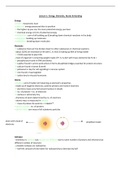
atom with cloud of simplified model
electrons
Isotopes
- chemistry is identical but masses are different due to same number of protons and electrons but
different number of neutrons
- unstable isotopes are radioactive
half-life: amount of time taken for radioactivity to decrease by half
, - s orbitals are spherical
1s orbital closest to nucleus
- p orbitals have a dumbbell shape
there are 3 p orbitals at each
Atomic Orbitals
energy level that hold 6 electrons
- region in atom that can hold up to two electrons with opposite spins
with 2 electrons in each one
- filled orbitals more stable than unfilled
- elements try lose or gain electrons to fill orbitals and become more stable
- valence electrons: electrons directly involved in chemical reactions to form bonds
Compounds
- substance made of two or more elements in fixed ratio
table salt (NaCl) made of equal numbers of Na and Cl atoms
Covalent Bonds
- sharing of electrons between two atoms
- non-polar covalent bond = equal sharing of electrons e.g. H2
- polar covalent bonds = inequal sharing of electrons e.g. O-H bond in H2O
electronegativity: measure of the tendency of an atom to attract a bonding pair of electrons
polar covalent bond stronger than regular covalent bonds
in polar covalent bond, element that’s more electronegative is given a partial negative charge
(δ−) and less electronegative element given partial positive charge (δ+)
Hydrogen Bonds
- molecules with polar bonds
can only form in a H-F bond, H-O bond or H-N bond as they are the most electronegative
elements
- weak compared to covalent & ionic bonds however when paired with one of them, they’re very
strong together
e.g. DNA structure held by H bonds
Ionic Bonds
- when two atoms with different attractions for valence electrons come together forming a crystal
very strong ~700kJ/mole
sodium:
1s2, 2s2, 2p6, 3s1 1s2, 2s2, 2p6, 3s1
chlorine:
1s2, 2s2, 2p6, 3s2, 3p5 1s2, 2s2, 2p6, 3s2, 3p6
= Na+
= Cl -
Van Der Waal’s Forces
- interaction between electron clouds forming δ− and δ+ which are attracted to each other
- very weak ~0.5kJ/mole but collectively strong
- short range
, Lecture 2: Water, Concentration, Equilibrium Constants, pH
Formation of Water Molecule
- oxygen more electronegative than hydrogen so hydrogen ends
up with a δ+ and oxygen with a δ−
due to this, water molecules can interact with each other &
form H bonds
unequal electron sharing leads to V shape
- two H atoms form single polar covalent bonds with O atom
Electron Orbitals in Water
3
1S 2S 2P 1 sp hybrid
O s p orbitals
H - both hydrogens share their 1s electron with oxygen’s 2p sub shells
forms covalent bond
- electronic configuration of water is sp3 hybridised
H sp3 hybridised is the mixing of one s orbital and three p orbitals having nearly
the same energy to form four equal orbitals
sp3 hybridised orbitals repel each other and are directed to four corners of a
tetrahedral
Water Molecule Shape
- has a V shape
- electrons repel as much as they can forming tetrahedral shape with 109.5°
however, lone pair is closer to central atom nucleus so repels more than bonding pair reducing
bond angle to 104.5°
Water & Hydrogen Bonding
- higher boiling point:
water is liquid at room temperature and has a very high boiling point compared to molecules with
similar molecular masses
H bonds in water require a lot of energy to break
- higher cohesion & adhesion:
water molecules can H bond with each and with surfaces
important for plants as water can travel from the roots to the leaves against gravity
- higher heat of vaporisation:
energy required to convert 1g of water from liquid to gas at 25℃
high for water (2424J) so lots of energy needed to go from liquid to gas
when water turns to gas, highest energy molecules leave as gases cooling the rest of the water
molecules e.g. sweat cooling
Energy
- kinetic: movement, heat
- potential: energy possessed due to position
the higher up you are, the more potential energy you have
chemical energy is form of potential energy
- metabolism: sum of all building up & breaking down chemical reactions in the body
- anabolism: building up molecules
- catabolism: breaking down molecules
Elements
substance that can’t be broken down to other substances in chemical reactions
- about 25/92 are essential to life with C, H, N & O making up 96% of living matter
17/92 essential to plant life
- most of organism’s remaining weight made of P, S, Ca & K with trace elements like Fe & I
phosphorous found in DNA and bones
sulphur found in amino acids where it forms disulphide bridges essential for protein structure
calcium found in bones & teeth
potassium is key for cell signalling in nervous system
iron found in haemoglobin
iodine key for thyroid hormones
Atoms
- smallest unit of matter still retaining an element’s properties
- made up of negative electrons, positive protons and neutral neutrons
electrons move very fast around nucleus in clouds
no. of protons = no. of electrons
nucleus is extremely tiny
- chemistry of atom determined by no. of electrons
- atomic mass is measured in daltons
mass of protons & neutrons = 1.66x10⁻²⁴
- atomic number: no. of protons
- atomic mass: sum mass of all subatomic particles
atom with cloud of simplified model
electrons
Isotopes
- chemistry is identical but masses are different due to same number of protons and electrons but
different number of neutrons
- unstable isotopes are radioactive
half-life: amount of time taken for radioactivity to decrease by half
, - s orbitals are spherical
1s orbital closest to nucleus
- p orbitals have a dumbbell shape
there are 3 p orbitals at each
Atomic Orbitals
energy level that hold 6 electrons
- region in atom that can hold up to two electrons with opposite spins
with 2 electrons in each one
- filled orbitals more stable than unfilled
- elements try lose or gain electrons to fill orbitals and become more stable
- valence electrons: electrons directly involved in chemical reactions to form bonds
Compounds
- substance made of two or more elements in fixed ratio
table salt (NaCl) made of equal numbers of Na and Cl atoms
Covalent Bonds
- sharing of electrons between two atoms
- non-polar covalent bond = equal sharing of electrons e.g. H2
- polar covalent bonds = inequal sharing of electrons e.g. O-H bond in H2O
electronegativity: measure of the tendency of an atom to attract a bonding pair of electrons
polar covalent bond stronger than regular covalent bonds
in polar covalent bond, element that’s more electronegative is given a partial negative charge
(δ−) and less electronegative element given partial positive charge (δ+)
Hydrogen Bonds
- molecules with polar bonds
can only form in a H-F bond, H-O bond or H-N bond as they are the most electronegative
elements
- weak compared to covalent & ionic bonds however when paired with one of them, they’re very
strong together
e.g. DNA structure held by H bonds
Ionic Bonds
- when two atoms with different attractions for valence electrons come together forming a crystal
very strong ~700kJ/mole
sodium:
1s2, 2s2, 2p6, 3s1 1s2, 2s2, 2p6, 3s1
chlorine:
1s2, 2s2, 2p6, 3s2, 3p5 1s2, 2s2, 2p6, 3s2, 3p6
= Na+
= Cl -
Van Der Waal’s Forces
- interaction between electron clouds forming δ− and δ+ which are attracted to each other
- very weak ~0.5kJ/mole but collectively strong
- short range
, Lecture 2: Water, Concentration, Equilibrium Constants, pH
Formation of Water Molecule
- oxygen more electronegative than hydrogen so hydrogen ends
up with a δ+ and oxygen with a δ−
due to this, water molecules can interact with each other &
form H bonds
unequal electron sharing leads to V shape
- two H atoms form single polar covalent bonds with O atom
Electron Orbitals in Water
3
1S 2S 2P 1 sp hybrid
O s p orbitals
H - both hydrogens share their 1s electron with oxygen’s 2p sub shells
forms covalent bond
- electronic configuration of water is sp3 hybridised
H sp3 hybridised is the mixing of one s orbital and three p orbitals having nearly
the same energy to form four equal orbitals
sp3 hybridised orbitals repel each other and are directed to four corners of a
tetrahedral
Water Molecule Shape
- has a V shape
- electrons repel as much as they can forming tetrahedral shape with 109.5°
however, lone pair is closer to central atom nucleus so repels more than bonding pair reducing
bond angle to 104.5°
Water & Hydrogen Bonding
- higher boiling point:
water is liquid at room temperature and has a very high boiling point compared to molecules with
similar molecular masses
H bonds in water require a lot of energy to break
- higher cohesion & adhesion:
water molecules can H bond with each and with surfaces
important for plants as water can travel from the roots to the leaves against gravity
- higher heat of vaporisation:
energy required to convert 1g of water from liquid to gas at 25℃
high for water (2424J) so lots of energy needed to go from liquid to gas
when water turns to gas, highest energy molecules leave as gases cooling the rest of the water
molecules e.g. sweat cooling