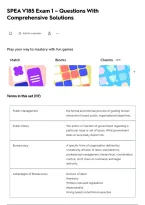
SPEA V185 Exam 1 – Questions With
Comprehensive Solutions
Add to calendar
Play your way to mastery with fun games
Match Blocks Charms NEW
Terms in this set (117)
Public Management the formal and informal process of guiding human
interaction toward public organizational objectives.
Public Policy The action or inaction of government regarding a
particular issue or set of issues. What government
does or purposely doesn't do.
Bureaucracy A specific form of organization defined by
complexity, division of labor, permanence,
professional management, hierarchical, coordination
control, strict chain of command, and legal
authority.
Advantages of Bureaucracy Division of labor
Hierarchy
Written rules and regulations
impersonality
Hiring based on technical expertise
,Disadvantages of Bureaucracy Division of labor
Hierarchy
Written rules and regulations
Impersonality
Hiring Based on technical expertise
politics-administration dichotomy Study of public administration as a neutral
instrument distinct from policy and politics.
Progressive era time at the turn of the 20th century in which groups
sought to reform America economically, socially,
and politically
How of the U.S. Bureaucracy grown Americans originally distrustful of large central
and developed over time? government after gaining independence. Only three
cabinet level departments. Very narrow functions in
regards to collection of revenues, maintaining
military, etc. The spoils system was in place until
President Garfield's assassination's. Government
came into a larger role due to more land and
growing population. Civil War resulted in more
federal agencies. People's attitudes changed
towards business which ended in calling for more
regulation of businesses. 1913 establishment of
income tax provides a basis for funding a large
sophisticated bureaucracy.
1930s great depression resulted in new deal
programs.
Social welfare became socially acceptable.
1940s to 1960s President Johnson's war on poverty.
(also a need to build technologically advanced
society)
Polarchys Government controls means of production and
relies heavily on coercive mechanisms of command
and control based on central.
, Markets Buyers and sellers particpate voluntary, prices
determined based on amount that people willing to
pay.
Producers try to sell highest quality for lowest price.
Advantages and Disadvantages of Advantages:
Markets - Creates competing prices so people get the best
product possible.
- Builds a strong economy
Disadvantage:
- Market failures (can't produce public goods)
Advantages of Disadvantages of Advantages:
Polarcys - Can produce public goods
- US has perfect system because we have both
Disadvantages:
- Hierarchical system creates inefficiency.
Public Goods definition Something government provides that benefits
everyone.
Characteristics of public goods non-rival and non-excludable
How do public and public Public organizations are risk aversive.
organizations differ in their risk Public organizations don't feel need to take risks
tasking because there's no incentive to make a profit like
there is in a public organization
What is free-rider? Collective action problem that arises when people
receive a public good without paying.