es10/27/2026,
P CHEM 10/27/2026,
Kinetics_
3:41:20
Notes@#&&*#&()&(*&)*$*)($*)*@($*(*@)$(*@$(&(*$$(&*$($2ZOIZHxh-2Page
4:25:30
AM~~~~~~())))))))))))))(@)(*@U*(Unit
AMUnit 3 AP CHEM Kinetics_ Notes10/27/2026,
3 AP CHEM Kinetics_
3:41:20
Notes@#&&*#&()&(*&)*$*)($*)*@($*(*@)$(*@$(&(*$$(&*$($2ZOIZHxh-2Page
AM~~~~~~())))))))))))))(@)(*@U*(Unit
1 of 5Unit 3 AP CHEM Kinetics_
3 AP Notes.pdf10/27/2026,
CHEM Kinetics_ Notes@#&&*#&()&(*&)*$*
3:41:39 AM
1 of 5Unit 3
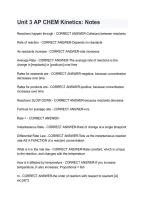
Unit 3 AP CHEM Kinetics: Notes
Reactions happen through - CORRECT ANSWER-Collisions between reactants
Rate of reaction - CORRECT ANSWER-Depends on reactants
As reactants increase - CORRECT ANSWER-rate increases
Average Rate - CORRECT ANSWER-The average rate of reactions is the
change in [reactants] or [products] over time
Rates for reactants are - CORRECT ANSWER-negative, because concentration
decreases over time
Rates for products are - CORRECT ANSWER-positive, because concentration
increases over time
Reactions SLOW DOWN - CORRECT ANSWER-because reactants decrease
Formula for average rate - CORRECT ANSWER-m/s
Rate = - CORRECT ANSWER-
Instantaneous Rate - CORRECT ANSWER-Rate of change at a single timepoint
Differential Rate Law - CORRECT ANSWER-Tells us the instantaneous reaction
rate AS A FUNCTION of a reactant concentration
What is k in the rate law - CORRECT ANSWER-Rate constant, which is unique
to the reaction, and changes with the temperature
How is k affected by temperature - CORRECT ANSWER-If you increase
temperature, K also increases. Proportional = fish
m - CORRECT ANSWER-the order of reaction with respect to reactant [A]
ex) [A]^2
es10/27/2026,
P CHEM 10/27/2026,
Kinetics_
3:41:20
Notes@#&&*#&()&(*&)*$*)($*)*@($*(*@)$(*@$(&(*$$(&*$($2ZOIZHxh-2Page
4:25:30
AM~~~~~~())))))))))))))(@)(*@U*(Unit
AMUnit 3 AP CHEM Kinetics_ Notes10/27/2026,
3 AP CHEM Kinetics_
3:41:20
Notes@#&&*#&()&(*&)*$*)($*)*@($*(*@)$(*@$(&(*$$(&*$($2ZOIZHxh-2Page
AM~~~~~~())))))))))))))(@)(*@U*(Unit
1 of 5Unit 3 AP CHEM Kinetics_
3 AP Notes.pdf10/27/2026,
CHEM Kinetics_ Notes@#&&*#&()&(*&)*$*
3:41:39 AM
1 of 5Unit 3
,es10/27/2026,
P CHEM 10/27/2026,
Kinetics_
3:41:20
Notes@#&&*#&()&(*&)*$*)($*)*@($*(*@)$(*@$(&(*$$(&*$($2ZOIZHxh-2Page
4:25:30
AM~~~~~~())))))))))))))(@)(*@U*(Unit
AMUnit 3 AP CHEM Kinetics_ Notes10/27/2026,
3 AP CHEM Kinetics_
3:41:20
Notes@#&&*#&()&(*&)*$*)($*)*@($*(*@)$(*@$(&(*$$(&*$($2ZOIZHxh-2Page
AM~~~~~~())))))))))))))(@)(*@U*(Unit
2 of 5Unit 3 AP CHEM Kinetics_
3 AP Notes.pdf10/27/2026,
CHEM Kinetics_ Notes@#&&*#&()&(*&)*$*
3:41:39 AM
2 of 5Unit 3
n - CORRECT ANSWER-the order of reaction with respect to reactant [B]
ex) [B]^1
m + n - CORRECT ANSWER-the OVERALL order of reaction.
Rate constant is determined by - CORRECT ANSWER-The activation energy of
a reaction
To find the value of K - CORRECT ANSWER-plug in a data set from the initial
rate data and solve for k.
Integrated Rate Law - CORRECT ANSWER-Tells us the concentration (of the
reactant) as a function of time.
- this is determined graphically
Zero Order Reaction Int. Rate Law - CORRECT ANSWER-[A] = -kt + [A]ₒ
-k = slope
Zero Order reaction REGULAR rate law - CORRECT ANSWER-Rate = k[A]ₒ
Units of K in a ZERO order reaction - CORRECT ANSWER-Ms⁻¹
Half life of ZERO order reaction - CORRECT ANSWER-t₁/₂ = [A]ₒ/ 2k
1st Order Reaction rate law - CORRECT ANSWER-Rate = k[A]
1st order INTEGRATED Rate Law - CORRECT ANSWER-Ln[A] = -kt + Ln[A]ₒ
-k = slope
Units of K for FIRST Order - CORRECT ANSWER-s⁻¹
Half life of 1st order reaction - CORRECT ANSWER-t₁/₂ = 0.693/ k
2nd Order rate law - CORRECT ANSWER-rate = k[A]²
2nd order INTEGRATED Rate Law - CORRECT ANSWER-1/[A] = kt + 1/[A]ₒ
es10/27/2026,
P CHEM 10/27/2026,
Kinetics_
3:41:20
Notes@#&&*#&()&(*&)*$*)($*)*@($*(*@)$(*@$(&(*$$(&*$($2ZOIZHxh-2Page
4:25:30
AM~~~~~~())))))))))))))(@)(*@U*(Unit
AMUnit 3 AP CHEM Kinetics_ Notes10/27/2026,
3 AP CHEM Kinetics_
3:41:20
Notes@#&&*#&()&(*&)*$*)($*)*@($*(*@)$(*@$(&(*$$(&*$($2ZOIZHxh-2Page
AM~~~~~~())))))))))))))(@)(*@U*(Unit
2 of 5Unit 3 AP CHEM Kinetics_
3 AP Notes.pdf10/27/2026,
CHEM Kinetics_ Notes@#&&*#&()&(*&)*$*
3:41:39 AM
2 of 5Unit 3
P CHEM 10/27/2026,
Kinetics_
3:41:20
Notes@#&&*#&()&(*&)*$*)($*)*@($*(*@)$(*@$(&(*$$(&*$($2ZOIZHxh-2Page
4:25:30
AM~~~~~~())))))))))))))(@)(*@U*(Unit
AMUnit 3 AP CHEM Kinetics_ Notes10/27/2026,
3 AP CHEM Kinetics_
3:41:20
Notes@#&&*#&()&(*&)*$*)($*)*@($*(*@)$(*@$(&(*$$(&*$($2ZOIZHxh-2Page
AM~~~~~~())))))))))))))(@)(*@U*(Unit
1 of 5Unit 3 AP CHEM Kinetics_
3 AP Notes.pdf10/27/2026,
CHEM Kinetics_ Notes@#&&*#&()&(*&)*$*
3:41:39 AM
1 of 5Unit 3
Unit 3 AP CHEM Kinetics: Notes
Reactions happen through - CORRECT ANSWER-Collisions between reactants
Rate of reaction - CORRECT ANSWER-Depends on reactants
As reactants increase - CORRECT ANSWER-rate increases
Average Rate - CORRECT ANSWER-The average rate of reactions is the
change in [reactants] or [products] over time
Rates for reactants are - CORRECT ANSWER-negative, because concentration
decreases over time
Rates for products are - CORRECT ANSWER-positive, because concentration
increases over time
Reactions SLOW DOWN - CORRECT ANSWER-because reactants decrease
Formula for average rate - CORRECT ANSWER-m/s
Rate = - CORRECT ANSWER-
Instantaneous Rate - CORRECT ANSWER-Rate of change at a single timepoint
Differential Rate Law - CORRECT ANSWER-Tells us the instantaneous reaction
rate AS A FUNCTION of a reactant concentration
What is k in the rate law - CORRECT ANSWER-Rate constant, which is unique
to the reaction, and changes with the temperature
How is k affected by temperature - CORRECT ANSWER-If you increase
temperature, K also increases. Proportional = fish
m - CORRECT ANSWER-the order of reaction with respect to reactant [A]
ex) [A]^2
es10/27/2026,
P CHEM 10/27/2026,
Kinetics_
3:41:20
Notes@#&&*#&()&(*&)*$*)($*)*@($*(*@)$(*@$(&(*$$(&*$($2ZOIZHxh-2Page
4:25:30
AM~~~~~~())))))))))))))(@)(*@U*(Unit
AMUnit 3 AP CHEM Kinetics_ Notes10/27/2026,
3 AP CHEM Kinetics_
3:41:20
Notes@#&&*#&()&(*&)*$*)($*)*@($*(*@)$(*@$(&(*$$(&*$($2ZOIZHxh-2Page
AM~~~~~~())))))))))))))(@)(*@U*(Unit
1 of 5Unit 3 AP CHEM Kinetics_
3 AP Notes.pdf10/27/2026,
CHEM Kinetics_ Notes@#&&*#&()&(*&)*$*
3:41:39 AM
1 of 5Unit 3
,es10/27/2026,
P CHEM 10/27/2026,
Kinetics_
3:41:20
Notes@#&&*#&()&(*&)*$*)($*)*@($*(*@)$(*@$(&(*$$(&*$($2ZOIZHxh-2Page
4:25:30
AM~~~~~~())))))))))))))(@)(*@U*(Unit
AMUnit 3 AP CHEM Kinetics_ Notes10/27/2026,
3 AP CHEM Kinetics_
3:41:20
Notes@#&&*#&()&(*&)*$*)($*)*@($*(*@)$(*@$(&(*$$(&*$($2ZOIZHxh-2Page
AM~~~~~~())))))))))))))(@)(*@U*(Unit
2 of 5Unit 3 AP CHEM Kinetics_
3 AP Notes.pdf10/27/2026,
CHEM Kinetics_ Notes@#&&*#&()&(*&)*$*
3:41:39 AM
2 of 5Unit 3
n - CORRECT ANSWER-the order of reaction with respect to reactant [B]
ex) [B]^1
m + n - CORRECT ANSWER-the OVERALL order of reaction.
Rate constant is determined by - CORRECT ANSWER-The activation energy of
a reaction
To find the value of K - CORRECT ANSWER-plug in a data set from the initial
rate data and solve for k.
Integrated Rate Law - CORRECT ANSWER-Tells us the concentration (of the
reactant) as a function of time.
- this is determined graphically
Zero Order Reaction Int. Rate Law - CORRECT ANSWER-[A] = -kt + [A]ₒ
-k = slope
Zero Order reaction REGULAR rate law - CORRECT ANSWER-Rate = k[A]ₒ
Units of K in a ZERO order reaction - CORRECT ANSWER-Ms⁻¹
Half life of ZERO order reaction - CORRECT ANSWER-t₁/₂ = [A]ₒ/ 2k
1st Order Reaction rate law - CORRECT ANSWER-Rate = k[A]
1st order INTEGRATED Rate Law - CORRECT ANSWER-Ln[A] = -kt + Ln[A]ₒ
-k = slope
Units of K for FIRST Order - CORRECT ANSWER-s⁻¹
Half life of 1st order reaction - CORRECT ANSWER-t₁/₂ = 0.693/ k
2nd Order rate law - CORRECT ANSWER-rate = k[A]²
2nd order INTEGRATED Rate Law - CORRECT ANSWER-1/[A] = kt + 1/[A]ₒ
es10/27/2026,
P CHEM 10/27/2026,
Kinetics_
3:41:20
Notes@#&&*#&()&(*&)*$*)($*)*@($*(*@)$(*@$(&(*$$(&*$($2ZOIZHxh-2Page
4:25:30
AM~~~~~~())))))))))))))(@)(*@U*(Unit
AMUnit 3 AP CHEM Kinetics_ Notes10/27/2026,
3 AP CHEM Kinetics_
3:41:20
Notes@#&&*#&()&(*&)*$*)($*)*@($*(*@)$(*@$(&(*$$(&*$($2ZOIZHxh-2Page
AM~~~~~~())))))))))))))(@)(*@U*(Unit
2 of 5Unit 3 AP CHEM Kinetics_
3 AP Notes.pdf10/27/2026,
CHEM Kinetics_ Notes@#&&*#&()&(*&)*$*
3:41:39 AM
2 of 5Unit 3