
Florida Security Guard Certification Exam
Florida Security Guard Certification Exam
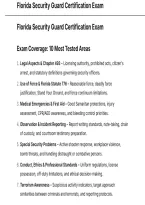
Exam Coverage: 10 Most Tested Areas
1. Legal Aspects & Chapter 493 – Licensing authority, prohibited acts, citizen's
arrest, and statutory definitions governing security officers.
2. Use of Force & Florida Statute 776 – Reasonable force, deadly force
justification, Stand Your Ground, and force continuum limitations.
3. Medical Emergencies & First Aid – Good Samaritan protections, injury
assessment, CPR/AED awareness, and bleeding control priorities.
4. Observation & Incident Reporting – Report writing standards, note-taking, chain
of custody, and courtroom testimony preparation.
5. Special Security Problems – Active shooter response, workplace violence,
bomb threats, and handling distraught or combative persons.
6. Conduct, Ethics & Professional Standards – Uniform regulations, license
possession, off-duty limitations, and ethical decision-making.
7. Terrorism Awareness – Suspicious activity indicators, target approach
similarities between criminals and terrorists, and reporting protocols.
, 8. Access Control & Physical Security – Visitor verification, trespass procedures,
perimeter control, and identification checks.
9. Patrol Procedures & Safety – Patrol types, hazard recognition, personal safety,
and vehicle versus foot patrol considerations.
10. Communications & Emergency Preparedness – Radio protocol, de-escalation,
evacuation procedures, and coordination with law enforcement.
Florida Security Guard Certification Exam
250 Multiple-Choice Questions with Answers and Rationales
1. Under Florida law, a security officer who observes a person committing a
forcible felony in their presence may exercise citizen's arrest authority primarily
because the officer is acting in which legal capacity?
A. A sworn law enforcement deputy with statewide jurisdiction
B. A private citizen authorized to detain for offenses committed in their presence
C. A federal protective service agent with limited authority
D. A licensed bail bond agent pursuing a fugitive
Answer: B
Rationale: Florida security officers are not law enforcement officers and possess
,no police powers; their detention authority derives from the same citizen's arrest
statute available to private persons, limited to felonies or breaches of the peace
committed in their presence . 4 9
2. A Class D security officer is on duty at a retail plaza when a shopkeeper asks
them to physically remove a trespasser who refuses to leave. Which action best
complies with Florida legal limitations on security officer authority?
A. Physically dragging the person off the property without further warning
B. Asking the person to leave, documenting the refusal, and contacting law
enforcement for trespass enforcement
C. Threatening arrest and placing the person in handcuffs until police arrive
D. Locking the person inside a stockroom to prevent escape
Answer: B
Rationale: Security officers should request departure, document the refusal, and
involve law enforcement rather than physically removing individuals, because
excessive force or false imprisonment creates criminal and civil liability for the
officer and employer . 10
3. According to Florida's Stand Your Ground provisions, a security officer who is
not engaged in unlawful activity and is attacked in a place they have a right to
be:
, A. Must retreat to the nearest safe location before using any force
B. Has no duty to retreat and may use force, including deadly force, if reasonably
necessary to prevent death or great bodily harm
C. May only use force after being physically struck first
D. Must call 911 and wait for law enforcement before acting
Answer: B
Rationale: Florida law removes any duty to retreat for persons lawfully present
who reasonably believe force is necessary to prevent death or great bodily harm,
and this protection extends to security officers acting within their lawful duties . 9
4. A security officer witnesses an individual conceal merchandise and walk past
all points of sale without paying. What is the officer's most legally defensible
initial course of action?
A. Immediately tackle the suspect to recover the merchandise
B. Observe and document the incident, then report to management or the
supervisor for appropriate follow-up
C. Block the exit and demand payment while displaying handcuffs
D. Pursue the suspect into the parking lot while shouting "stop or I'll shoot"
Answer: B
Rationale: The primary role of a security officer is to observe and report rather
Florida Security Guard Certification Exam
Exam Coverage: 10 Most Tested Areas
1. Legal Aspects & Chapter 493 – Licensing authority, prohibited acts, citizen's
arrest, and statutory definitions governing security officers.
2. Use of Force & Florida Statute 776 – Reasonable force, deadly force
justification, Stand Your Ground, and force continuum limitations.
3. Medical Emergencies & First Aid – Good Samaritan protections, injury
assessment, CPR/AED awareness, and bleeding control priorities.
4. Observation & Incident Reporting – Report writing standards, note-taking, chain
of custody, and courtroom testimony preparation.
5. Special Security Problems – Active shooter response, workplace violence,
bomb threats, and handling distraught or combative persons.
6. Conduct, Ethics & Professional Standards – Uniform regulations, license
possession, off-duty limitations, and ethical decision-making.
7. Terrorism Awareness – Suspicious activity indicators, target approach
similarities between criminals and terrorists, and reporting protocols.
, 8. Access Control & Physical Security – Visitor verification, trespass procedures,
perimeter control, and identification checks.
9. Patrol Procedures & Safety – Patrol types, hazard recognition, personal safety,
and vehicle versus foot patrol considerations.
10. Communications & Emergency Preparedness – Radio protocol, de-escalation,
evacuation procedures, and coordination with law enforcement.
Florida Security Guard Certification Exam
250 Multiple-Choice Questions with Answers and Rationales
1. Under Florida law, a security officer who observes a person committing a
forcible felony in their presence may exercise citizen's arrest authority primarily
because the officer is acting in which legal capacity?
A. A sworn law enforcement deputy with statewide jurisdiction
B. A private citizen authorized to detain for offenses committed in their presence
C. A federal protective service agent with limited authority
D. A licensed bail bond agent pursuing a fugitive
Answer: B
Rationale: Florida security officers are not law enforcement officers and possess
,no police powers; their detention authority derives from the same citizen's arrest
statute available to private persons, limited to felonies or breaches of the peace
committed in their presence . 4 9
2. A Class D security officer is on duty at a retail plaza when a shopkeeper asks
them to physically remove a trespasser who refuses to leave. Which action best
complies with Florida legal limitations on security officer authority?
A. Physically dragging the person off the property without further warning
B. Asking the person to leave, documenting the refusal, and contacting law
enforcement for trespass enforcement
C. Threatening arrest and placing the person in handcuffs until police arrive
D. Locking the person inside a stockroom to prevent escape
Answer: B
Rationale: Security officers should request departure, document the refusal, and
involve law enforcement rather than physically removing individuals, because
excessive force or false imprisonment creates criminal and civil liability for the
officer and employer . 10
3. According to Florida's Stand Your Ground provisions, a security officer who is
not engaged in unlawful activity and is attacked in a place they have a right to
be:
, A. Must retreat to the nearest safe location before using any force
B. Has no duty to retreat and may use force, including deadly force, if reasonably
necessary to prevent death or great bodily harm
C. May only use force after being physically struck first
D. Must call 911 and wait for law enforcement before acting
Answer: B
Rationale: Florida law removes any duty to retreat for persons lawfully present
who reasonably believe force is necessary to prevent death or great bodily harm,
and this protection extends to security officers acting within their lawful duties . 9
4. A security officer witnesses an individual conceal merchandise and walk past
all points of sale without paying. What is the officer's most legally defensible
initial course of action?
A. Immediately tackle the suspect to recover the merchandise
B. Observe and document the incident, then report to management or the
supervisor for appropriate follow-up
C. Block the exit and demand payment while displaying handcuffs
D. Pursue the suspect into the parking lot while shouting "stop or I'll shoot"
Answer: B
Rationale: The primary role of a security officer is to observe and report rather

