
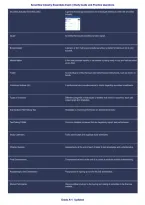
Securities Industry Essentials Exam | Study Guide and Practice Questions
Securities Industry Essentials (SIE) A general knowledge examination for individuals seeking to enter the securities
industry.
Issuer An entity that issues securities to raise capital.
Broker-Dealer A person or firm that buys and sells securities on behalf of clients or for its own
account.
Market Maker A firm that provides liquidity in the market by being ready to buy and sell securities
at any time.
Trader An individual or entity that buys and sells financial instruments, such as stocks or
bonds.
Investment Adviser (IA) A professional who provides advice to clients regarding securities investments.
Types of Investors Different categories of individuals or entities that invest in securities, each with
unique goals and strategies.
Standardized Test-Taking Tips Strategies to improve performance on standardized tests.
Test-Taking Pitfalls Common mistakes or issues that can negatively impact test performance.
Study Calendars Tools used to plan and organize study schedules.
Chapter Quizzes Assessments at the end of each chapter to test knowledge and understanding.
Final Examinations Comprehensive tests at the end of a course to evaluate overall understanding.
Registering for the Examination The process of signing up to take the SIE examination.
Market Participants Various entities involved in the buying and selling of securities in the financial
markets.
Grade A+ | Updated
, Securities Industry Essentials Exam | Study Guide and Practice Questions
Course Materials Resources provided for studying and preparing for the SIE examination.
Online Study Manual A digital version of the study manual that is updated in real-time.
Print Study Manual A physical version of the study manual provided to students.
Disclaimer A statement that clarifies the limitations and conditions of the study materials.
Copyright Legal protection for the published materials, preventing unauthorized reproduction.
Customer Service Support provided to students for inquiries and assistance.
Keyword Search A method to quickly find specific information in a document using a search function.
Control + F A keyboard shortcut used to open the search function in most applications.
Command + F A keyboard shortcut used to open the search function on Mac computers.
Retail Investors Individual investors who buy and sell securities for their personal accounts.
Accredited Investors Individuals or entities that meet specific financial criteria set by regulators, allowing
them to invest in certain high-risk investments.
Institutional Investors Organizations that invest large sums of money on behalf of clients, such as pension
funds, insurance companies, and mutual funds.
Market Structure The organization and functioning of a market, including the rules and systems that
govern trading.
Primary Market The market where new securities are issued and sold for the first time.
Secondary Market The market where previously issued securities are bought and sold among
investors.
Grade A+ | Updated
, Securities Industry Essentials Exam | Study Guide and Practice Questions
Other Execution Methods and Venues Alternative ways and platforms through which securities can be traded outside of
traditional exchanges.
Clearing and Settlement The process of reconciling buy and sell orders and transferring ownership of
securities after a trade.
The Depository Trust & Clearing Corporation (DTCC) A financial services company that provides clearing and settlement services for
securities transactions.
Processing the Trade The steps involved in completing a trade, including clearing and introducing firms.
Introducing Firms Firms that facilitate trades for clients and may use either fully disclosed or omnibus
accounts.
Fully Disclosed Versus Omnibus Accounts Types of accounts used by introducing firms; fully disclosed accounts provide
detailed client information, while omnibus accounts aggregate client transactions.
Other Customers of Clearing Firms Entities or individuals that utilize the services of clearing firms for trade processing.
Clearing Options Contracts The process of managing and settling trades involving options contracts.
Other Entities That Keep Markets Running Smoothly Organizations that support market operations, ensuring liquidity and stability.
Conclusion The final summary or closing remarks of a document or discussion.
Chapter 1 Summary A brief overview of the key points covered in Chapter 1.
Complete a Chapter 1 Quiz An assessment to test understanding of the material covered in Chapter 1.
Chapter 2 - Overview of Regulation An introduction to the regulatory framework governing financial markets.
Grade A+ | Updated
, Securities Industry Essentials Exam | Study Guide and Practice Questions
Regulation Rules and laws established to govern financial markets and protect investors.
Federal Regulation Regulatory oversight provided by federal agencies to ensure compliance with laws.
Other Federal Regulators Additional federal agencies that oversee various aspects of the financial markets.
SRO Regulation Regulation enforced by self-regulatory organizations that oversee industry
practices.
State (Blue-Sky) Regulation State laws designed to protect investors from fraudulent securities offerings.
Firm (In-House) Rules Internal policies and procedures established by a firm to govern its operations.
Why Take the SIE Exam? A rationale for taking the Securities Industry Essentials Exam, which assesses basic
knowledge of the securities industry.
Federal Regulation - The Acts Key legislative acts that govern the securities industry.
The Securities Act of 1933 A federal law requiring the disclosure of financial information to investors during the
sale of securities.
The Securities Exchange Act of 1934 A federal law regulating the trading of securities in the secondary market.
The Maloney Act of 1938 Legislation that allowed for the creation of self-regulatory organizations in the
securities industry.
The Investment Advisers Act of 1940 A law that regulates investment advisers and requires them to register with the
SEC.
Securities Investor Protection Act of 1970 (SIPA)
Grade A+ | Updated

