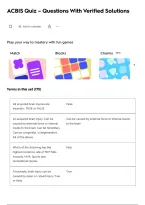
ACBIS Quiz – Questions With Verified Solutions
Add to calendar
Play your way to mastery with fun games
Match Blocks Charms NEW
Terms in this set (175)
All acquired brain injuries are False
traumatic. TRUE or FALSE
An acquired brain injury: Can be Can be caused by external force or internal insults
caused by external force or internal to the brain
insults to the brain. Can be hereditary.
Can be congenital. Is degenerative.
All of the above.
Which of the following has the Falls
highest incidence rate of TBI? Falls.
Assaults. MVA. Sports and
recreational injuries.
A traumatic brain injury can be True
caused by open or closed injury. True
or false
,A non traumatic insult can be caused Stroke, anoxia, tumors, All of the above
by: Stroke. Anoxia. Tumors. All of the
above.
Mortality from seizures is how many 22
times more likely after TBI? 29. 22. 4.
2.5.
If a person has one brain injury how 3
many times more likely that they will
have another one? 3. 8. 15. No more
likely.
The increase of TBI rates of men over 40% to 20%
women is: 20% to 40%. 75% to 20%.
40% to 20%. 50% to 10%.
Examples of TBI are all of the Stroke
following except: Concussion.
Gunshot wound. Stroke. Diffuse
exanol injury.
LOC stands for which of the Loss of consciousness
following: Level of care. Loss of
consciousness. Locus of control.
Location of cognition.
What is the age group that has the 10-19
highest number of sports related
TBIs? 0-5. 5-10. 10-19. 19-35.
Women that have experienced True
domestic violence have a rate of 67%
that also suffer a TBI. True or false
What is the leading cause of brain Blast injury
injury in the military? Blast injury.
Gunshot wounds. MVA. Falls.
,Which of the following is not a MPAI-4
screening tool? ACE. MPAI - 4.
IMPACT. TBIQ.
CARF stands for: Center for Commission on Accreditation of Rehabilitation
accreditation in rehabilitation Facilities
facilities. Certification of accreditation
and rehabilitation facilities.
Commission on accreditation for
rehabilitation facilities. Central agency
for rehabilitation facility.
The total annual cost for all people False
with brain injury is 152 million. True or
false
The Olmstead decision was an Challenged government to develop cost effective,
important ruling because: Allowed community based services for ppl with disabilities
patients access to their medical
records. Increased access to service
by backing the patient and affordable
care act. Establish the patient bill of
rights. Challenge government to
develop cost-effective community
base services for people with
disabilities.
The TBI Act of 1996 is the single most Funds advocacy programs
important because it gave authority
for all of the following except: The
CDC to establish project to prevent
TBI. Funds advocacy programs.
Through the NIH awards grants for
research and treatment. HRSA makes
grants available for state to carry out
demonstration projects, and
statewide act access to services.
, What is the average decrease in life 7 years
expectancy after TBI? No different
than the general population. 1 year. 7
years. 10+ years.
Results of a CT scan do not typically True
show consequences of PPCS and are
usually not used in treatment
planning. true or false.
Once it is determined a person is Early treatment
stable what type of intervention is the
most effective way to address a
mTBI? Hyperbaric treatment. Early
treatment. Neurological testing.
Cognitive rehabilitation.
Chronic Traumatic Encephalopathy A progressive condition typically seen from
(CTE) is: A form of dementia. A repetitive brain trauma
progressive condition typically seen
from repetitive brain trauma. A
condition only athletes develop. Is a
degenerative condition of the brain
and spinal cord. Is easily detected by
an MRI.
What percentage of TBIs are mTBIs? 75%
15%. 25%. 50%. 75%.
Which of the following symptoms are Increased Energy
not usually associated with mTBI?
Fatigue. Headaches. Changes in
balance. Increased energy.
Components of Central Nervous brain and spinal cord
System include: Dura mater,
arachnoid, Pia Mater. Axon, dendrite,
synapse. Brain and spinal cord.
Serotonin, dopamine, norepinephrine