
Unit 1- Systems Architecture
Topic 1- Architecture of the CPU
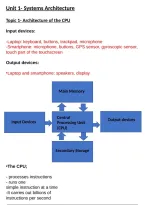
Input devices:
-Laptop: keyboard, buttons, trackpad, microphone
-Smartphone: microphone, buttons, GPS sensor, gyroscopic sensor,
touch part of the touchscreen
Output devices:
•Laptop and smartphone: speakers, display
Main Memory
Central
Input Devices Output devices
Processing Unit
(CPU)
Secondary Storage
•The CPU;
- processes instructions
- runs one
simple instruction at a time
-It carries out billions of
instructions per second
,Vonn Neumann Architecture
-Program instructions and the data the programs are using are both stored in
the same memory
-The CPU accesses both instructions and data from the
same RAM
The CPU has two major components;
-Control Unit
-Arithmetic-Logic Unit (ALU)
-There are also registers that are used to carry out these operations;
-A register is a very fast memory location in the CPU itself.
-Cache is located on the CPU – it is slower to access than registers but faster
than RAM.
Registers in the CPU;
-Program Counter (PC) -holds the address of the next instruction to
be executed
-Memory Address Register (MAR)-holds the memory address of the
current instruction, and then the data that it uses, so that these can be
fetched from memory
-Memory Data Register (MDR)-holds the actual instruction, and then
the data that has been fetched from memory
-Accumulator-holds the result of an instruction before it is transferred
to memory
Control unit;
-coordinates and controls all of the activities taking place within the
CPU
-It decodes instructions and executes them
-It receives signals from the system clock
-It directs the timing and control of other parts of the CPU
,The Arithmetic Logic Unit(ALU) carries out logical operations.
Fetch-Decode- Execute cycle;
-The CPU operates by repeating three operations:
-FETCH – causes the next instruction and any data involved to be fetched
from main memory
-DECODE – decodes the instruction
-EXECUTE – the instruction is executed
-This process is then repeated
Program Counter(PC);
-holds the address of the next instruction to be executed
-is incremented (increased by 1) as soon as that instruction has been
fetched
Accumulator(ACC);
-where arithmetic and logic results are temporarily stored
MAR and MDR;
-In the FETCH stage of the F-E cycle, the address of the instruction to be
executed is copied from the PC to the MAR
-The instruction at that address is fetched from memory and copied to the
MDR
-The Control Unit decodes the instruction and decides if data needs to be
fetched
-If so, the MAR is then used to hold the address of the data to be used in
the instruction
-The data is fetched and copied to the MDR
, Topic 2- CPU Performance
Factors affecting CPU performance;
-Clock speed- cycles per second measures in hertz (Hz)
-Cache size- memory on the CPU that is faster than RAM but slower than
registers
-Number of cores- number of duplicate processing units(cores) in one CPU
Clock Speed;
-Everything in a computer happens on the pulse of the internal clock
-The faster the clock speed, the faster instructions are processed
Processor Speed;
•One cycle per second = 1 hertz (Hz) = 1 instruction carried out each second
•1 kilohertz (kHz) = 1000 cycles per second
•1 Megahertz (MHz) = 1,000,000 cycles per second
•1 Gigahertz (GHz) = 1,000,000,000 cycles per second
Multi-core Processors;
-A dual-core processor has two processors in the same integrated circuit,
linked together
-It has the potential to perform two instructions at the same time
-This allows twice as many instructions to be executed, however, it doesn’t
always perform at this rate as software may not be able to take full advantage
of both cores
-A quad-core processor has four linked processors
-A quad-core processor working on many different tasks simultaneously,
under ideal conditions can be up to four times faster than a single-core
processor
-If the computer is running a single program, it is not necessarily any faster,
since the program may have been designed to only run on one core

