
NUA 5950 Chapter Chapter 15 - Neurological System : Rockhurst University
Chapter 15 - Neurological System
1. Anatomy and Physiology Review
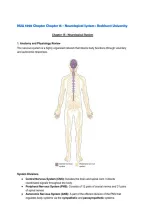
The nervous system is a highly organized network that directs body functions through voluntary
and autonomic responses.
System Divisions
● Central Nervous System (CNS): Includes the brain and spinal cord; it directs
coordinated signals throughout the body.
● Peripheral Nervous System (PNS): Consists of 12 pairs of cranial nerves and 31 pairs
of spinal nerves.
● Autonomic Nervous System (ANS): A part of the efferent division of the PNS that
regulates body systems via the sympathetic and parasympathetic systems.
, Nervous Tissue and Communication
● Neurons: The functional units of the system, composed of a cell body (metabolic
center), dendrites (conduct impulses toward the cell body), and a single axon (conducts
impulses away).
● Supporting Cells: Provide protection and metabolic support; they form the myelin
sheath which acts as insulation for nerve impulses .
● Synapses: Gaps where neurons communicate.
○ Chemical synapses (most common) use neurotransmitters for unidirectional
conduction.
○ Electrical synapses allow current to travel in either direction.
Protective Structures
The CNS is shielded by the skull (cranium), meninges (protective connective sheaths), and
cerebrospinal fluid (CSF), which allows the brain and cord to float.
2. Brain and Spinal Cord Structures
The Brain
● Cerebrum: Divided into two hemispheres (right controls left body, left controls right).
○ Frontal Lobe: Voluntary motor movement, judgment, and personality.
○ Parietal Lobe: Sensory function and interpretation (pain, pressure,
proprioception).
○ Occipital Lobe: Primary vision center.
○ Temporal Lobe: Sound interpretation, taste, smell, and balance.
● Cerebellum: Coordinates muscle action, influences muscle tone, and controls
equilibrium/posture.
● Brain Stem: Includes the medulla oblongata, pons, and midbrain; it controls involuntary
functions like respiration and circulation.
Spinal Cord Anatomy
The spinal cord begins at the foramen magnum and ends at L1 or L2.
● White Matter: Contains ascending (sensory) and descending (motor) tracts.

