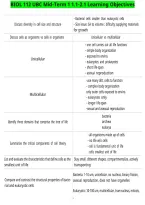
BIOL 112 UBC Mid-Term 1 1.1-2.1 Learning Objectives
- Bacterial cells smaller than eukaryotic cells
Discuss diversity in cell size and structure - Size issue: SA to volume ; diflculty supplying materials
for growth
Discuss cells as organisms vs cells in organisms Unicellular vs multicellular
- one cell carries out all life functions
- simple body organization
- exposed to enviro.
Unicellular
- eukaryotes and prokaryotes
- short life-span
- asexual reproduction
-use many ditt. cells to function
- complex body organization
only outer cells exposed to enviro.
Multicellular
- eukaryotes only
- longer life-span
-sexual and asexual reproduction
bacteria
Identify three domains that comprise the tree of life archea
eukarya
- all organisms made up of cells
- no life w/o cells
Summarize the critical components of cell theory
- cell is fundamental unit of life
- cells smallest unit of life
List and evaluate the characteristics that define cells as the Stay small. ditterent shapes. compartmentalize. actively
smallest unit of life transporting
Bacteria: 1-10 um, unicellular, no nucleus, binary fission,
Compare and contrast the structural properties of bacte- asexual reproduction, does not have organelles
rial and eukaryotic cells
Eukaryotic: 10-100 um, multicellular, true nucleus, mitosis,
1/8
, BIOL 112 UBC Mid-Term 1 1.1-2.1 Learning Objectives
sexual and asexual reproduction, has membrane-bound
organelles
Endosymbiosis: certain organelles within eukaryotes re-
semble engulfed prokaryotes
Evidence: mitochondria/chloroplasts
Explain endosymbiotic theory in the evolution of eukary-
1. Surrounded by two membranes
otic cells. Discuss the evidence that supports it.
2. inner membrane have structures similar to certain
prokaryotes
3. Contain circular genome for codes similar to bacterial
genes
Individual (Binary fission): self-replication= levels of avail-
able nutrients low, competition, temp and pH, osmotic
Describe what is meant by growth in a prokaryotic or-
pressure
ganism distinguishing between growth and division of
individual cells and growth of a population of cells.
Population (generation time): lag, log (exponential), sta-
tionary, death
Lag: growing not dividing, creating tools for optimal sur-
Compare and Contrast a population of cells in lag phase, vival
exponential phase, stationary phase, and death phase in Log: Overall population undergo binary fission
terms of division rate and cell survival. Stationary: competition b/t bacteria and others begin
Death: more cells dying than actively dividing
Identify how the highly electronegative atoms (for exam-
ple O and N) lead to uneven electron sharing and perma- Highly electronegative atoms are bonded to less elec-
nent dipoles when bonded to other biologically relevant tronegative atoms
atoms.
Polar electrons shared unequally/ charged
Nonpolar electrons shared equally/ no charge
Neutral no charge
2/8