
• ¿Documento equivocado? Cámbialo gratis
  • Escrito por estudiantes que aprobaron
  • Inmediatamente disponible después del pago
  • Leer en línea o como PDF
Vender
¿Dónde estudias?
Tu idioma
Document preview thumbnail
Vista previa 3 fuera de 28 páginas
Examen

he New Mexico MM-98 Mechanical Contractor Examination evaluates qualifying agents on the administrative standards, safety regulations, technical trade codes, and operational engineering mechanics required to execute residential, commercial, and industrial

Document preview thumbnail
Vista previa 3 fuera de 28 páginas

he New Mexico MM-98 Mechanical Contractor Examination evaluates qualifying agents on the administrative standards, safety regulations, technical trade codes, and operational engineering mechanics required to execute residential, commercial, and industrial mechanical installations across New Mexico. Administered under the oversight of the New Mexico Regulation and Licensing Department (RLD) Construction Industries Division (CID), the comprehensive MM-98 Combined Mechanical Contractor license encompasses the full statutory scopes of classifications MM-1 (Plumbing), MM-2 (Natural Gas Fitting), MM-3 (Heating, Ventilation, and Air Conditioning), and MM-4 (Heating, Cooling, and Process Piping), as well as specialty scopes including MS-3 (Septic Tanks and Sewer Lines), MS-6 (Lawn Sprinklers), MS-12 (Fire Suppression Systems), and MS-14 (Dry Chemical Fire Protection). To qualify for the exam, candidates must document a minimum of four years (8,000 hours) of verifiable journeyman-level mechanical experience and achieve a minimum passing score of 75% on the statutory Business and Law exam as well as the specialized trade portions. Plumbing systems (MM-1 scope) and natural gas fitting (MM-2 scope) represent a core technical domain tested under the New Mexico Plumbing and Mechanical Code, which is based on the Uniform Plumbing Code (UPC) and Uniform Mechanical Code (UMC) with state-specific amendments. Candidates are evaluated on drain, waste, and vent (DWV) design, water distribution sizing, backflow prevention protocols, and material selection. For example, when selecting underground water service piping through heavy-duty or corrosive soil applications, Type K copper tubing is required due to its thickest wall specification compared to Types L, M, or DWV. In gas fitting, candidates must master pipe sizing charts, purge safety rules, and test pressure standards; for instance, testing natural gas piping systems with air requires applying a test pressure of not less than $1.5$ times the maximum working pressure. Safety appurtenances are strictly regulated, such as requiring Temperature and Pressure (T&P) relief valve discharge piping on water heaters to extend downward and terminate within 6 inches of the floor or waste receptor to prevent thermal scalding hazards. Heating, ventilation, air conditioning (MM-3 scope), and process piping (MM-4 scope) form another major technical focus on the MM-98 assessment. Test-takers must apply thermodynamic principles—such as Boyle's Law ($P_1 V_1 = P_2 V_2$), which establishes that gas pressure is inversely proportional to volume at constant temperature—to analyze compression cycles, refrigerant behavior, and airflow mechanics. Candidates are tested on hydronic heating loops, where a closed expansion tank with a compressible air cushion is integrated to absorb thermal expansion and prevent unsafe pressure spikes from opening system relief valves. In HVAC duct design, technicians must evaluate velocity pressure and friction losses, recognizing that substantially increasing duct velocity while maintaining constant airflow leads to higher static pressure losses and elevated acoustic noise. Accessibility regulations under the mechanical code require maintaining a minimum clearance working space of 30 inches in front of equipment like furnaces or boilers for safe maintenance access. Safety protocols, administrative mandates, and code compliance round out the licensing expectations evaluated on the MM-98 exam. Candidates must understand OSHA Part 1926 construction safety rules—including confined space entry, trenching/shoring, and personal protective equipment—alongside state administrative rules regarding permit acquisition, jobsite inspections, and qualifying agent responsibilities. Proper venting standards mandate that roof penetrations for plumbing vents extend at least $6text{ inches}$ above the roof line (or higher in snow-prone regions) to prevent ice blockage and sewer gas accumulation inside the structure. By demonstrating proficiency across plumbing DWV systems, natural gas piping, hydronic process piping, refrigeration thermodynamics, and state business law, candidates demonstrate the technical competency required to manage complex mechanical contracting operations throughout New Mexico

Vista previa del contenido

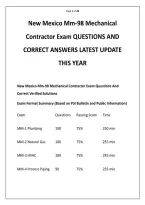
Page 1 of 28


New Mexico Mm-98 Mechanical
Contractor Exam QUESTIONS AND
CORRECT ANSWERS LATEST UPDATE
THIS YEAR


New Mexico Mm-98 Mechanical Contractor Exam Questions And
Correct Verified Solutions

Exam Format Summary (Based on PSI Bulletin and Public Information)

Exam Questions Passing Score Time


MM-1 Plumbing 100 75% 250 min


MM-2 Natural Gas 100 75% 255 min


MM-3 HVAC 100 75% 245 min


MM-4 Process Piping 90 75% 235 min

, Page 2 of 28


Exam Questions Passing Score Time


Business & Law 50 75% 130 min


.


MM-1 Plumbing (Questions 1–60)

1. A residential water heater T&P relief valve discharge pipe terminates
4 inches above the floor. What is the primary code concern?
A. Termination height is too low
B. Discharge pipe material is not specified
C. Discharge pipe diameter must match valve outlet and terminate near
floor
D. T&P valve is not required on residential water heaters
Answer: C。Rationale: UPC requires T&P discharge pipe to be same size

, Page 3 of 28


as valve outlet (typically 3/4 inch) and terminate near floor to prevent
scalding and allow safe drainage.

2. A kitchen sink P-trap is being installed. What is the minimum trap
arm size for a residential kitchen sink?
A. 1-1/4 inch
B. 1-1/2 inch
C. 2 inch
D. 3 inch
Answer: B。Rationale: Standard residential kitchen sink requires
minimum 1-1/2 inch trap and drain based on fixture unit load.

3. A plumbing vent terminates through a roof in an area subject to snow
accumulation. What is the minimum required height above the roof?
A. 2 inches
B. 4 inches
C. 6 inches
D. 12 inches
Answer: C。Rationale: Vents must extend at least 6 inches above roof
surface to prevent blockage by snow or debris.

4. An atmospheric vacuum breaker (AVB) is being installed for backflow
prevention. Which installation condition is critical?
A. Must be under continuous pressure


Información del documento

Subido en
19 de octubre de 2026
Número de páginas
28
Escrito en
2026/2027
Tipo
Examen
Contiene
Preguntas y respuestas
$25.99

¿Documento equivocado? Cámbialo gratis Dentro de los 14 días posteriores a la compra y antes de descargarlo, puedes elegir otro documento. Puedes gastar el importe de nuevo.
Escrito por estudiantes que aprobaron
Inmediatamente disponible después del pago
Leer en línea o como PDF

Seller avatar
Los indicadores de reputación están sujetos a la cantidad de artículos vendidos por una tarifa y las reseñas que ha recibido por esos documentos. Hay tres niveles: Bronce, Plata y Oro. Cuanto mayor reputación, más podrás confiar en la calidad del trabajo del vendedor.
derejj
3.2
(5)
Vendido
23
Seguidores
0
Artículos
1306
Última venta
5 días hace


Por qué los estudiantes eligen Stuvia

Creado por compañeros estudiantes, verificado por reseñas

Calidad en la que puedes confiar: escrito por estudiantes que aprobaron y evaluado por otros que han usado estos resúmenes.

¿No estás satisfecho? Elige otro documento

¡No te preocupes! Puedes elegir directamente otro documento que se ajuste mejor a lo que buscas.

Paga como quieras, empieza a estudiar al instante

Sin suscripción, sin compromisos. Paga como estés acostumbrado con tarjeta de crédito y descarga tu documento PDF inmediatamente.

Student with book image

“Comprado, descargado y aprobado. Así de fácil puede ser.”

Alisha Student

Preguntas frecuentes