
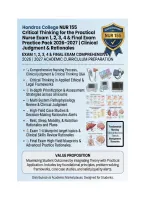
,Hondros College NUR 155 Critical Thinking
for the Practical Nurse Exam 1, 2, 3, 4 &
Final Exam Practice Pack 2026–2027 |
Clinical Judgment & Rationales
Hondros College NUR 155 Critical Thinking for the Practical Nurse
Exam 1 Practice Pack 2026–2027 | Clinical Judgment & Rationales
Q1. A nurse is caring for a client who is 6 hours postoperative following abdominal surgery.
The client's heart rate is 124 beats per minute, blood pressure is 88/54 mm Hg, and urine
output has been 15 mL over the past 3 hours. The nurse notes the surgical dressing is dry and
intact. Which action should the nurse take first?
A. Administer prescribed IV pain medication
B. Increase the IV fluid rate and notify the provider
C. Document the findings and reassess in 1 hour
D. Encourage the client to drink oral fluids
Correct Answer: B. Increase the IV fluid rate and notify the provider
Rationale: The client is exhibiting classic signs of hypovolemic shock, including tachycardia,
hypotension, and oliguria, which may indicate internal bleeding even with a dry dressing. The
priority is to restore circulating volume by increasing the IV fluid rate and alerting the
provider for further evaluation and possible blood transfusion. Administering pain medication
does not address the underlying hypovolemia and may worsen hypotension. Documenting
and reassessing in 1 hour delays life-saving intervention. Oral fluids are insufficient for a client
in shock.
Key Takeaway: Tachycardia plus hypotension plus low urine output equals shock; act now.
Q2. A nurse is caring for a client with chronic kidney disease who has a serum potassium level
of 7.2 mEq/L. The cardiac monitor shows a widened QRS complex and absent P waves. Which
prescribed medication should the nurse anticipate administering first?
,A. Sodium polystyrene sulfonate 30 g PO
B. Regular insulin 10 units IV with 25 g dextrose 50% IV
C. Calcium gluconate 10% 10 mL IV over 10 minutes
D. Furosemide 40 mg IV push
Correct Answer: C. Calcium gluconate 10% 10 mL IV over 10 minutes
Rationale: The client has severe hyperkalemia with ECG changes indicating imminent cardiac
arrest. Calcium gluconate stabilizes the myocardial cell membrane and is the fastest-acting
intervention. Insulin with dextrose shifts potassium intracellularly but takes 15 to 30 minutes
to act. Sodium polystyrene sulfonate and furosemide lower total body potassium but work
much more slowly. The nurse must always treat the heart first when hyperkalemia causes ECG
changes.
Key Takeaway: Calcium gluconate stabilizes the heart; insulin shifts potassium; Kayexalate
removes it.
Q3. A nurse is preparing to delegate tasks to an unlicensed assistive personnel (UAP) and an
LPN/LVN. Which task is most appropriate for the nurse to delegate to the UAP?
A. Administering a scheduled oral pain medication
B. Obtaining vital signs on a stable client who is 2 days postoperative
C. Performing a sterile dressing change on a surgical incision
D. Assessing a client's new complaint of chest pain
Correct Answer: B. Obtaining vital signs on a stable client who is 2 days postoperative
Rationale: UAPs can perform basic, routine tasks such as obtaining vital signs on stable clients,
assisting with hygiene, and measuring intake and output. Administering medications and
performing sterile dressing changes require the education and licensure of an LPN/LVN or RN.
Assessing a new complaint such as chest pain requires the clinical judgment of an RN and is
never delegated. Delegation must always be based on client stability and task complexity.
Key Takeaway: Delegate routine, stable tasks to UAPs; never delegate assessment or
medication administration.
, Q4. A client with type 1 diabetes mellitus is found unresponsive by the nurse. The client's skin
is cool and clammy, and the nurse notes a fruity odor to the breath. Which action should the
nurse take first?
A. Administer 50% dextrose IV push
B. Check the client's blood glucose level
C. Obtain an arterial blood gas sample
D. Administer regular insulin IV push
Correct Answer: B. Check the client's blood glucose level
Rationale: The client is unresponsive with signs that could indicate either hypoglycemia (cool,
clammy skin) or hyperglycemia with ketoacidosis (fruity breath). The nurse cannot safely treat
without knowing the blood glucose level. Checking the glucose level takes only seconds and is
the critical assessment that determines the correct intervention. Giving insulin to a
hypoglycemic client would be fatal, and giving dextrose to a hyperglycemic client would
worsen the condition.
Key Takeaway: Never treat an unresponsive diabetic client without checking the glucose first.
Q5. A nurse is caring for a client who is receiving a blood transfusion. Fifteen minutes into the
transfusion, the client reports chills, flank pain, and has a temperature of 38.9 degrees C (102
degrees F). Which action should the nurse take first?
A. Slow the transfusion rate and administer acetaminophen
B. Stop the transfusion immediately and maintain IV access with normal saline
C. Collect a urine specimen and send it to the laboratory
D. Administer diphenhydramine as prescribed
Correct Answer: B. Stop the transfusion immediately and maintain IV access with normal
saline
Rationale: The client is exhibiting signs of an acute hemolytic transfusion reaction, which
includes fever, chills, and flank pain. This is a life-threatening emergency. The first and most
critical action is to stop the transfusion immediately to prevent further administration of
incompatible blood. The IV line is then maintained with normal saline using new tubing to
keep the vein open for emergency medications and to support renal perfusion.

