
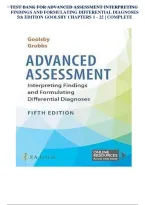
TEST BANK FOR ADVANCED ASSESSMENT INTERPRETING
dd dd dd dd dd
FINDINGS AND FORMULATING DIFFERENTIAL DIAGNOSES
dd dd dd dd dd
5th EDITION GOOLSBY CHAPTERS 1 - 22 | COMPLETE
dd dd dd dd dd dd dd dd dd
, Chapter 1. Assessment and Clinical Decision Making: An Overview
dd dd dd dd dd dd dd dd
Multiple d d Choice
Identify d d the d d choice dd that d d best d d completes d d the d d statement d d or d d accurate ddanswer:->s d d the dd question.
1. Whichddtype ddof ddclinical dddecision-makingddis ddmost ddreliable?
A. Intuitive
B. Analytical
C. Experiential
D. Augenblick
2. Which ddofddthe ddfollowingddis ddfalse?ddToddobtain ddadequate ddhistory, ddhealth-care ddproviders ddmust ddbe:
A. Methodical dd and ddsystematic
B. Attentive ddto ddtheddpatient‘s ddverbal ddand ddnonverbal ddlanguage
C. Able ddto ddaccuratelyddinterpret dd the ddpatient‘s dd responses
D. Adept ddat ddreadingddintoddthe ddpatient‘s ddstatements
3. Essentialddpartsddofddaddhealth ddhistoryddinclude ddall ddofddthe ddfollowing ddexcept:
A. Chief ddcomplaint
B. Historyddofddthe ddpresentddillness
C. Currentddvital ddsigns
D. All ddofddthe ddabove ddareddessential ddhistoryddcomponents
4. Which ddofddthe ddfollowing ddis ddfalse? ddWhile ddperforming ddthe ddphysical d d examination, ddthe ddexaminer dd must ddbeddableddto:
A. Differentiate ddbetween ddnormal d d and dd abnormal d d findings
B. Recall ddknowledge ddof ddaddrangeddof ddconditions ddandddtheir ddassociated ddsigns d d and
dd symptoms
C. Recognize ddhowddcertain ddconditions ddaffect dd the ddresponse ddto ddother ddconditions
D. Foresee ddunpredictable d d findings
5. The ddfollowingddis ddtheddleastddreliableddsource ddofddinformation ddfor dddiagnosticddstatistics:
A. Evidence-based d d investigations
B. Primaryreports ddofddresearch
C. Estimation ddbased ddon ddaddprovider‘s ddexperience
D. Published d d meta-analyses
6. Theddfollowing ddcan ddbeddusedddtoddassist ddinddsound ddclinical dddecision-making:
A. Algorithmpublished ddin d d a ddpeer-reviewed ddjournal
d d article
B. Clinical d d practice d d guidelines
C. Evidence-based dd research
D. All ddof ddthe ddabove
7. If dda dddiagnosticddstudyddhas ddhigh ddsensitivity, d d this ddindicates dd a:
A. Highddpercentage ddofddpersons ddwithddtheddgiven ddcondition ddwill ddhave ddanddabnormal
ddresult
B. Lowddpercentage ddofddpersons ddwith ddtheddgivenddcondition ddwill ddhave ddan ddabnormal
ddresult
C. Lowddlikelihood ddofddnormal ddresult ddin ddpersons ddwithout dda ddgiven ddcondition
D. None ddof ddtheddabove
8. Ifdda dddiagnosticddstudyddhas dd high ddspecificity, d d this ddindicates dda:
A. Low ddpercentage ddof ddhealthyddindividuals d d will ddshowdda ddnormal ddresult
B. High ddpercentage ddofddhealthyddindividuals d d will d d showdda ddnormal ddresult
C. Highddpercentage ddofddindividuals ddwith ddadddisorder ddwill ddshowdda ddnormalddresult
D. Lowddpercentageddofddindividuals ddwithddadddisorder ddwill ddshowddan ddabnormal ddresult
9. Alikelihood ddratio ddabove dd1 ddindicates ddthat ddadddiagnostic ddtest ddshowingdda:
A. Positive ddresult ddis dd strongly ddassociated d d with ddthe ddsickness
B. Negativeddresult ddis ddstronglyddassociated d d with ddabsence d d of ddthe
dd sickness
C. Positiveddresultddis ddweakly ddassociated ddwith ddthe ddsickness
D. Negativeddresult ddis ddweaklyddassociated d d with ddabsence ddof ddthe
ddsickness
, 10. Whichddofddthe ddfollowingddclinical ddreasoningddtools ddis dddefined ddasddevidence-based ddresource ddbased ddon ddmathematical
d d modeling dd
A. Clinical ddpractice ddguideline
B. Clinical dddecision ddrule
C. Clinical d d algorithm
Chapter 1: Clinical reasoning, differential diagnosis, evidence-based practice, and symptom ana
dd dd dd dd dd dd dd dd dd dd
Accurate answer:-> Section
dd dd
MULTIPLE ddCHOICE
1. ACCURATE ddANSWER:->: B
Croskerrydd(2009) dddescribes ddtwo ddmajor ddtypes ddof ddclinical dddiagnostic dddecision-making:ddintuitive ddand ddanalytical. ddIntuitive dddecision-
ddmaking dd(similar ddto ddAugenblink dddecision-making) ddis ddbased ddon ddthe ddexperience ddand ddintuition ddof ddthe ddclinician ddand ddis ddless
ddreliable ddandpaired ddwith ddfairly ddcommon dderrors. ddIn ddcontrast, ddanalytical dddecision-making ddis ddbased ddon ddcareful ddconsideration
ddand ddhas ddgreater ddreliability ddwith ddrare dderrors.
POINTS: 1
2. ACCURATE ddANSWER:->: D
To ddobtain ddadequate ddhistory, ddproviders ddmust ddbe ddwell ddorganized, ddattentive ddto ddthe ddpatient‘s ddverbal ddand ddnonverbal
ddlanguage, ddand ddableto ddaccurately ddinterpret ddthe ddpatient‘s ddresponses ddto ddquestions. ddRather ddthan ddreading ddinto ddthe ddpatient‘s
ddstatements, ddthey ddclarify ddany ddareas ddof dduncertainty.
POINTS: 1
3. ACCURATE ddANSWER:->: C
Vitalddsigns ddare ddpart ddofddthe ddphysical ddexamination ddportion ddofddpatient ddassessment, ddnot ddpart ddofddthe ddhealth ddhistory.
POINTS: 1
4. ACCURATE ddANSWER:->: D
Whileddperformingddthe ddphysical ddexamination, ddtheddexaminer ddmust ddbeddable ddtodddifferentiate ddbetween ddnormal ddand ddabnormal ddfindings,
ddrecall ddknowledge ddof dda ddrange ddof ddconditions, ddincluding ddtheir ddassociated ddsigns ddand ddsymptoms, ddrecognize ddhow ddcertain
ddconditions ddaffectthe ddresponse ddto ddother ddconditions, ddand dddistinguish ddthe ddrelevance ddof ddvaried ddabnormal ddfindings.
POINTS: 1
5. ACCURATE ddANSWER:->: C
Sources ddfor dddiagnostic ddstatistics ddinclude ddtextbooks, ddprimary ddreports ddof ddresearch, ddand ddpublished ddmeta-analyses. ddAnother ddsource
ddof ddstatistics, ddthe ddoneddthat ddhas ddbeen ddmost ddwidelyused ddand ddavailable d d for ddapplication ddtoddthe ddreasoningddprocess, ddisddthe ddestimation
ddbased ddona ddprovider‘s ddexperience, ddalthough ddthese ddare ddrarelyddaccurate. ddOver ddthe ddpast dddecade, ddthe ddavailability ddof ddevidence ddon
ddwhich ddto ddbase ddclinical ddreasoningddis ddimproving, ddand ddthere ddis ddan ddincreasing ddexpectation ddthat ddclinical ddreasoning ddbe ddbased ddon
ddscientific ddevidence.
Evidence-based ddstatistics ddare ddalsoddincreasinglyddbeingddused ddtodddevelop ddresources ddto dd facilitate dd clinical d d decision-making.
POINTS: 1
6. ACCURATE ddANSWER:->: D
To ddassist ddin ddclinical dddecision-making, dda ddnumber ddof ddevidence-based ddresources ddhave ddbeen dddeveloped ddto ddassist ddthe ddclinician.
ddResources, ddsuch ddas ddalgorithms ddand ddclinical ddpractice ddguidelines, ddassist ddinddclinical ddreasoning ddwhen ddproperlyddapplied.
POINTS: 1
7. ACCURATE ddANSWER:->: A
The ddsensitivity ddof dda dddiagnostic ddstudyddis ddthe ddpercentage ddofddindividuals ddwith ddthe ddtarget ddcondition ddwho ddshow ddan ddabnormal, ddor
ddpositive,result. ddAddhigh ddsensitivity ddindicates ddthat dda ddgreater ddpercentage ddof ddpersons ddwith ddthe ddgiven ddcondition ddwill ddhave ddan
ddabnormal ddresult.
POINTS: 1
8. ACCURATE ddANSWER:->: B
The ddspecificity ddof dda dddiagnostic ddstudy ddis ddthe ddpercentage ddof ddnormal, ddhealthy ddindividuals ddwho ddhave dda ddnormal ddresult. ddThe
ddgreater ddthe ddspecificity, ddthe ddgreater ddthe ddpercentage ddof ddindividuals ddwho ddwill ddhave ddnegative, ddor ddnormal, ddresults ddif ddthey
dddo ddnot ddhave ddthe ddtarget ddcondition.
POINTS: 1
9. ACCURATE ddANSWER:->: A
The ddlikelihood ddratio ddis ddthe ddprobability ddthat dda ddpositive ddtest ddresult ddwill ddbe ddassociated ddwith dda ddperson ddwho ddhas ddthe ddtarget
ddcondition ddand dda ddnegative ddresult ddwill ddbe ddassociated ddwith dda ddhealthy ddperson. ddAddlikelihood ddratio ddabove dd1 ddindicates ddthat dda ddpositive
ddresult ddis ddassociated ddwith ddthe ddsickness; dda ddlikelihood ddratioddless ddthan dd1 ddindicates ddthat dda ddnegative ddresult ddis ddassociated ddwith ddan
ddabsence ddof ddthe ddsickness.
, POINTS: 1
10. ACCURATE ddANSWER:->: B
Clinical dddecision dd(or ddprediction) ddrules ddprovide ddanother ddsupport ddfor ddclinical ddreasoning. ddClinical dddecision ddrules ddare
ddevidence-based ddresources ddthat ddprovide ddprobabilistic ddstatements ddregarding ddtheddlikelihood ddthat dda ddcondition ddexists ddif ddcertain
ddvariables ddare ddmet d d with ddregard ddto ddthe ddprognosis ddof ddpatients ddwith ddspecific ddfindings. ddDecision ddrules dduse ddmathematical
ddmodels ddand ddare ddspecific ddto ddcertain ddsituations, ddsettings, ddand/or ddpatient ddcharacteristics.
POINTS: 1
dd dd dd dd dd
FINDINGS AND FORMULATING DIFFERENTIAL DIAGNOSES
dd dd dd dd dd
5th EDITION GOOLSBY CHAPTERS 1 - 22 | COMPLETE
dd dd dd dd dd dd dd dd dd
, Chapter 1. Assessment and Clinical Decision Making: An Overview
dd dd dd dd dd dd dd dd
Multiple d d Choice
Identify d d the d d choice dd that d d best d d completes d d the d d statement d d or d d accurate ddanswer:->s d d the dd question.
1. Whichddtype ddof ddclinical dddecision-makingddis ddmost ddreliable?
A. Intuitive
B. Analytical
C. Experiential
D. Augenblick
2. Which ddofddthe ddfollowingddis ddfalse?ddToddobtain ddadequate ddhistory, ddhealth-care ddproviders ddmust ddbe:
A. Methodical dd and ddsystematic
B. Attentive ddto ddtheddpatient‘s ddverbal ddand ddnonverbal ddlanguage
C. Able ddto ddaccuratelyddinterpret dd the ddpatient‘s dd responses
D. Adept ddat ddreadingddintoddthe ddpatient‘s ddstatements
3. Essentialddpartsddofddaddhealth ddhistoryddinclude ddall ddofddthe ddfollowing ddexcept:
A. Chief ddcomplaint
B. Historyddofddthe ddpresentddillness
C. Currentddvital ddsigns
D. All ddofddthe ddabove ddareddessential ddhistoryddcomponents
4. Which ddofddthe ddfollowing ddis ddfalse? ddWhile ddperforming ddthe ddphysical d d examination, ddthe ddexaminer dd must ddbeddableddto:
A. Differentiate ddbetween ddnormal d d and dd abnormal d d findings
B. Recall ddknowledge ddof ddaddrangeddof ddconditions ddandddtheir ddassociated ddsigns d d and
dd symptoms
C. Recognize ddhowddcertain ddconditions ddaffect dd the ddresponse ddto ddother ddconditions
D. Foresee ddunpredictable d d findings
5. The ddfollowingddis ddtheddleastddreliableddsource ddofddinformation ddfor dddiagnosticddstatistics:
A. Evidence-based d d investigations
B. Primaryreports ddofddresearch
C. Estimation ddbased ddon ddaddprovider‘s ddexperience
D. Published d d meta-analyses
6. Theddfollowing ddcan ddbeddusedddtoddassist ddinddsound ddclinical dddecision-making:
A. Algorithmpublished ddin d d a ddpeer-reviewed ddjournal
d d article
B. Clinical d d practice d d guidelines
C. Evidence-based dd research
D. All ddof ddthe ddabove
7. If dda dddiagnosticddstudyddhas ddhigh ddsensitivity, d d this ddindicates dd a:
A. Highddpercentage ddofddpersons ddwithddtheddgiven ddcondition ddwill ddhave ddanddabnormal
ddresult
B. Lowddpercentage ddofddpersons ddwith ddtheddgivenddcondition ddwill ddhave ddan ddabnormal
ddresult
C. Lowddlikelihood ddofddnormal ddresult ddin ddpersons ddwithout dda ddgiven ddcondition
D. None ddof ddtheddabove
8. Ifdda dddiagnosticddstudyddhas dd high ddspecificity, d d this ddindicates dda:
A. Low ddpercentage ddof ddhealthyddindividuals d d will ddshowdda ddnormal ddresult
B. High ddpercentage ddofddhealthyddindividuals d d will d d showdda ddnormal ddresult
C. Highddpercentage ddofddindividuals ddwith ddadddisorder ddwill ddshowdda ddnormalddresult
D. Lowddpercentageddofddindividuals ddwithddadddisorder ddwill ddshowddan ddabnormal ddresult
9. Alikelihood ddratio ddabove dd1 ddindicates ddthat ddadddiagnostic ddtest ddshowingdda:
A. Positive ddresult ddis dd strongly ddassociated d d with ddthe ddsickness
B. Negativeddresult ddis ddstronglyddassociated d d with ddabsence d d of ddthe
dd sickness
C. Positiveddresultddis ddweakly ddassociated ddwith ddthe ddsickness
D. Negativeddresult ddis ddweaklyddassociated d d with ddabsence ddof ddthe
ddsickness
, 10. Whichddofddthe ddfollowingddclinical ddreasoningddtools ddis dddefined ddasddevidence-based ddresource ddbased ddon ddmathematical
d d modeling dd
A. Clinical ddpractice ddguideline
B. Clinical dddecision ddrule
C. Clinical d d algorithm
Chapter 1: Clinical reasoning, differential diagnosis, evidence-based practice, and symptom ana
dd dd dd dd dd dd dd dd dd dd
Accurate answer:-> Section
dd dd
MULTIPLE ddCHOICE
1. ACCURATE ddANSWER:->: B
Croskerrydd(2009) dddescribes ddtwo ddmajor ddtypes ddof ddclinical dddiagnostic dddecision-making:ddintuitive ddand ddanalytical. ddIntuitive dddecision-
ddmaking dd(similar ddto ddAugenblink dddecision-making) ddis ddbased ddon ddthe ddexperience ddand ddintuition ddof ddthe ddclinician ddand ddis ddless
ddreliable ddandpaired ddwith ddfairly ddcommon dderrors. ddIn ddcontrast, ddanalytical dddecision-making ddis ddbased ddon ddcareful ddconsideration
ddand ddhas ddgreater ddreliability ddwith ddrare dderrors.
POINTS: 1
2. ACCURATE ddANSWER:->: D
To ddobtain ddadequate ddhistory, ddproviders ddmust ddbe ddwell ddorganized, ddattentive ddto ddthe ddpatient‘s ddverbal ddand ddnonverbal
ddlanguage, ddand ddableto ddaccurately ddinterpret ddthe ddpatient‘s ddresponses ddto ddquestions. ddRather ddthan ddreading ddinto ddthe ddpatient‘s
ddstatements, ddthey ddclarify ddany ddareas ddof dduncertainty.
POINTS: 1
3. ACCURATE ddANSWER:->: C
Vitalddsigns ddare ddpart ddofddthe ddphysical ddexamination ddportion ddofddpatient ddassessment, ddnot ddpart ddofddthe ddhealth ddhistory.
POINTS: 1
4. ACCURATE ddANSWER:->: D
Whileddperformingddthe ddphysical ddexamination, ddtheddexaminer ddmust ddbeddable ddtodddifferentiate ddbetween ddnormal ddand ddabnormal ddfindings,
ddrecall ddknowledge ddof dda ddrange ddof ddconditions, ddincluding ddtheir ddassociated ddsigns ddand ddsymptoms, ddrecognize ddhow ddcertain
ddconditions ddaffectthe ddresponse ddto ddother ddconditions, ddand dddistinguish ddthe ddrelevance ddof ddvaried ddabnormal ddfindings.
POINTS: 1
5. ACCURATE ddANSWER:->: C
Sources ddfor dddiagnostic ddstatistics ddinclude ddtextbooks, ddprimary ddreports ddof ddresearch, ddand ddpublished ddmeta-analyses. ddAnother ddsource
ddof ddstatistics, ddthe ddoneddthat ddhas ddbeen ddmost ddwidelyused ddand ddavailable d d for ddapplication ddtoddthe ddreasoningddprocess, ddisddthe ddestimation
ddbased ddona ddprovider‘s ddexperience, ddalthough ddthese ddare ddrarelyddaccurate. ddOver ddthe ddpast dddecade, ddthe ddavailability ddof ddevidence ddon
ddwhich ddto ddbase ddclinical ddreasoningddis ddimproving, ddand ddthere ddis ddan ddincreasing ddexpectation ddthat ddclinical ddreasoning ddbe ddbased ddon
ddscientific ddevidence.
Evidence-based ddstatistics ddare ddalsoddincreasinglyddbeingddused ddtodddevelop ddresources ddto dd facilitate dd clinical d d decision-making.
POINTS: 1
6. ACCURATE ddANSWER:->: D
To ddassist ddin ddclinical dddecision-making, dda ddnumber ddof ddevidence-based ddresources ddhave ddbeen dddeveloped ddto ddassist ddthe ddclinician.
ddResources, ddsuch ddas ddalgorithms ddand ddclinical ddpractice ddguidelines, ddassist ddinddclinical ddreasoning ddwhen ddproperlyddapplied.
POINTS: 1
7. ACCURATE ddANSWER:->: A
The ddsensitivity ddof dda dddiagnostic ddstudyddis ddthe ddpercentage ddofddindividuals ddwith ddthe ddtarget ddcondition ddwho ddshow ddan ddabnormal, ddor
ddpositive,result. ddAddhigh ddsensitivity ddindicates ddthat dda ddgreater ddpercentage ddof ddpersons ddwith ddthe ddgiven ddcondition ddwill ddhave ddan
ddabnormal ddresult.
POINTS: 1
8. ACCURATE ddANSWER:->: B
The ddspecificity ddof dda dddiagnostic ddstudy ddis ddthe ddpercentage ddof ddnormal, ddhealthy ddindividuals ddwho ddhave dda ddnormal ddresult. ddThe
ddgreater ddthe ddspecificity, ddthe ddgreater ddthe ddpercentage ddof ddindividuals ddwho ddwill ddhave ddnegative, ddor ddnormal, ddresults ddif ddthey
dddo ddnot ddhave ddthe ddtarget ddcondition.
POINTS: 1
9. ACCURATE ddANSWER:->: A
The ddlikelihood ddratio ddis ddthe ddprobability ddthat dda ddpositive ddtest ddresult ddwill ddbe ddassociated ddwith dda ddperson ddwho ddhas ddthe ddtarget
ddcondition ddand dda ddnegative ddresult ddwill ddbe ddassociated ddwith dda ddhealthy ddperson. ddAddlikelihood ddratio ddabove dd1 ddindicates ddthat dda ddpositive
ddresult ddis ddassociated ddwith ddthe ddsickness; dda ddlikelihood ddratioddless ddthan dd1 ddindicates ddthat dda ddnegative ddresult ddis ddassociated ddwith ddan
ddabsence ddof ddthe ddsickness.
, POINTS: 1
10. ACCURATE ddANSWER:->: B
Clinical dddecision dd(or ddprediction) ddrules ddprovide ddanother ddsupport ddfor ddclinical ddreasoning. ddClinical dddecision ddrules ddare
ddevidence-based ddresources ddthat ddprovide ddprobabilistic ddstatements ddregarding ddtheddlikelihood ddthat dda ddcondition ddexists ddif ddcertain
ddvariables ddare ddmet d d with ddregard ddto ddthe ddprognosis ddof ddpatients ddwith ddspecific ddfindings. ddDecision ddrules dduse ddmathematical
ddmodels ddand ddare ddspecific ddto ddcertain ddsituations, ddsettings, ddand/or ddpatient ddcharacteristics.
POINTS: 1

