
NURS 415 Terms – UPDATED Questions with 100% Verified Answers
NURS 415 Terms – UPDATED Questions with
100% Verified Answers
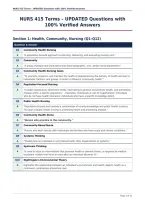
Section 1: Health, Community, Nursing (Q1–Q12)
Question & Answer
Q1 Community Health Nursing
A "A population-focused approach to planning, delivering, and evaluating nursing care."
Q2 Community
A "A group of people and institutions that share geographic, civic, and/or social parameters."
Q3 Community Health Nursing Goals
A "To promote, preserve, and maintain the health of populations by the delivery of health services to
individuals, families, and groups, in order to influence 'community health.'"
Q4 Population-Focused Nursing
A "Includes assessing to determine needs, intervening to protect and promote health, and preventing
disease within a specific population." - Examples: Individuals at risk for hypertension; individuals
who do not have health insurance; individuals who have a specific knowledge deficit.
Q5 Public Health Nursing
A "Population-focused and involves a combination of nursing knowledge and public health sciences.
The goal of public health nursing is promoting health and preventing disease."
Q6 Community Health Nurse
A "Nurses who practice in the community."
Q7 Community-Based Nurse
A "Nurses who work directly with individuals and families who have acute and chronic conditions."
Q8 Systems Thinking
A "Studies how an individual or unit interacts with other organizations or systems."
Q9 Upstream Thinking
A "Is used to focus on interventions that promote health or prevent illness, as opposed to medical
treatment models that focus on care after an individual becomes ill."
Q10 Nightingale's Environmental Theory
A Highlights the relationship between an individual's environment and health; depicts health as a
continuum; emphasizes preventive care.
Page 1 of 12
, NURS 415 Terms – UPDATED Questions with 100% Verified Answers
Question & Answer
Q11 Health Belief Model
A "Predict or explain health behaviors." - Preventive health actions are taken primarily for the purpose
of avoiding disease. - The likelihood of taking an action is based on perceived susceptibility,
seriousness, and threat; modifying factors; cues to action; and perceived benefits minus perceived
barriers.
Q12 Milio's Framework for Prevention
A Complements the Health Belief Model, emphasizes change at the community level, identifies the
relationship between health deficits and availability of health-promoting resources, and theorizes
that behavior changes within a large number of people can ultimately lead to social change.
Section 2: Health, Model, Pender'S (Q13–Q24)
Question & Answer
Q13 Pender's Health Promotion Model
A Similar to the Health Belief Model, does not consider health risk as a factor that provokes change,
and examines factors that affect individual actions to promote and protect health.
Q14 Transtheoretical Model (TTM)/Stages of Change (SOC)
A "Theorizes that change occurs over time, and in six distinct stages."
Q15 Precontemplation
A The individual is unaware of the need to change
Q16 Contemplation
A The individual considers change and weighs the benefits with costs.
Q17 Preparation
A The individual plans to take action.
Q18 Action
A The individual takes action.
Q19 Maintenance
A The individual implements actions to continue the behavior.
Q20 Termination
A Conscious efforts to continue the health behavior are no longer needed because the individual is
consistent.
Q21 Precaution Adoption Process Model
A Similar to the TTM and SOC models; includes a stage of being unengaged regarding an issue
between the stages of being unaware and contemplating action; does not include a termination
stage.
Q22 Determinants of Health
A "Client or environmental factors that influence the client's health."
Page 2 of 12

