
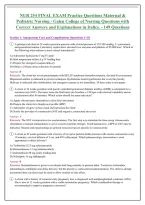
NUR 254 FINAL EXAM Practice Questions Maternal &
Pediatric Nursing - Galen College of Nursing Questions with
Correct Answers and Explanations in Italics. - 149 Questions
Section 1: Antepartum Care and Complications (Questions 1-13)
1 A primigravid client at 28 weeks gestation presents with a blood pressure of 155/100 mmHg, 2+ proteinuria,
and generalized edema. Laboratory results show elevated liver enzymes and platelets of 95,000/mm³. Which of
the following interventions is most critical immediately?
A) Administer hydralazine 5 mg IV push
B) Start magnesium sulfate 4 g IV loading dose
C) Prepare for emergent cesarean delivery
D) Obtain a 24-hour urine collection for protein
Answer: B
Rationale: The client has severe preeclampsia with HELLP syndrome (thrombocytopenia, elevated liver enzymes).
Magnesium sulfate is indicated to prevent eclampsia. Hydralazine treats hypertension but is not the priority.
Delivery is indicated after stabilization, but emergent cesarean is not immediate. 24-hour urine is not urgent.
2 A client at 34 weeks gestation with poorly controlled gestational diabetes mellitus (GDM) is scheduled for a
nonstress test (NST). The nurse notes the fetal heart rate baseline is 150 bpm with minimal variability and no
accelerations after 40 minutes. Which action should the nurse take next?
A) Apply vibroacoustic stimulation to elicit fetal movement
B) Prepare the client for a biophysical profile (BPP)
C) Administer oxygen via face mask and reposition the client
D) Notify the provider of a nonreactive NST and request a contraction stress test
Answer: A
Rationale: The NST is nonreactive (no accelerations). The first step is to stimulate the fetus using vibroacoustic
stimulation or manual manipulation to see if a reactive pattern emerges. If still nonreactive, a BPP or CST may be
indicated. Oxygen and repositioning are general measures but not specific for nonreactivity.
3 A client at 30 weeks gestation with a history of two prior preterm births presents with uterine contractions every
10 minutes, cervical dilation of 2 cm, and 80% effacement. Which pharmacologic intervention is most
appropriate to delay delivery?
A) Terbutaline 0.25 mg subcutaneously
B) Betamethasone 12 mg intramuscularly
C) Indomethacin 50 mg orally loading dose
D) Nifedipine 10 mg sublingually
Answer: B
Rationale: Betamethasone is given to accelerate fetal lung maturity in preterm labor. Tocolytics (terbutaline,
indomethacin, nifedipine) can delay delivery, but the priority is corticosteroid administration. The client is already
in preterm labor; tocolysis may be used to allow steroids to take effect.
4 A client with a history of recurrent early pregnancy loss is diagnosed with antiphospholipid syndrome (APS).
She is now at 12 weeks gestation with a viable intrauterine pregnancy. Which combination therapy is
recommended to improve pregnancy outcomes?
,A) Low-dose aspirin alone
B) Unfractionated heparin plus low-dose aspirin
C) Enoxaparin alone
D) Warfarin plus aspirin
Answer: B
Rationale: APS is associated with thrombotic events and pregnancy loss. The standard therapy is the combination of
unfractionated heparin (or low-molecular-weight heparin) and low-dose aspirin. Warfarin is teratogenic and
contraindicated. Aspirin alone is insufficient, and enoxaparin alone is not first-line.
5 A client at 38 weeks gestation is undergoing an amniocentesis to assess fetal lung maturity. The
lecithin/sphingomyelin (L/S) ratio is 1.8:1. Which interpretation is most accurate?
A) Fetal lungs are mature; delivery can proceed safely
B) Fetal lungs are immature; delivery should be delayed if possible
C) The result is equivocal; further testing with phosphatidylglycerol (PG) is needed
D) The result indicates risk of respiratory distress syndrome; administer corticosteroids
Answer: B
Rationale: An L/S ratio < 2:1 indicates fetal lung immaturity and increased risk of respiratory distress syndrome. At
38 weeks, delivery may be indicated for other reasons, but the result suggests delay if safe. PG presence would
confirm maturity, but the L/S ratio alone is predictive. Corticosteroids are not given at 38 weeks.
6 A client at 16 weeks gestation presents with acute onset of severe right lower quadrant pain, nausea, and
vomiting. Ultrasound reveals a 5 cm adnexal mass with internal debris and no fetal cardiac activity in the uterus.
What is the most likely diagnosis?
A) Ruptured ovarian cyst
B) Ectopic pregnancy
C) Ovarian torsion
D) Corpus luteum cyst
Answer: B
Rationale: The combination of an adnexal mass, no intrauterine pregnancy, and acute pain suggests ectopic
pregnancy. Absent fetal cardiac activity in the uterus confirms no intrauterine pregnancy. Ovarian torsion is
possible but less likely without a visible mass. Ruptured cyst and corpus luteum are not typically associated with
absent IUP.
7 A client at 24 weeks gestation with chronic hypertension is admitted with a blood pressure of 170/110 mmHg.
She reports a severe headache and visual changes. Laboratory results show creatinine 1.4 mg/dL and uric acid
7.8 mg/dL. Which of the following is the priority nursing action?
A) Administer labetalol 20 mg IV push
B) Start magnesium sulfate infusion
C) Place the client in left lateral position
D) Obtain a stat CT scan of the head
Answer: A
Rationale: This client has a hypertensive emergency (severe range with symptoms). The priority is to lower blood
pressure to prevent stroke. Labetalol is first-line for acute hypertension in pregnancy. Magnesium is given if
preeclampsia is diagnosed, but hypertension management takes precedence. Left lateral position is supportive but
not urgent. CT is not indicated.
,8 A nurse is reviewing the prenatal record of a client at 10 weeks gestation. Rubella titer is 1:8. Which
intervention is most appropriate?
A) Administer rubella vaccine now
B) Advise client to avoid children with rash
C) Repeat titer at 20 weeks
D) No intervention needed; titer is protective
Answer: B
Rationale: A rubella titer of 1:8 indicates low immunity (nonprotective). The client is susceptible to rubella, which
can cause congenital rubella syndrome. The vaccine is contraindicated during pregnancy. She should avoid
exposure to infected individuals. Repeat titer is not indicated; postpartum vaccination is recommended.
9 A client at 36 weeks gestation with a known velamentous insertion of the umbilical cord presents with sudden
painless vaginal bleeding. Fetal heart rate shows variable decelerations. What is the most likely cause?
A) Placenta previa
B) Abruptio placentae
C) Vasa previa
D) Uterine rupture
Answer: C
Rationale: Velamentous insertion predisposes to vasa previa, where fetal vessels cross the membranes over the
internal os. Rupture of membranes can cause fetal hemorrhage, presenting as painless vaginal bleeding with fetal
distress. Placenta previa also causes painless bleeding but is less likely with known velamentous insertion.
Abruptio placentae is painful.
10 A client at 20 weeks gestation with a history of one prior cesarean delivery is diagnosed with a complete
placenta previa. She is asymptomatic. Which management plan is most appropriate?
A) Schedule cesarean delivery at 36 weeks
B) Admit for inpatient monitoring
C) Perform cervical cerclage
D) Advise bed rest with pelvic rest and serial ultrasounds
Answer: D
Rationale: Asymptomatic placenta previa in the second trimester often resolves as the lower uterine segment forms.
Management includes activity restriction, pelvic rest, and serial ultrasound to assess placental location. Cesarean is
planned if previa persists near term, but not at 36 weeks unless bleeding occurs. Admission is not needed if
asymptomatic. Cerclage is not indicated.
11 A primigravida at 34 weeks gestation presents with a blood pressure of 155/100 mmHg, proteinuria (2+ on
dipstick), and generalized edema. She reports a headache that has not resolved with acetaminophen. Laboratory
results show elevated liver enzymes (AST 120 U/L, ALT 150 U/L) and a platelet count of 95,000/L. Which of
the following is the most appropriate initial management step?
A) Administer intravenous labetalol and magnesium sulfate, then plan for delivery within 24-48 hours.
B) Prescribe oral nifedipine and recommend bed rest at home with daily blood pressure monitoring.
C) Administer intravenous hydralazine and obtain a 24-hour urine collection for protein quantification.
D) Perform an amniocentesis to assess fetal lung maturity before considering delivery.
Answer: A
Rationale: The patient has severe preeclampsia with features of HELLP syndrome (elevated liver enzymes,
thrombocytopenia). Immediate delivery is indicated regardless of gestational age, with antihypertensive therapy
(labetalol or hydralazine) and seizure prophylaxis (magnesium sulfate). Option A is correct. Option B is
, inappropriate for severe disease; home management is not safe. Option C delays delivery, which is contraindicated.
Option D is not necessary because delivery is indicated regardless of fetal lung maturity.
12 A patient at 28 weeks gestation with a history of two prior cesarean deliveries presents with sudden onset of
severe abdominal pain and vaginal bleeding. On examination, the uterus is tender and hypertonic. Fetal heart
rate monitoring shows late decelerations. A bedside ultrasound reveals an anterior placenta with a
retroplacental hypoechoic area. Which of the following is the most likely diagnosis?
A) Placenta previa with vasa previa
B) Uterine rupture
C) Placental abruption
D) Preterm labor with chorioamnionitis
Answer: C
Rationale: The presentation (painful vaginal bleeding, uterine hypertonicity, late decelerations, retroplacental clot on
ultrasound) is classic for placental abruption. The history of prior cesarean deliveries increases risk for uterine
rupture, but the ultrasound finding of a retroplacental hypoechoic area strongly supports abruption. Uterine rupture
typically presents with fetal bradycardia, loss of station, and hemoperitoneum, not a retroplacental clot. Placenta
previa is painless bleeding. Chorioamnionitis presents with fever and foul discharge, not hypertonicity.
13 A patient at 16 weeks gestation is diagnosed with type 2 diabetes mellitus (HbA1c 8.5%). She is started on
insulin therapy. Which of the following fetal complications is most specifically associated with poor glycemic
control during the first trimester?
A) Macrosomia and neonatal hypoglycemia
B) Congenital cardiac defects and neural tube defects
C) Polyhydramnios and preterm labor
D) Intrauterine growth restriction and oligohydramnios
Answer: B
Rationale: First-trimester hyperglycemia is teratogenic, particularly affecting organogenesis during weeks 5-8. The
most common congenital anomalies associated with pregestational diabetes are cardiac (ventricular septal defect,
transposition) and neural tube defects (anencephaly, spina bifida). Macrosomia (option A) is a third-trimester
complication due to fetal hyperinsulinemia. Polyhydramnios (option C) is associated with poor glycemic control
later in pregnancy. IUGR and oligohydramnios (option D) are not typical; diabetes more often causes
large-for-gestational-age.
Section 2: Intrapartum Care and Complications (Questions 14-25)
14 A patient in active labor has a sudden onset of severe abdominal pain with vaginal bleeding. The fetal heart rate
tracing shows a prolonged deceleration to 80 bpm lasting 4 minutes. Which intervention should the nurse
prioritize?
A) Administer oxygen via non-rebreather mask at 10 L/min
B) Place the patient in left lateral position
C) Prepare for immediate cesarean birth
D) Increase intravenous fluid rate
Answer: C
Rationale: The scenario suggests placental abruption or uterine rupture, both requiring immediate cesarean delivery.
While oxygen and positioning are supportive, the priority is to expedite birth due to non-reassuring fetal status.
Delaying surgery increases risk of fetal demise.
Pediatric Nursing - Galen College of Nursing Questions with
Correct Answers and Explanations in Italics. - 149 Questions
Section 1: Antepartum Care and Complications (Questions 1-13)
1 A primigravid client at 28 weeks gestation presents with a blood pressure of 155/100 mmHg, 2+ proteinuria,
and generalized edema. Laboratory results show elevated liver enzymes and platelets of 95,000/mm³. Which of
the following interventions is most critical immediately?
A) Administer hydralazine 5 mg IV push
B) Start magnesium sulfate 4 g IV loading dose
C) Prepare for emergent cesarean delivery
D) Obtain a 24-hour urine collection for protein
Answer: B
Rationale: The client has severe preeclampsia with HELLP syndrome (thrombocytopenia, elevated liver enzymes).
Magnesium sulfate is indicated to prevent eclampsia. Hydralazine treats hypertension but is not the priority.
Delivery is indicated after stabilization, but emergent cesarean is not immediate. 24-hour urine is not urgent.
2 A client at 34 weeks gestation with poorly controlled gestational diabetes mellitus (GDM) is scheduled for a
nonstress test (NST). The nurse notes the fetal heart rate baseline is 150 bpm with minimal variability and no
accelerations after 40 minutes. Which action should the nurse take next?
A) Apply vibroacoustic stimulation to elicit fetal movement
B) Prepare the client for a biophysical profile (BPP)
C) Administer oxygen via face mask and reposition the client
D) Notify the provider of a nonreactive NST and request a contraction stress test
Answer: A
Rationale: The NST is nonreactive (no accelerations). The first step is to stimulate the fetus using vibroacoustic
stimulation or manual manipulation to see if a reactive pattern emerges. If still nonreactive, a BPP or CST may be
indicated. Oxygen and repositioning are general measures but not specific for nonreactivity.
3 A client at 30 weeks gestation with a history of two prior preterm births presents with uterine contractions every
10 minutes, cervical dilation of 2 cm, and 80% effacement. Which pharmacologic intervention is most
appropriate to delay delivery?
A) Terbutaline 0.25 mg subcutaneously
B) Betamethasone 12 mg intramuscularly
C) Indomethacin 50 mg orally loading dose
D) Nifedipine 10 mg sublingually
Answer: B
Rationale: Betamethasone is given to accelerate fetal lung maturity in preterm labor. Tocolytics (terbutaline,
indomethacin, nifedipine) can delay delivery, but the priority is corticosteroid administration. The client is already
in preterm labor; tocolysis may be used to allow steroids to take effect.
4 A client with a history of recurrent early pregnancy loss is diagnosed with antiphospholipid syndrome (APS).
She is now at 12 weeks gestation with a viable intrauterine pregnancy. Which combination therapy is
recommended to improve pregnancy outcomes?
,A) Low-dose aspirin alone
B) Unfractionated heparin plus low-dose aspirin
C) Enoxaparin alone
D) Warfarin plus aspirin
Answer: B
Rationale: APS is associated with thrombotic events and pregnancy loss. The standard therapy is the combination of
unfractionated heparin (or low-molecular-weight heparin) and low-dose aspirin. Warfarin is teratogenic and
contraindicated. Aspirin alone is insufficient, and enoxaparin alone is not first-line.
5 A client at 38 weeks gestation is undergoing an amniocentesis to assess fetal lung maturity. The
lecithin/sphingomyelin (L/S) ratio is 1.8:1. Which interpretation is most accurate?
A) Fetal lungs are mature; delivery can proceed safely
B) Fetal lungs are immature; delivery should be delayed if possible
C) The result is equivocal; further testing with phosphatidylglycerol (PG) is needed
D) The result indicates risk of respiratory distress syndrome; administer corticosteroids
Answer: B
Rationale: An L/S ratio < 2:1 indicates fetal lung immaturity and increased risk of respiratory distress syndrome. At
38 weeks, delivery may be indicated for other reasons, but the result suggests delay if safe. PG presence would
confirm maturity, but the L/S ratio alone is predictive. Corticosteroids are not given at 38 weeks.
6 A client at 16 weeks gestation presents with acute onset of severe right lower quadrant pain, nausea, and
vomiting. Ultrasound reveals a 5 cm adnexal mass with internal debris and no fetal cardiac activity in the uterus.
What is the most likely diagnosis?
A) Ruptured ovarian cyst
B) Ectopic pregnancy
C) Ovarian torsion
D) Corpus luteum cyst
Answer: B
Rationale: The combination of an adnexal mass, no intrauterine pregnancy, and acute pain suggests ectopic
pregnancy. Absent fetal cardiac activity in the uterus confirms no intrauterine pregnancy. Ovarian torsion is
possible but less likely without a visible mass. Ruptured cyst and corpus luteum are not typically associated with
absent IUP.
7 A client at 24 weeks gestation with chronic hypertension is admitted with a blood pressure of 170/110 mmHg.
She reports a severe headache and visual changes. Laboratory results show creatinine 1.4 mg/dL and uric acid
7.8 mg/dL. Which of the following is the priority nursing action?
A) Administer labetalol 20 mg IV push
B) Start magnesium sulfate infusion
C) Place the client in left lateral position
D) Obtain a stat CT scan of the head
Answer: A
Rationale: This client has a hypertensive emergency (severe range with symptoms). The priority is to lower blood
pressure to prevent stroke. Labetalol is first-line for acute hypertension in pregnancy. Magnesium is given if
preeclampsia is diagnosed, but hypertension management takes precedence. Left lateral position is supportive but
not urgent. CT is not indicated.
,8 A nurse is reviewing the prenatal record of a client at 10 weeks gestation. Rubella titer is 1:8. Which
intervention is most appropriate?
A) Administer rubella vaccine now
B) Advise client to avoid children with rash
C) Repeat titer at 20 weeks
D) No intervention needed; titer is protective
Answer: B
Rationale: A rubella titer of 1:8 indicates low immunity (nonprotective). The client is susceptible to rubella, which
can cause congenital rubella syndrome. The vaccine is contraindicated during pregnancy. She should avoid
exposure to infected individuals. Repeat titer is not indicated; postpartum vaccination is recommended.
9 A client at 36 weeks gestation with a known velamentous insertion of the umbilical cord presents with sudden
painless vaginal bleeding. Fetal heart rate shows variable decelerations. What is the most likely cause?
A) Placenta previa
B) Abruptio placentae
C) Vasa previa
D) Uterine rupture
Answer: C
Rationale: Velamentous insertion predisposes to vasa previa, where fetal vessels cross the membranes over the
internal os. Rupture of membranes can cause fetal hemorrhage, presenting as painless vaginal bleeding with fetal
distress. Placenta previa also causes painless bleeding but is less likely with known velamentous insertion.
Abruptio placentae is painful.
10 A client at 20 weeks gestation with a history of one prior cesarean delivery is diagnosed with a complete
placenta previa. She is asymptomatic. Which management plan is most appropriate?
A) Schedule cesarean delivery at 36 weeks
B) Admit for inpatient monitoring
C) Perform cervical cerclage
D) Advise bed rest with pelvic rest and serial ultrasounds
Answer: D
Rationale: Asymptomatic placenta previa in the second trimester often resolves as the lower uterine segment forms.
Management includes activity restriction, pelvic rest, and serial ultrasound to assess placental location. Cesarean is
planned if previa persists near term, but not at 36 weeks unless bleeding occurs. Admission is not needed if
asymptomatic. Cerclage is not indicated.
11 A primigravida at 34 weeks gestation presents with a blood pressure of 155/100 mmHg, proteinuria (2+ on
dipstick), and generalized edema. She reports a headache that has not resolved with acetaminophen. Laboratory
results show elevated liver enzymes (AST 120 U/L, ALT 150 U/L) and a platelet count of 95,000/L. Which of
the following is the most appropriate initial management step?
A) Administer intravenous labetalol and magnesium sulfate, then plan for delivery within 24-48 hours.
B) Prescribe oral nifedipine and recommend bed rest at home with daily blood pressure monitoring.
C) Administer intravenous hydralazine and obtain a 24-hour urine collection for protein quantification.
D) Perform an amniocentesis to assess fetal lung maturity before considering delivery.
Answer: A
Rationale: The patient has severe preeclampsia with features of HELLP syndrome (elevated liver enzymes,
thrombocytopenia). Immediate delivery is indicated regardless of gestational age, with antihypertensive therapy
(labetalol or hydralazine) and seizure prophylaxis (magnesium sulfate). Option A is correct. Option B is
, inappropriate for severe disease; home management is not safe. Option C delays delivery, which is contraindicated.
Option D is not necessary because delivery is indicated regardless of fetal lung maturity.
12 A patient at 28 weeks gestation with a history of two prior cesarean deliveries presents with sudden onset of
severe abdominal pain and vaginal bleeding. On examination, the uterus is tender and hypertonic. Fetal heart
rate monitoring shows late decelerations. A bedside ultrasound reveals an anterior placenta with a
retroplacental hypoechoic area. Which of the following is the most likely diagnosis?
A) Placenta previa with vasa previa
B) Uterine rupture
C) Placental abruption
D) Preterm labor with chorioamnionitis
Answer: C
Rationale: The presentation (painful vaginal bleeding, uterine hypertonicity, late decelerations, retroplacental clot on
ultrasound) is classic for placental abruption. The history of prior cesarean deliveries increases risk for uterine
rupture, but the ultrasound finding of a retroplacental hypoechoic area strongly supports abruption. Uterine rupture
typically presents with fetal bradycardia, loss of station, and hemoperitoneum, not a retroplacental clot. Placenta
previa is painless bleeding. Chorioamnionitis presents with fever and foul discharge, not hypertonicity.
13 A patient at 16 weeks gestation is diagnosed with type 2 diabetes mellitus (HbA1c 8.5%). She is started on
insulin therapy. Which of the following fetal complications is most specifically associated with poor glycemic
control during the first trimester?
A) Macrosomia and neonatal hypoglycemia
B) Congenital cardiac defects and neural tube defects
C) Polyhydramnios and preterm labor
D) Intrauterine growth restriction and oligohydramnios
Answer: B
Rationale: First-trimester hyperglycemia is teratogenic, particularly affecting organogenesis during weeks 5-8. The
most common congenital anomalies associated with pregestational diabetes are cardiac (ventricular septal defect,
transposition) and neural tube defects (anencephaly, spina bifida). Macrosomia (option A) is a third-trimester
complication due to fetal hyperinsulinemia. Polyhydramnios (option C) is associated with poor glycemic control
later in pregnancy. IUGR and oligohydramnios (option D) are not typical; diabetes more often causes
large-for-gestational-age.
Section 2: Intrapartum Care and Complications (Questions 14-25)
14 A patient in active labor has a sudden onset of severe abdominal pain with vaginal bleeding. The fetal heart rate
tracing shows a prolonged deceleration to 80 bpm lasting 4 minutes. Which intervention should the nurse
prioritize?
A) Administer oxygen via non-rebreather mask at 10 L/min
B) Place the patient in left lateral position
C) Prepare for immediate cesarean birth
D) Increase intravenous fluid rate
Answer: C
Rationale: The scenario suggests placental abruption or uterine rupture, both requiring immediate cesarean delivery.
While oxygen and positioning are supportive, the priority is to expedite birth due to non-reassuring fetal status.
Delaying surgery increases risk of fetal demise.

