
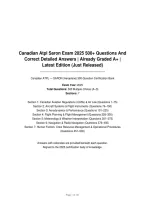
Canadian Atpl Saron Exam 2025 500+ Questions And
Correct Detailed Answers | Already Graded A+ |
Latest Edition (Just Released)
Canadian ATPL — SARON (Aeroplane) 500-Question Certification Bank
Exam Year: 2025
Total Questions: 500 Multiple-Choice (A–D)
Sections: 7
Section 1: Canadian Aviation Regulations (CARs) & Air Law (Questions 1–75)
Section 2: Aircraft Systems & Flight Instruments (Questions 76–150)
Section 3: Aerodynamics & Performance (Questions 151–225)
Section 4: Flight Planning & Flight Management (Questions 226–300)
Section 5: Meteorology & Weather Interpretation (Questions 301–375)
Section 6: Navigation & Radio Navigation (Questions 376–450)
Section 7: Human Factors, Crew Resource Management & Operational Procedures
(Questions 451–500)
Answers with rationales are provided beneath each question.
Aligned to the 2025 certification body of knowledge.
Page 1 of 151
,Table of Contents
Section 1: Canadian Aviation Regulations (CARs) & Air Law (Questions 1–75)3
Section 2: Aircraft Systems & Flight Instruments (Questions 76–150)28
Section 3: Aerodynamics & Performance (Questions 151–225)51
Section 4: Flight Planning & Flight Management (Questions 226–300)73
Section 5: Meteorology & Weather Interpretation (Questions 301–375)97
Section 6: Navigation & Radio Navigation (Questions 376–450)118
Section 7: Human Factors, Crew Resource Management & Operational Procedures
(Questions 451–500)138
Page 2 of 151
,Section 1: Canadian Aviation Regulations (CARs) & Air Law
(Questions 1–75)
Q1: What total flight time must an applicant for an Airline Transport Pilot Licence — Aeroplane
have completed?
A. 1,500 hours **[CORRECT]**
B. 500 hours
C. 1,000 hours
D. 2,000 hours
Correct Answer: A
Rationale: The ATPL — Aeroplane requires 1,500 hours total flight time along with the
associated command and instrument experience. The lower figures apply to commercial
licence issue or to US ATP minimums, and 2,000 hours exceeds the Canadian
requirement.
Q2: Which medical certificate category is required for a pilot exercising the privileges of an
Airline Transport Pilot Licence?
A. Category 2
B. Category 3
C. Category 4
D. Category 1 **[CORRECT]**
Correct Answer: D
Rationale: A Category 1 medical certificate is required for commercial and airline
operations, including ATPL privileges. Category 3 is for private flight, Category 2 for air
traffic controllers, and Category 4 for certain non-flying purposes.
Q3: A captain has not flown the aircraft type for seven months and is scheduled to carry
passengers tomorrow. Under the recency requirements, what must be completed?
A. Five take-offs and five landings in the same category and class within the preceding six
months, or a competency check to re-establish the requirement **[CORRECT]**
B. Nothing, because ATPL holders are exempt from recency rules
C. A full type rating renewal flight test
D. Ten hours of simulator time in any aircraft type
Correct Answer: A
Rationale: Carrying passengers requires five take-offs and five landings within the
preceding six months in the same category and class, or the equivalent competency check
process. ATPL holders are not exempt, a full type rating renewal is beyond what is
required, and simulator time in an unrelated type does not satisfy the rule.
Page 3 of 151
, Q4: An instrument-rated pilot completed an instrument proficiency check 14 months ago.
Which requirement now applies to exercise instrument rating privileges?
A. No additional requirement until a new IPC is due at 24 months
B. Twelve hours of instrument time within the previous twelve months
C. Six hours of instrument time and six instrument approaches within the previous six
months **[CORRECT]**
D. A new instrument rating flight test immediately
Correct Answer: C
Rationale: After the first day of the 13th month following the check, the pilot must have
acquired six hours of instrument time and completed six instrument approaches within the
preceding six months. Doing nothing, immediately retesting, or substituting a twelve-hour
requirement misapplies the rule.
Q5: A turbojet aircraft is planned on an IFR flight with an alternate aerodrome specified. Under
CAR 602.88, what minimum fuel must be carried?
A. Fuel to the destination plus 30 minutes
B. Fuel to destination, an approach and missed approach at destination, to the alternate,
and then 30 minutes **[CORRECT]**
C. Fuel to destination plus 45 minutes with no alternate requirement
D. Fuel to destination, an approach and missed approach at destination, to the alternate,
and then 45 minutes
Correct Answer: B
Rationale: For turbojet aeroplanes with an alternate specified, the reserve after landing at
the alternate is 30 minutes, whereas propeller-driven aircraft require 45 minutes. Fuel to
destination only, the propeller-driven reserve, and omitting the alternate leg do not meet
the regulation.
Q6: An aeroplane is planned on a VFR flight that will depart at 1700 and land after civil
twilight. What fuel reserve applies?
A. 45 minutes at normal cruising speed **[CORRECT]**
B. 60 minutes at normal cruising speed
C. 30 minutes at normal cruising speed
D. 20 minutes at normal cruising speed
Correct Answer: A
Rationale: VFR at night requires fuel to fly to the destination and then for 45 minutes at
normal cruising speed, while the day requirement is 30 minutes. Helicopter and 60-minute
figures do not apply here.
Page 4 of 151

