
Chem 112 Recitation Worksheet 8
Acid-Basics Part 1
20-1 Proton Transfer
20-2 Structure and Strength
20-3 Lewis Acids and Bases
Acids and Base-ics (yes, it’s a pun)
Acids and Bases play integral roles in our everyday lives. From storing chemical energy in
batteries, to allowing enzymes in our blood to properly function, to giving limes their sour taste,
the commonplace effects of acids and bases are often overlooked! This worksheet will focus on
a few commonly used acids and bases, discussing their structure and how it relates to strength
and function.
1. Aspirin
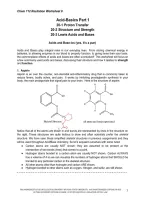
Aspirin is an over the counter, non-steroidal anti-inflammatory drug that is commonly taken to
reduce fevers, bodily aches, and pain. It works by inhibiting prostaglandin synthesis in your
body, the main protagonists that signal pain to your brain. Here is the structure of aspirin:
Notice that all of the atoms are drawn in and bonds are represented by lines in the structure on
the right. These structures are quite tedious to draw and often scientists prefer the skeletal
structure. We have seen these simplified skeletal structures in previous assignments and they
will be used throughout Acid/Base chemistry. So let’s acquaint ourselves with some rules!
● Carbon atoms are usually NOT shown; they are assumed to be present at the
intersection of two bonds (lines) that comes to a point.
● Hydrogen atoms bonded to a carbon atom are usually NOT shown. Carbon ALWAYS
has a valence of 4 so we can visualize the numbers of hydrogen atoms that SHOULD be
bonded to any particular carbon in the skeletal structure.
● All other atoms other than hydrogen and carbon ARE shown.
● Hydrogen bonded to other atoms such as oxygen, nitrogen, and sulfur, are still shown.
THIS WORKSHEET IS THE INTELLECTUAL PROPERTY OF PENN STATE UNIVERSITY. ANY UNAUTHORIZED COPYING OR USE
OF THIS DOCUMENT OUTSIDE OF CHEM 112 STUDY GROUPS IS A VIOLATION OF THE LAW
1
, Chem 112 Recitation Worksheet 8
a. In CHEM 110, you learned about common functional groups used in organic chemistry.
Given the list below, circle the two functional groups that are present in aspirin and provide the
names of these moieties. It may help to redraw the skeletal structure on this page!
b. Is aspirin a strong acid or a weak acid? Explain your answer. (Hint: Look at the name of the
functional groups!)
c. In an aqueous solution, aspirin undergoes an acid/base reaction with water. Draw the
products below; identify the acid, base, conjugate base, and conjugate acid in the reaction.
d. Below are a few derivatives of aspirin (in skeletal structure format).
Using your knowledge about how structure influences acidity of the indicated carboxylic acids,
rank the aspirin derivatives from weakest acid to strongest acid then explain why.
THIS WORKSHEET IS THE INTELLECTUAL PROPERTY OF PENN STATE UNIVERSITY. ANY UNAUTHORIZED COPYING OR USE
OF THIS DOCUMENT OUTSIDE OF CHEM 112 STUDY GROUPS IS A VIOLATION OF THE LAW
2

