
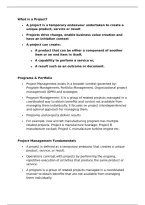
What is a Project?
A project is a temporary endeavour undertaken to create a
unique product, service or result
Projects drive change, enable business value creation and
have an initiation context
A project can create:
o A product that can be either a component of another
item or an end item in itself,
o A capability to perform a service or,
o A result such as an outcome or document.
Programs & Portfolio
Project Management exists in a broader context governed by:
Program Management, Portfolio Management, Organizational project
management (OPM) and strategies
Program Management: It is a group of related projects managed in a
coordinated way to obtain benefits and control not available from
managing them individually. It focuses on project interdependencies
and optimal approach for managing them.
Programs and projects deliver results
For example, new aircraft manufacturing program has multiple
related projects. Project A manufacture fuselage; Project B
manufacture cockpit; Project C manufacture turbine engine etc.
Project Management Fundamentals
A project is defined as a temporary endeavor that creates a unique
product, service, or result.
Operations contrast with projects by performing the ongoing,
repetitive execution of activities that produce the same product or
service.
A program is a group of related projects managed in a coordinated
manner to obtain benefits that are not available from managing
them individually.
, Portfolios group projects, programs, and other work to facilitate
effective management and meet strategic business objectives.
Project execution is heavily influenced by Organizational Process
Assets (OPA), which include corporate knowledge bases, historical
information, and policies.
Enterprise Environmental Factors (EEF) also influence projects
through elements such as organizational culture, legal restrictions,
and infrastructure.
Life Cycles and Process Groups
Development life cycles dictate how a product is built and include
Predictive (waterfall), Iterative, Incremental, Adaptive (Agile), and
Hybrid approaches.
The Predictive approach fixes requirements early and estimates
resources and time.
The Agile approach fixes resources and time while estimating
features to maximize customer value.
Project management is accomplished through five core Process
Groups: Initiating, Planning, Executing, Monitoring and controlling,
and Closing.
The 10 Knowledge Areas
Integration Management: Integrates all processes across the
project lifecycle, featuring key outputs like the Project Charter and
Project Management Plan. The Change Control Board (CCB) formally
evaluates and approves or rejects change requests within this area.
Scope Management: Ensures the project includes all the work
required, and only the required work, to complete deliverables. The
Work Breakdown Structure (WBS) decomposes project deliverables
into smaller, manageable work packages.
Schedule Management: Utilizes the Critical Path Method (CPM) to
determine planned start and finish dates for activities. The critical
path identifies the activities with the longest duration and typically
possesses zero total float.
Cost Management: Relies heavily on Earned Value Management
(EVM) to integrate scope, schedule, and cost metrics. Performance
is tracked using Planned Value (PV), Earned Value (EV), Actual Cost
(AC), Cost Variance (CV), and Schedule Variance (SV).
A project is a temporary endeavour undertaken to create a
unique product, service or result
Projects drive change, enable business value creation and
have an initiation context
A project can create:
o A product that can be either a component of another
item or an end item in itself,
o A capability to perform a service or,
o A result such as an outcome or document.
Programs & Portfolio
Project Management exists in a broader context governed by:
Program Management, Portfolio Management, Organizational project
management (OPM) and strategies
Program Management: It is a group of related projects managed in a
coordinated way to obtain benefits and control not available from
managing them individually. It focuses on project interdependencies
and optimal approach for managing them.
Programs and projects deliver results
For example, new aircraft manufacturing program has multiple
related projects. Project A manufacture fuselage; Project B
manufacture cockpit; Project C manufacture turbine engine etc.
Project Management Fundamentals
A project is defined as a temporary endeavor that creates a unique
product, service, or result.
Operations contrast with projects by performing the ongoing,
repetitive execution of activities that produce the same product or
service.
A program is a group of related projects managed in a coordinated
manner to obtain benefits that are not available from managing
them individually.
, Portfolios group projects, programs, and other work to facilitate
effective management and meet strategic business objectives.
Project execution is heavily influenced by Organizational Process
Assets (OPA), which include corporate knowledge bases, historical
information, and policies.
Enterprise Environmental Factors (EEF) also influence projects
through elements such as organizational culture, legal restrictions,
and infrastructure.
Life Cycles and Process Groups
Development life cycles dictate how a product is built and include
Predictive (waterfall), Iterative, Incremental, Adaptive (Agile), and
Hybrid approaches.
The Predictive approach fixes requirements early and estimates
resources and time.
The Agile approach fixes resources and time while estimating
features to maximize customer value.
Project management is accomplished through five core Process
Groups: Initiating, Planning, Executing, Monitoring and controlling,
and Closing.
The 10 Knowledge Areas
Integration Management: Integrates all processes across the
project lifecycle, featuring key outputs like the Project Charter and
Project Management Plan. The Change Control Board (CCB) formally
evaluates and approves or rejects change requests within this area.
Scope Management: Ensures the project includes all the work
required, and only the required work, to complete deliverables. The
Work Breakdown Structure (WBS) decomposes project deliverables
into smaller, manageable work packages.
Schedule Management: Utilizes the Critical Path Method (CPM) to
determine planned start and finish dates for activities. The critical
path identifies the activities with the longest duration and typically
possesses zero total float.
Cost Management: Relies heavily on Earned Value Management
(EVM) to integrate scope, schedule, and cost metrics. Performance
is tracked using Planned Value (PV), Earned Value (EV), Actual Cost
(AC), Cost Variance (CV), and Schedule Variance (SV).

