
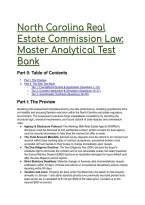
North Carolina Real
Estate Commission Law:
Master Analytical Test
Bank
Part 0: Table of Contents
1. Part I: The Preview
2. Part II: The Elite Test Bank
○ Tier 1: Foundational Syntax & Application (Questions 1–18)
○ Tier 2: Complex Application & Simulation (Questions 19–37)
○ Tier 3: Grandmaster Synthesis (Questions 38–55)
Part I: The Preview
Mastering this assessment translates directly into elite performance, shielding practitioners from
civil liability and ensuring flawless execution within the North Carolina real estate regulatory
environment. The subsequent scenarios forge unparalleled competency by decoding the
structural logic, historical mechanisms, and future outlook of state statutes and commission
rules.
● Agency & Disclosure Protocol: The Working With Real Estate Agents (WWREA)
disclosure must be delivered at first substantial contact; written consent for dual agency
must be secured absolutely no later than the moment an offer is made.
● The Trust Account Mandate: Earnest money deposits must be placed in an insured trust
account within three banking days of contract acceptance; provisional brokers must
surrender all trust monies to their broker-in-charge immediately upon receipt.
● The Due Diligence Doctrine: The Due Diligence Fee (DDF) secures the buyer's
unilateral right to terminate the contract and is non-refundable unless the seller breaches;
the Earnest Money Deposit (EMD) functions as liquidated damages for buyer default only
after the due diligence period expires.
● Strict Statutory Deadlines: Material changes in licensee data (name/address) require
notification within 10 days; criminal convictions or occupational disciplinary actions require
reporting within 60 days.
● Taxation and Liens: Property tax liens under the Machinery Act attach to real property
annually on January 1 and attain absolute priority over previously recorded private liens;
state excise tax is calculated at $1.00 per $500 of the sales price, rounded up to the
nearest $500 increment.
,Regulatory Deadline Statutory Trigger Event NCREC Action Window
3 Days Delivery of transaction Within 3 days of broker's
instruments receipt
10 Days Change of name, address, or Within 10 days of the change
email
60 Days Criminal conviction or board Within 60 days of final
discipline judgment
3 Years Retention of transaction 3 years post-closing or
records disbursement
Part II: The Elite Test Bank
Tier 1: Foundational Syntax & Application
Q1: A provisional broker receives an earnest money check from a buyer client on a Tuesday
morning. Based on the principles of NCREC Trust Account protocols, which action is the FIRST
legal requirement for this provisional broker? A) Deposit the funds into the firm’s trust account
before Friday. B) Hold the check in a secure ledger until the seller accepts the offer. C) Deliver
the funds immediately upon receipt to their affiliated broker-in-charge. D) Endorse the check
over to the closing attorney within three banking days.
● Answer: C (Deliver the funds immediately upon receipt to their affiliated broker-in-charge)
● Distractor Analysis:
○ A is incorrect: Provisional brokers do not possess the statutory authority to
independently manage or deposit into trust accounts.
○ B is incorrect: Withholding earnest money from the supervising broker breaks the
chain of custody and violates immediate delivery mandates.
○ D is incorrect: Provisional brokers cannot independently route funds to third-party
attorneys without the explicit oversight of their BIC.
The Mentor's Analysis: Provisional brokers operate under a doctrine of strict mandatory
supervision. To ensure that the firm meets the rigorous three-banking-day deposit rule
established by G.S. 93A-6, the provisional broker's only legal mechanism is to immediately
surrender all fiduciary instruments to the Broker-in-Charge. This eliminates custody gaps.
Professional Intuition: Provisional brokers must immediately surrender all trust monies to
their broker-in-charge to preserve the chain of custody.
Q2: An active broker legally changes their last name and moves to a new primary residence.
Based on the principles of NCREC administrative rules (21 NCAC 58A .0103), which timeline
represents the MAXIMUM allowable period to report this change to the Commission? A) 3 days
B) 10 days C) 30 days D) 60 days
● Answer: B (10 days)
● Distractor Analysis:
○ A is incorrect: The three-day rule is reserved exclusively for the delivery of
transaction instruments, not administrative data updates.
○ C is incorrect: While thirty days is common in other jurisdictions, North Carolina
enforces a much tighter window to prevent communication failures.
○ D is incorrect: The sixty-day window is applied strictly to the reporting of criminal
convictions and occupational disciplinary actions.
The Mentor's Analysis: The Commission’s ability to protect the public relies on an unbroken line
of communication with its licensees. When a broker's demographic data changes, Rule 21
, NCAC 58A .0103 triggers a rapid 10-day reporting mandate. Failure to comply can result in
missed disciplinary notices and default judgments against the broker. Professional Intuition:
Administrative data changes demand a strict 10-day reporting window to maintain
regulatory contact.
Q3: A buyer and seller successfully execute a standard Offer to Purchase and Contract. Based
on the principles of Rule 21 NCAC 58A .0106 regarding the delivery of instruments, which
requirement reflects the MAXIMUM allowable delay? A) The broker must deliver the executed
contract immediately upon receipt. B) The broker must deliver the executed contract within three
days of the document's initial creation. C) The broker must deliver the executed contract within
three days of the broker's receipt of the executed document. D) The broker must deliver the
executed contract within five days of the transaction's closing.
● Answer: C (The broker must deliver the executed contract within three days of the
broker's receipt of the executed document)
● Distractor Analysis:
○ A is incorrect: While immediate delivery is the professional ideal, the administrative
code provides a specific 72-hour grace period.
○ B is incorrect: The statutory clock is activated by the broker's actual receipt of the
fully executed document, not its creation date.
○ D is incorrect: The five-day rule applies only to a property owner's request for
copies of property management leases, not sales contracts.
The Mentor's Analysis: Transaction transparency prevents contract disputes. The three-day
delivery rule ensures that neither the buyer nor the seller is left vulnerable to unverified, invisible
contractual obligations. The countdown strictly begins the moment the broker takes possession
of the signed instrument. Professional Intuition: All binding transaction instruments must be
physically or electronically delivered within three days of the broker's receipt.
Q4: A broker successfully closes a residential transaction, and the attorney disburses all trust
funds. Based on the principles of NCREC Rule 21 NCAC 58A .0108, what is the MINIMUM
duration the broker must retain the transaction records? A) 1 year from the date of the executed
contract. B) 3 years after all funds are disbursed or the transaction concludes, whichever is
later. C) 5 years after the agency agreement is terminated. D) 7 years to align with federal IRS
auditing compliance.
● Answer: B (3 years after all funds are disbursed or the transaction concludes, whichever
is later)
● Distractor Analysis:
○ A is incorrect: One year is a gross violation of the Commission's audit protocols and
invites severe disciplinary action.
○ C is incorrect: The five-year misconception stems from general business statutes,
not the specific real estate license law.
○ D is incorrect: Federal IRS tax guidelines do not supersede or dictate the NCREC's
specific three-year disciplinary and investigative window.
The Mentor's Analysis: The integrity of the real estate industry rests on verifiable paper trails.
The three-year retention threshold provides the Commission with a sufficient chronological
window to investigate consumer complaints, audit trust account ledgers, and verify fiduciary
compliance long after the closing date. Professional Intuition: Transaction records, agency
agreements, and trust account data carry an absolute three-year retention mandate.
Q5: An active broker intends to apply for Broker-in-Charge (BIC) Eligible status to open a new
firm. Based on the principles of NCREC Rule 21 NCAC 58A .0110, which prerequisite is
REQUIRED? A) Five years of consecutive part-time brokerage experience. B) Two years of
Estate Commission Law:
Master Analytical Test
Bank
Part 0: Table of Contents
1. Part I: The Preview
2. Part II: The Elite Test Bank
○ Tier 1: Foundational Syntax & Application (Questions 1–18)
○ Tier 2: Complex Application & Simulation (Questions 19–37)
○ Tier 3: Grandmaster Synthesis (Questions 38–55)
Part I: The Preview
Mastering this assessment translates directly into elite performance, shielding practitioners from
civil liability and ensuring flawless execution within the North Carolina real estate regulatory
environment. The subsequent scenarios forge unparalleled competency by decoding the
structural logic, historical mechanisms, and future outlook of state statutes and commission
rules.
● Agency & Disclosure Protocol: The Working With Real Estate Agents (WWREA)
disclosure must be delivered at first substantial contact; written consent for dual agency
must be secured absolutely no later than the moment an offer is made.
● The Trust Account Mandate: Earnest money deposits must be placed in an insured trust
account within three banking days of contract acceptance; provisional brokers must
surrender all trust monies to their broker-in-charge immediately upon receipt.
● The Due Diligence Doctrine: The Due Diligence Fee (DDF) secures the buyer's
unilateral right to terminate the contract and is non-refundable unless the seller breaches;
the Earnest Money Deposit (EMD) functions as liquidated damages for buyer default only
after the due diligence period expires.
● Strict Statutory Deadlines: Material changes in licensee data (name/address) require
notification within 10 days; criminal convictions or occupational disciplinary actions require
reporting within 60 days.
● Taxation and Liens: Property tax liens under the Machinery Act attach to real property
annually on January 1 and attain absolute priority over previously recorded private liens;
state excise tax is calculated at $1.00 per $500 of the sales price, rounded up to the
nearest $500 increment.
,Regulatory Deadline Statutory Trigger Event NCREC Action Window
3 Days Delivery of transaction Within 3 days of broker's
instruments receipt
10 Days Change of name, address, or Within 10 days of the change
60 Days Criminal conviction or board Within 60 days of final
discipline judgment
3 Years Retention of transaction 3 years post-closing or
records disbursement
Part II: The Elite Test Bank
Tier 1: Foundational Syntax & Application
Q1: A provisional broker receives an earnest money check from a buyer client on a Tuesday
morning. Based on the principles of NCREC Trust Account protocols, which action is the FIRST
legal requirement for this provisional broker? A) Deposit the funds into the firm’s trust account
before Friday. B) Hold the check in a secure ledger until the seller accepts the offer. C) Deliver
the funds immediately upon receipt to their affiliated broker-in-charge. D) Endorse the check
over to the closing attorney within three banking days.
● Answer: C (Deliver the funds immediately upon receipt to their affiliated broker-in-charge)
● Distractor Analysis:
○ A is incorrect: Provisional brokers do not possess the statutory authority to
independently manage or deposit into trust accounts.
○ B is incorrect: Withholding earnest money from the supervising broker breaks the
chain of custody and violates immediate delivery mandates.
○ D is incorrect: Provisional brokers cannot independently route funds to third-party
attorneys without the explicit oversight of their BIC.
The Mentor's Analysis: Provisional brokers operate under a doctrine of strict mandatory
supervision. To ensure that the firm meets the rigorous three-banking-day deposit rule
established by G.S. 93A-6, the provisional broker's only legal mechanism is to immediately
surrender all fiduciary instruments to the Broker-in-Charge. This eliminates custody gaps.
Professional Intuition: Provisional brokers must immediately surrender all trust monies to
their broker-in-charge to preserve the chain of custody.
Q2: An active broker legally changes their last name and moves to a new primary residence.
Based on the principles of NCREC administrative rules (21 NCAC 58A .0103), which timeline
represents the MAXIMUM allowable period to report this change to the Commission? A) 3 days
B) 10 days C) 30 days D) 60 days
● Answer: B (10 days)
● Distractor Analysis:
○ A is incorrect: The three-day rule is reserved exclusively for the delivery of
transaction instruments, not administrative data updates.
○ C is incorrect: While thirty days is common in other jurisdictions, North Carolina
enforces a much tighter window to prevent communication failures.
○ D is incorrect: The sixty-day window is applied strictly to the reporting of criminal
convictions and occupational disciplinary actions.
The Mentor's Analysis: The Commission’s ability to protect the public relies on an unbroken line
of communication with its licensees. When a broker's demographic data changes, Rule 21
, NCAC 58A .0103 triggers a rapid 10-day reporting mandate. Failure to comply can result in
missed disciplinary notices and default judgments against the broker. Professional Intuition:
Administrative data changes demand a strict 10-day reporting window to maintain
regulatory contact.
Q3: A buyer and seller successfully execute a standard Offer to Purchase and Contract. Based
on the principles of Rule 21 NCAC 58A .0106 regarding the delivery of instruments, which
requirement reflects the MAXIMUM allowable delay? A) The broker must deliver the executed
contract immediately upon receipt. B) The broker must deliver the executed contract within three
days of the document's initial creation. C) The broker must deliver the executed contract within
three days of the broker's receipt of the executed document. D) The broker must deliver the
executed contract within five days of the transaction's closing.
● Answer: C (The broker must deliver the executed contract within three days of the
broker's receipt of the executed document)
● Distractor Analysis:
○ A is incorrect: While immediate delivery is the professional ideal, the administrative
code provides a specific 72-hour grace period.
○ B is incorrect: The statutory clock is activated by the broker's actual receipt of the
fully executed document, not its creation date.
○ D is incorrect: The five-day rule applies only to a property owner's request for
copies of property management leases, not sales contracts.
The Mentor's Analysis: Transaction transparency prevents contract disputes. The three-day
delivery rule ensures that neither the buyer nor the seller is left vulnerable to unverified, invisible
contractual obligations. The countdown strictly begins the moment the broker takes possession
of the signed instrument. Professional Intuition: All binding transaction instruments must be
physically or electronically delivered within three days of the broker's receipt.
Q4: A broker successfully closes a residential transaction, and the attorney disburses all trust
funds. Based on the principles of NCREC Rule 21 NCAC 58A .0108, what is the MINIMUM
duration the broker must retain the transaction records? A) 1 year from the date of the executed
contract. B) 3 years after all funds are disbursed or the transaction concludes, whichever is
later. C) 5 years after the agency agreement is terminated. D) 7 years to align with federal IRS
auditing compliance.
● Answer: B (3 years after all funds are disbursed or the transaction concludes, whichever
is later)
● Distractor Analysis:
○ A is incorrect: One year is a gross violation of the Commission's audit protocols and
invites severe disciplinary action.
○ C is incorrect: The five-year misconception stems from general business statutes,
not the specific real estate license law.
○ D is incorrect: Federal IRS tax guidelines do not supersede or dictate the NCREC's
specific three-year disciplinary and investigative window.
The Mentor's Analysis: The integrity of the real estate industry rests on verifiable paper trails.
The three-year retention threshold provides the Commission with a sufficient chronological
window to investigate consumer complaints, audit trust account ledgers, and verify fiduciary
compliance long after the closing date. Professional Intuition: Transaction records, agency
agreements, and trust account data carry an absolute three-year retention mandate.
Q5: An active broker intends to apply for Broker-in-Charge (BIC) Eligible status to open a new
firm. Based on the principles of NCREC Rule 21 NCAC 58A .0110, which prerequisite is
REQUIRED? A) Five years of consecutive part-time brokerage experience. B) Two years of

