[STUDY GUIDE] • HIGH-YIELD PRACTICE & REVIEW EDITION
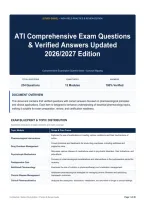
ATI Comprehensive Exam Questions
& Verified Answers Updated
2026/2027 Edition
Comprehensive Examination Question Bank • Concept Mapping
TOTAL QUESTIONS EXAM TOPICS ANSWERS
234 Questions 12 Modules 100% Verified
DOCUMENT OVERVIEW
This document contains 234 verified questions with correct answers focused on pharmacological principles
and clinical applications. Each item is designed to enhance understanding of essential pharmacology topics,
making it suitable for exam preparation, review, and certification readiness.
EXAM BLUEPRINT & TOPIC DISTRIBUTION
Systematic breakdown of subject domains and exam coverage.
Topic Module Scope & Core Focus
Explores the use of medications in treating various conditions and their mechanisms of
Pharmacological Interventions action.
Covers protocols and treatments for acute drug overdoses, including antidotes and
Drug Overdose Management supportive care.
Discusses various classes of medications used in psychiatric disorders, their indications, and
Psychotropic Medications side effects.
Focuses on pharmacological considerations and interventions in the postoperative period for
Postoperative Care recovery.
Nutritional Pharmacology Examines the role of nutrition in pharmacotherapy and medication management.
Addresses pharmacological strategies for managing chronic illnesses and optimizing
Chronic Disease Management therapeutic outcomes.
Clinical Pharmacokinetics Analyzes the absorption, distribution, metabolism, and excretion of drugs in clinical settings.
Confidential • Student Study Edition • Practice & Review Guide Page 1 of 49
,STUDENT STUDY & MASTERY EDITION PRACTICE & REVIEW GUIDE
Details critical medications used in emergency situations and their protocols for
Emergency Pharmacology administration.
Focuses on effective communication strategies for educating patients about their
Patient Education on Medications medications.
Explores the identification, management, and reporting of adverse drug reactions in clinical
Adverse Drug Reactions practice.
Drug Interaction Management Covers the principles of recognizing and managing drug-drug and drug-food interactions.
Discusses methodologies in pharmacological research and the development of new
Pharmacological Research Methods therapeutic agents.
Total Exam Coverage 12 Integrated Topic Modules • 234 Examination Questions
HIGH-YIELD: QUESTIONS & VERIFIED ANSWERS
Complete Examination Questions • 234 Questions • Sequential Exam Layout
QUESTION 1
Resuscitation phase
Answer: Onset of injury to 24-48 hours post-burn. ends when fluid resuscitation complete incr in hematocrit
hyperkalemia hyponatremia decr albumin.
QUESTION 2
PTSD non-pharmacological treatment
Answer: Guided imagery.
QUESTION 3
The steps of a root cause analysis are:
Answer: Collect all data surrounding event, thoroughly analyze data, identify probable causes, outline
corrective actions.
Confidential • Student Study Edition • Practice & Review Guide Page 2 of 49
,STUDENT STUDY & MASTERY EDITION PRACTICE & REVIEW GUIDE
QUESTION 4
Contraindication for cath insertion
Answer: Latex allergy.
QUESTION 5
False labor
Answer: Discomfort localized in abdomen; no lower back pain; contractions decrease in intensity or
frequency with ambulation.
QUESTION 6
Manifestations of Ovarian Cancer
Answer: EARLY : abdominal bloating, pelvic or abdominal pain, early satiety, urinary frequency constip.
QUESTION 7
Nagele's Rule
Answer: 1St day of last period + 7 days - 3 months.
QUESTION 8
Oxygen toxicity
Answer: Substernal pain.
QUESTION 9
Reporting STIs
Answer: Explain to the client why this info will be shared
- It is the responsibility of the nurse to advocate for the client, provide confidential information, and explain
legal
requirements. Reporting communicable disease occurrences helps with identifying outbreaks and overall
disease trends.
Confidential • Student Study Edition • Practice & Review Guide Page 3 of 49
, STUDENT STUDY & MASTERY EDITION PRACTICE & REVIEW GUIDE
QUESTION 10
Burkholderia cepacia
Answer: Abx
Contact precautions.
QUESTION 11
Placenta previa
Answer: Implantation of the placenta over the cervical opening or in the lower region of the uterus
experience a relaxed uterus and bright red vaginal bleeding. With abruptio placentae the nurse should expect
to find dark red vaginal bleeding.
QUESTION 12
Acetaminophen overdose
Answer: Acetylcysteine.
QUESTION 13
AV fistula
Answer: Palpate thrill, hear the bruit
Encourage ROM
No venipuncture in affected extremity.
QUESTION 14
Implementing a Scheduling Change
Answer: First : Provide information about scheduling issues to the staff.
QUESTION 15
Opiate overdose
Answer: Pinpoint pupils give naloxone.
Confidential • Student Study Edition • Practice & Review Guide Page 4 of 49