Industrialisation was most successfully applied during the First World War” How far do you agree?
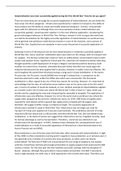
There are many ways we can judge the successful application of industrialisation, we can divide the
main areas into three categories; infrastructure (particularly in relation to transport,) the ability to
mass produce and the ability to create and modify advanced weaponry. Overall, I only partially
agree with the statement as although there are many examples of where industrialisation was
successfully applied, I would question weather it is the most effective application, considering the
great technological advances in World War Two. Perhaps, instead it is fair to argue that world war
one laid the foundations for the highly successful application of industrialisation on world war two,
where generals and politicians made decisions based on some of the mistakes, and successes of
World War One. Equally there are examples in wars across the period of successful application of
industry.
Speaking in terms of infostructure we see that industrialisation is relatively successfully applied in
World War One. Every countries’ mobilisation plans was reliant on the railway, both as transport and
for supplies. The German sclifian plan relied on trains to swiftly deliver concentrated troops to both
eastern and western fronts. Equally the French plan XIV, used their rail network to deliver what they
thought would be a swift deployment of troops in Belgium and Germany before Germany could
mobilise its reserve force. However, ultimately they both failed, therefore one could argue the
industrial infostructure has been applied well in practice, however in reality it was not effective. We
see throughout the period that infostructure plays a large part in troop mobilisation. In the Austro
Prussian war, the Prussians moved 285000 men through 5 railway lines, in comparison to the
Austrians who had to walk, unlike the sliffian plan which was unsuccessful, this fast paced
mobilisation is often argued to be one of their key reasons for winning. However, it is important to
acknowledge that the wars of unification were nowhere near on the same scale as the first world
war, in terms of number of countries involved, or men. Another example of industrialisation applied
on a smaller scale is the Crimean war where the British laid 7 miles of track in 7 days, which was
mostly used for supplying the army and transporting the wounded to hospitals. This application of
infostructure was very effective, however it is not on the same level as world war one; where the
supply trains propped up the army for a whole four years, by 1918 1,000 tones of supplies were
required for each division which required two supply trains complete with 50 wagons each,
therefore the supply of WW1 troops is certainly far larger. The successful application of
infostructure reached it’s peak in World War Two. Infostructure was no longer just used for
transport of troops and supplies but it was also used tactically. The amphibious element of D-day
required 6,039 sea vessels and 11,590 aircrafts, therefore World War Two, like Von Moltke troop
mobilisation in the Austro-Prussian war suggest that infostructure can be, if applied correctly, used
for tactical advantage as well as transportation. Therefore,, overall we see attempts to use
infrastructure for tactical gains in WW1, however these ultimately fail, consequently the use of
industrialisation as a result of successful application of infostructure is best demonstrated in the
Austro-Prussian war and WW2.
Mass production is one of the key areas that historians often associate with industrialisation. In light
of this, WW1 is often considered a turning point in regards to mass production, as in previous wars it
was generally only a handful of countries who mass produced, as others were not heavily
industrialised. The factories of WW1 not only produced the vast range of weaponry, but equally
uniforms, tinned food, helmets and enough ammunition to supply weapons that could now fire 600
rounds a minuet. For the most part this was relatively successful, perhaps with the exception of
Russia. However, although they were able to mass produce ammunition, this didn’t necessarily
reach a high standard, the shell crisis in 1916 exposed the 14% of shells were duds. Therefore, just
There are many ways we can judge the successful application of industrialisation, we can divide the
main areas into three categories; infrastructure (particularly in relation to transport,) the ability to
mass produce and the ability to create and modify advanced weaponry. Overall, I only partially
agree with the statement as although there are many examples of where industrialisation was
successfully applied, I would question weather it is the most effective application, considering the
great technological advances in World War Two. Perhaps, instead it is fair to argue that world war
one laid the foundations for the highly successful application of industrialisation on world war two,
where generals and politicians made decisions based on some of the mistakes, and successes of
World War One. Equally there are examples in wars across the period of successful application of
industry.
Speaking in terms of infostructure we see that industrialisation is relatively successfully applied in
World War One. Every countries’ mobilisation plans was reliant on the railway, both as transport and
for supplies. The German sclifian plan relied on trains to swiftly deliver concentrated troops to both
eastern and western fronts. Equally the French plan XIV, used their rail network to deliver what they
thought would be a swift deployment of troops in Belgium and Germany before Germany could
mobilise its reserve force. However, ultimately they both failed, therefore one could argue the
industrial infostructure has been applied well in practice, however in reality it was not effective. We
see throughout the period that infostructure plays a large part in troop mobilisation. In the Austro
Prussian war, the Prussians moved 285000 men through 5 railway lines, in comparison to the
Austrians who had to walk, unlike the sliffian plan which was unsuccessful, this fast paced
mobilisation is often argued to be one of their key reasons for winning. However, it is important to
acknowledge that the wars of unification were nowhere near on the same scale as the first world
war, in terms of number of countries involved, or men. Another example of industrialisation applied
on a smaller scale is the Crimean war where the British laid 7 miles of track in 7 days, which was
mostly used for supplying the army and transporting the wounded to hospitals. This application of
infostructure was very effective, however it is not on the same level as world war one; where the
supply trains propped up the army for a whole four years, by 1918 1,000 tones of supplies were
required for each division which required two supply trains complete with 50 wagons each,
therefore the supply of WW1 troops is certainly far larger. The successful application of
infostructure reached it’s peak in World War Two. Infostructure was no longer just used for
transport of troops and supplies but it was also used tactically. The amphibious element of D-day
required 6,039 sea vessels and 11,590 aircrafts, therefore World War Two, like Von Moltke troop
mobilisation in the Austro-Prussian war suggest that infostructure can be, if applied correctly, used
for tactical advantage as well as transportation. Therefore,, overall we see attempts to use
infrastructure for tactical gains in WW1, however these ultimately fail, consequently the use of
industrialisation as a result of successful application of infostructure is best demonstrated in the
Austro-Prussian war and WW2.
Mass production is one of the key areas that historians often associate with industrialisation. In light
of this, WW1 is often considered a turning point in regards to mass production, as in previous wars it
was generally only a handful of countries who mass produced, as others were not heavily
industrialised. The factories of WW1 not only produced the vast range of weaponry, but equally
uniforms, tinned food, helmets and enough ammunition to supply weapons that could now fire 600
rounds a minuet. For the most part this was relatively successful, perhaps with the exception of
Russia. However, although they were able to mass produce ammunition, this didn’t necessarily
reach a high standard, the shell crisis in 1916 exposed the 14% of shells were duds. Therefore, just